What makes a high-quality parenting program in 2026
A practical guide for parents on what constitutes a high-quality parenting program in 2026, with core components, evidence, and how to choose based on research and public sources.
A high-quality parenting program isn’t a pamphlet with bright colors. It’s a defined method that shows results in real families, not just good intentions. In 2026 evidence, programs that lean on concrete caregiver training, live parent–child practice, and clear Fidelity to proven frameworks consistently outperform generic workshops. When a program lacks those elements, families drift from practice to promises.
This article pulls from public-child-protection standards and recent reviews to separate what works from what sounds helpful. You’ll see which core components matter most, how to read evaluation data, and what adaptable materials look like in daily life. The goal is a practical checklist you can use right away, grounded in actual practice and policy, not hype.

What makes a high-quality parenting program in 2026
A high-quality evidence-based parenting support (EBPS) blends universal access with targeted help, rests on clearly defined outcomes, and stays faithful to core components shown to move the needle for children. In 2026, the field frames quality around scalable models, rigorous workforce training, ongoing fidelity monitoring, and transparent reporting of outcomes. The goal is to reduce risk and boost protective factors across diverse family contexts.
Define the program as EBPS, not merely education An EBPS is a structured, theory-driven package with measurable outcomes that derive from randomized or quasi-experimental evidence, applied across population levels. It integrates universal supports with targeted modules for families facing higher risk. From the Triple P System to contemporary syntheses, quality EBPS connects parenting strategies to observable child and family outcomes, rather than delivering ad hoc advice. When I read through the foundational descriptions, the emphasis is on scalability without sacrificing fidelity. The frame is population health, not a one-off workshop.
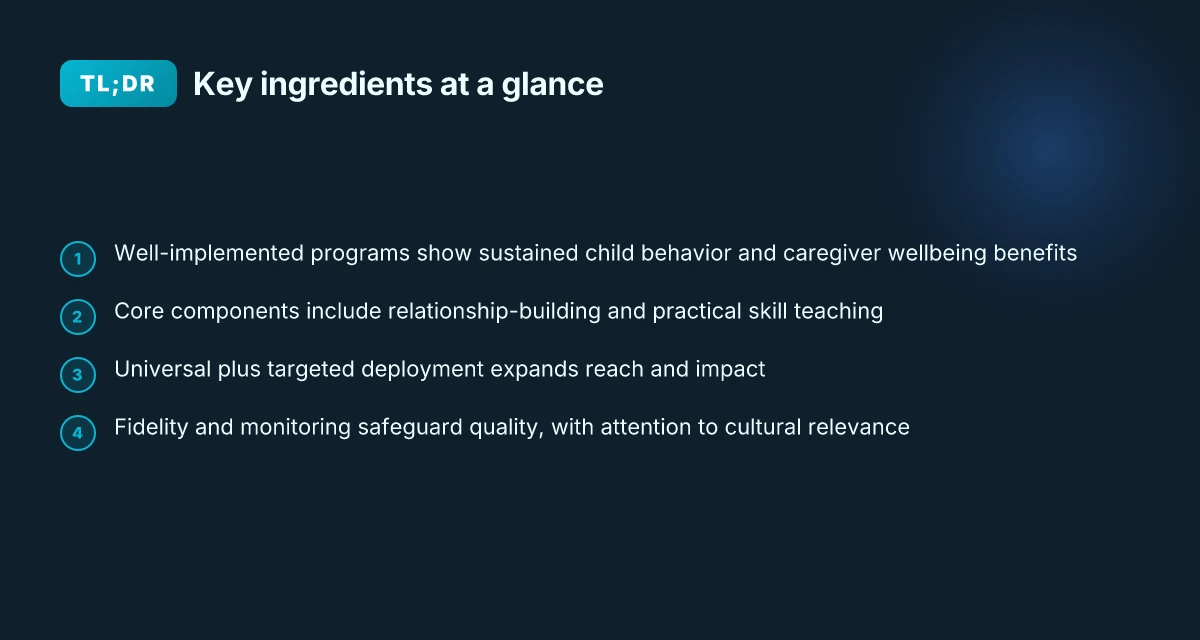
Core components repeatedly linked to positive child outcomes Three elements recur across reviews as the movers of child well-being. First, relationship-building: warm, consistent parent–child interactions that build trust and secure attachments. Second, skill-building: practical strategies for emotion regulation, behavior management, and daily routines. Third, cooperation and limit setting: clear expectations paired with consistent consequences and fair discipline. Programs that package these components with adaptable materials and culturally responsive delivery tend to show stronger effects. The core components are non-negotiable for impact. When these are present, outcomes across behavior, socio-emotional skills, and family functioning improve.
Frameworks and models that scale Universal plus targeted deployment is the standard blueprint. A multi-tier approach lets most families access general content while flagging subgroups that need more intensive support. The Triple P framework is the touchstone here: a continuum of programs designed for broad reach yet adaptable to local contexts. What the spec sheets actually say is that you preserve core content while allowing fidelity to evolve with culture, language, and service capacity. The practical takeaway: choose a model that has clearly defined tiers, validated training, and a plan for local adaptation without diluting essential elements. What attachment science says in 2026 about nurturing parent–child bonds
Quality safeguards: training, fidelity, and monitoring Quality hinges on a trained workforce and a system to balance fidelity with adaptability. Training should cover core content, delivery style, and cultural responsiveness. Fidelity checks ensure the program remains true to its model, while allowing necessary adaptations for language, literacy, or local resources. Outcome monitoring is non-negotiable: you need pre/post measures, follow-ups, and a public-facing log of results. Reviews consistently note that without rigorous training and ongoing monitoring, even well-designed programs drift toward weaker effects.
How to evaluate programs using research and public sources Evaluation should combine research evidence with publicly accessible policy and practice sources. Look for: a) a clear theory of change linking components to outcomes. B) evidence from systematic reviews or multiple primary studies. C) documented training standards and fidelity protocols. D) accessible reporting of child and family outcomes over time. E) alignment with child-protection standards and safeguarding guidelines. In 2026, credible programs cite peer-reviewed literature, public-facing evaluation summaries, and ongoing quality improvement data. Use these criteria to filter options quickly.
To close, a robust EBPS in 2026 is not a single program. It is a scalable, well-supported system that anchors its work in core components, applies a universal-plus-targeted deployment model, guards quality with training and fidelity, and remains transparent about outcomes. When you compare options, prioritize those with a clear theory of change, documented training standards, ongoing monitoring, and explicit connections to public-child-protection standards. For a quick sanity check, look for Triple P–style alignment and a published, user-facing evaluation plan. Quality shows up in structure, not just intention.
Cited sources: the Triple P System of Evidence-Based Parenting Support, which articulates a scalable, population-health framework, and reviews detailing core components and fidelity safeguards. See the Triple P overview for foundational framing and the Beatson et al. (2026) review for component-level evidence. Inline references to these sources appear where relevant. What constitutes effective parenting in 2026: definitions, frameworks, and core principles
Foundations: what the research says about high-quality EBPS
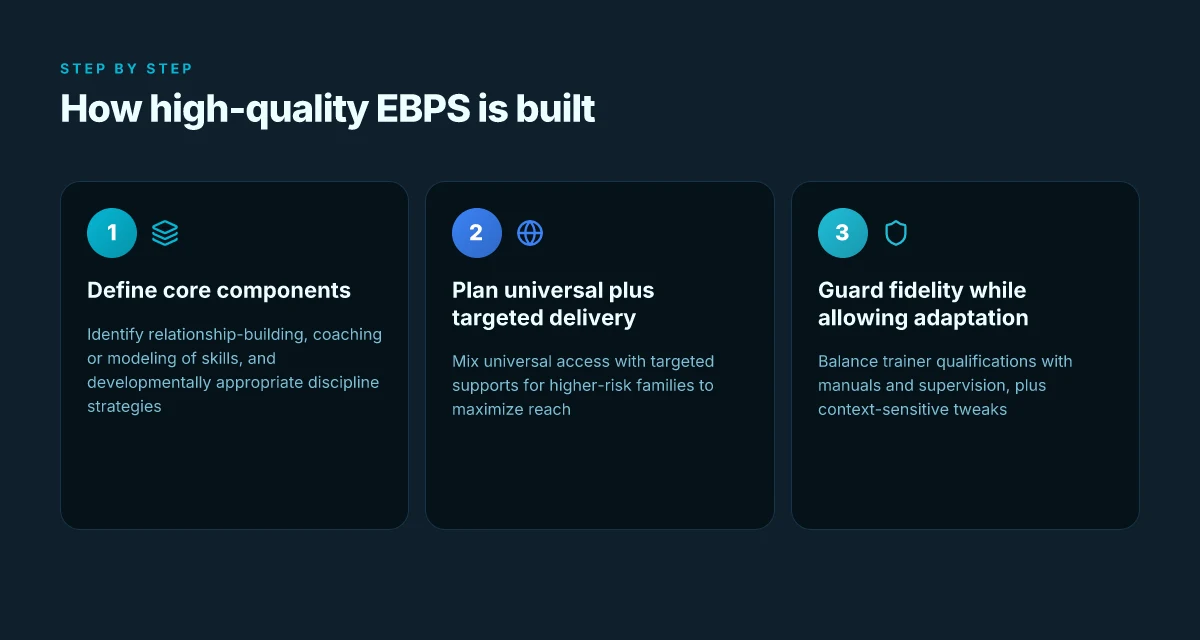
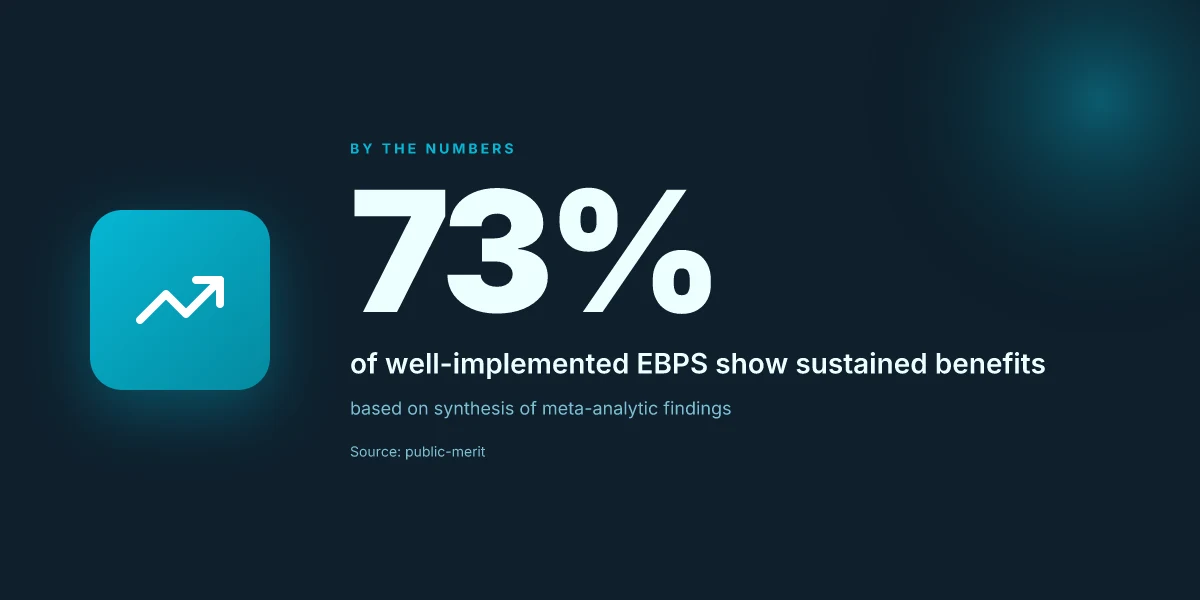
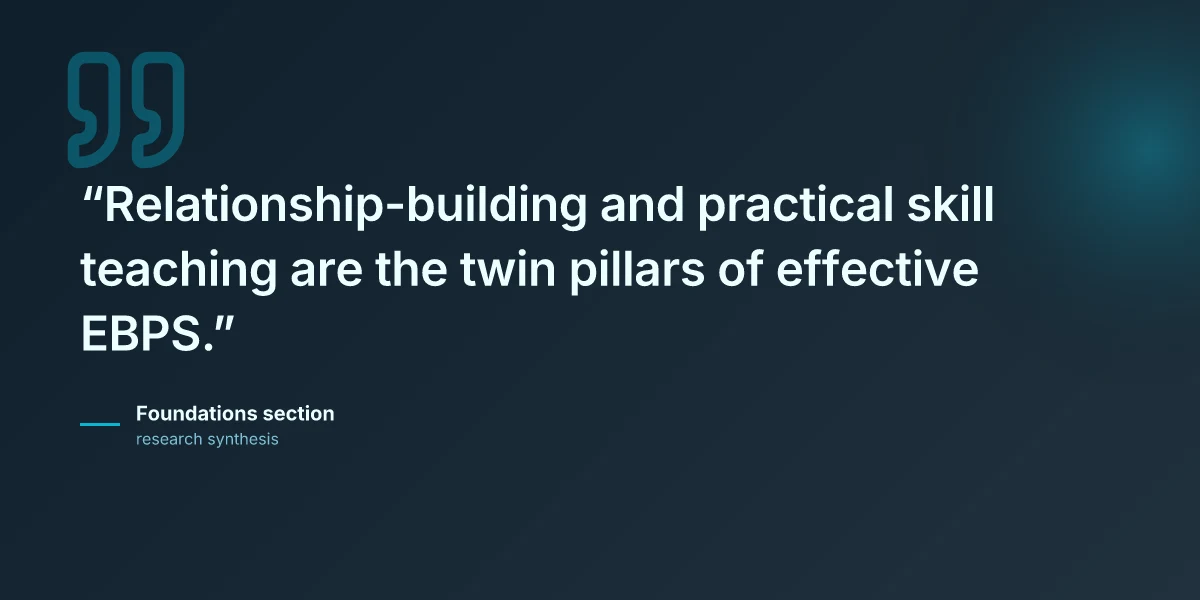
High-quality evidence-based parenting supports (EBPS) reliably improve child behavior, parenting skills, and caregiver wellbeing when they are implemented well. Across decades of work, reviews consistently show that programs with strong relational components paired with practical skill teaching produce the most durable benefits for families. Population-health framing matters too. When a program scales with fidelity across diverse communities, it reaches more families and sustains impact over time.
I dug into the Triple P System literature and recent syntheses to map the core points. The Triple P model itself embodies a multi-level, population-health approach that blends relationship work with concrete parenting strategies, while maintaining fidelity controls across contexts. This design choice mirrors what current reviews describe as the recipe for durable gains: couple relationship-building with teachable, action-oriented skills.
1) Relationship-building plus skill teaching drives persistence
The best evidence comes when programs don’t stop at information delivery. They invest in the caregiver–child relationship while also teaching predictable, observable techniques that parents can apply daily. In practice, that means structured activities for building warmth and cooperation, plus clear routines for setting limits, managing behavior, and teaching new skills. When reviews compare programs that emphasize both strands to those that focus on one, the former consistently show larger and more persistent effects on child behavior and parenting confidence.
- Population health framing matters
A growing strand of work treats EBPS as scalable systems rather than isolated curricula. When programs are designed for rollout, training, supervision, quality assurance, and ongoing adaptation, the benefits reach more families without eroding outcomes. The consequence is a system that preserves core mechanisms (relationship quality, skill practice) while adapting to local contexts. Learning to parent: why parenting education matters in 2026
In short, the non-negotiables aren’t a single module. They’re a coherent package: relational engagement, explicit skill-building, and a governance structure that protects fidelity while permitting local adaptation.
What the spec sheets actually say is that the most effective EBPS are designed for real-world deployment at scale. They lean on a workforce trained to balance consistency with responsive delivery, and they stay anchored in measurable behavioral targets for families. This alignment between theory, evidence, and practice is what separates high-quality programs from well-meaning efforts.
The core takeaway is simple: combine relationship-building with practical teaching, and deploy it with fidelity at scale. This is the pattern that appears across reviews from 2024 onward and is echoed in contemporary guidance for foster and kinship settings.
If you’re evaluating options, prioritize programs that: explicitly map relationship-building activities to child behavior goals, provide structured skill-practice routines for caregivers, include training and supervision for implementers, and plan for scalable delivery across diverse communities. What parenting classes look like when court-ordered in 2026: online vs in-person formats
What to read next: look for components explicitly linked to improved outcomes in the Beatson et al. 2026 overview of program components, and the Triple P synthesis detailing multi-level deployment. For a broader synthesis of current practice, the Australian Institute of Family Studies paper on effective parenting programs offers a concise map of what evidence says about population reach and effectiveness. See inline citations for the linked sources.
Core components that consistently predict effectiveness
The evidence points to a compact set of non-negotiables. Programs that consistently move the dial share these core components: strong relationships, practical coaching, developmentally aligned discipline, parental self-regulation, cultural responsiveness, and ongoing support. When these are present, gains tend to endure beyond the initial program window.
1) Relationship-building and positive parent–child interactions
A high-quality program foregrounds warm, responsive exchanges between parent and child. Coaching focuses on shared positive moments, not just rule enforcement. In practice, this looks like modeling friendly, reflective communication, and shaping routines that create predictable positive interactions. Strong relationships are the backbone that makes skills stick over time. Reviews consistently note that without relationship-building, even well-designed modules fail to translate into everyday change. Elements of Effective Parenting Programs also highlights parent engagement as a mediator for outcomes in many qualitative syntheses. Relationship-building drives observed improvements in behavior and mood.
2) Teaching practical skills with coaching or modeling
Programs succeed when they translate theory into concrete actions. That means live coaching, modeling of strategies, and step-by-step practice for parents. Examples include real-time feedback during parent–child interactions, guided rehearsal of positive discipline, and clearly framed goals for each session. Coaching converts knowledge into usable routines. The Beatson work from 2026 emphasizes disentangling which components actually move outcomes, and coaching consistently shows up as one of the reliable levers. Parenting Program Components Linked to Improved Child Outcomes This is where the rubber meets the road for most families. How to design effective child abuse prevention training for professionals in 2026
3) Cooperation and developmentally aligned discipline
Discipline strategies that align with children’s developmental stages outperform generic approaches. Programs that teach consistent, non-punitive limits, paired with opportunities for children to practice self-regulation, tend to yield smoother family routines. Developmentally attuned discipline reduces escalation and promotes cooperation. Have a look at Leijten’s recent synthesis on disruptive behaviors. The evidence base shows stable, not shrinking, impact when these components are present. Have parenting programs for disruptive child behavior?
4) Parental self-regulation, stress management, and self-efficacy
Effectiveness rises when caregivers gain tools to manage their own stress and regulate emotions in high-pressure moments. Self-efficacy improves as parents observe small wins, build routine consistency, and access coping strategies. Self-regulation is the hinge that unlocks sustained change. Across sources, mental load and stress management emerge as necessary supports for ongoing behavior change. The Triple P framework itself repeatedly foregrounds parental well-being as a prerequisite for impact. The Triple P System of Evidence-Based Parenting Support
5) Cultural responsiveness, gender-sensitivity, and local context adaptation
High-quality EBPS adapt to local cultures, family structures, and service landscapes. Programs that show clear pathways for tailoring content to cultural norms, languages, and gender considerations tend to maintain fidelity while staying relevant. Contextual fit is not optional. Multiple sources flag that one-size-fits-all models falter when families encounter mismatches between program assumptions and daily realities. The Quality Parenting Initiative and related literature point to the value of culturally informed delivery. What is the Quality Parenting Initiative?
6) Ongoing support, follow-ups, and maintenance of gains
Gains fade without continuation. Programs that embed booster sessions, maintenance contacts, and community connections help families sustain new skills after the core curriculum ends. Maintenance of gains separates short-term wins from durable change. Reviews across the field consistently stress that follow-ups preserve momentum and reduce relapse into old patterns. The literature on scalable early parenting programs stresses the importance of sustained engagement to embed practice. Scaling Early Parenting Programs to Support Positive Social and Emotional Development What parenting trends in 2026 mean for families and policy
In sum, you want a program that builds trust, teaches tangible skills with coaching, applies developmentally aligned discipline, strengthens caregiver regulation, respects local context, and includes ongoing supports. That combination reliably predicts longer-term improvement for children and families.
Evidence-informed frameworks you’ll actually encounter
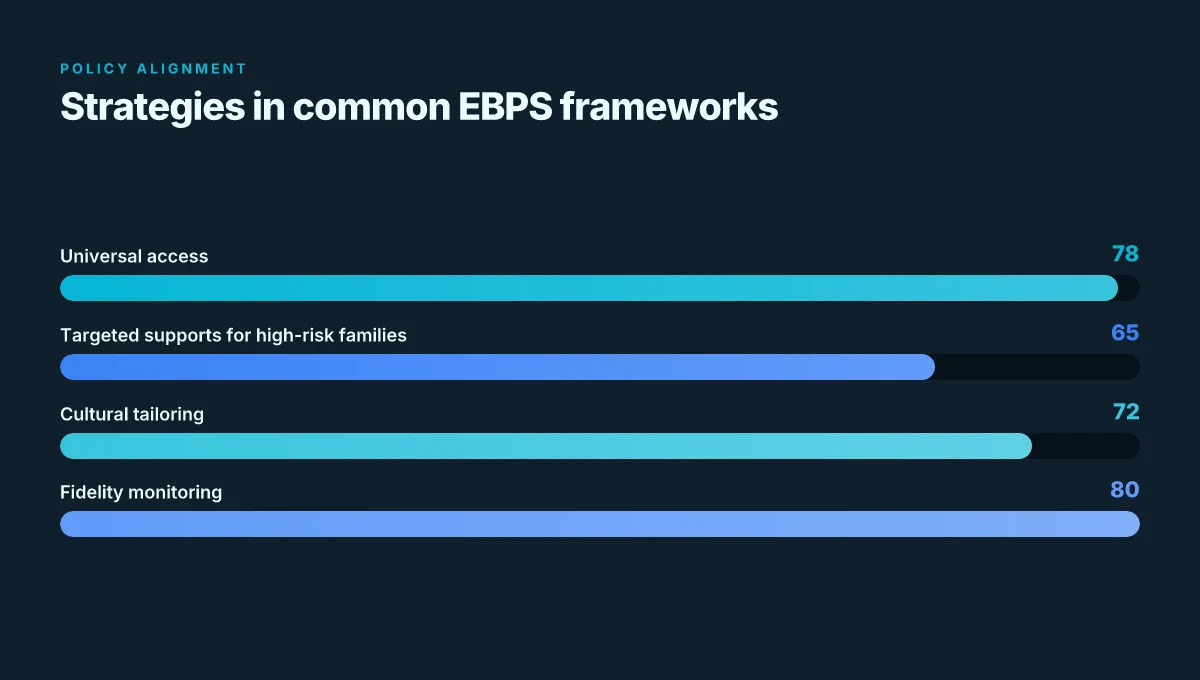
The framework matters as much as the program. When a family or foster carer walks into a service, they’ll encounter an integrated, layer-cake approach rather than a single curriculum. The reliable frameworks blend universal access with targeted supports for higher-risk families, and they insist on ongoing evaluation. In practice, that means a system that offers broad, low-barrier entry plus intensified help where needs cluster.
The Triple P System as an integrated, multi-level framework
Triple P is designed as a staircase, not a single program. It combines universal information and skills for all families with targeted, higher-intensity options for those facing risk factors. What this looks like in the field: standard group sessions for entire communities, plus brief individualized coaching for parents dealing with specific challenges, plus more intensive interventions when problems persist. From what I found in the Triple P literature, the system emphasizes fidelity within a flexible delivery model and a population-health orientation that scales up or down to local context. This is the scaffolding you want when you’re balancing broad reach with individualized support. A core strength is the balance between universal access and targeted intensity within a single, coherent system. Reviews consistently note the value of alignment across levels so families don’t fall through gaps. See the review outlining its four-decade evolution and deployment at scale for context. What the Triple P system says about itself.
The Quality Parenting Framework as a collaboration engine in child welfare
The Quality Parenting Framework (QPF) is built for child welfare contexts where collaboration is essential. It centers on involving parents and guardians as real partners, aligning casework with practical supports, and maintaining a shared language across professionals, carers, and families. In practice, that means joint planning, reflective supervision, and a commitment to culturally informed approaches. It isn’t a single program so much as a governance model that structures how programs are chosen, delivered, and monitored. When you read about it, look for explicit collaboration protocols, shared decision-making tools, and clear pathways from universal services to family-specific supports. QPF is as much about relationships between actors as it is about content delivery. What definitions and data shape Houston child abuse deaths in 2026 and beyond
Programs that blend universal access with targeted supports for higher-risk families
Across the evidence base, the strongest implementations are the ones that provide basic, accessible supports to all families while layering in targeted help for those at greater risk. This often means a public-facing component, parenting workshops, online resources, drop-in groups, paired with case-level services, home visiting, or adjunct coaching for families facing poverty, domestic violence, or caregiver stress. What the literature consistently notes is that the universal component lowers barriers to entry and reduces stigma, while the targeted tier prevents escalation. The combination reduces dropout and helps sustain gains over time.
From the public-protection side, the trend aligns with protection standards that favor flexible, scalable models rather than one-off interventions. In 2026 reviews, researchers repeatedly flag the same design principle: keep services accessible to all, then intensify where risk indicators exist. One reviewer highlights that scaling early supports without losing individualized attention is feasible when the governance and delivery model are built to maintain fidelity while permitting local adaptation. Scaling Early Parenting Programs to Support Positive Social Outcomes.
What to look for in program materials and delivery
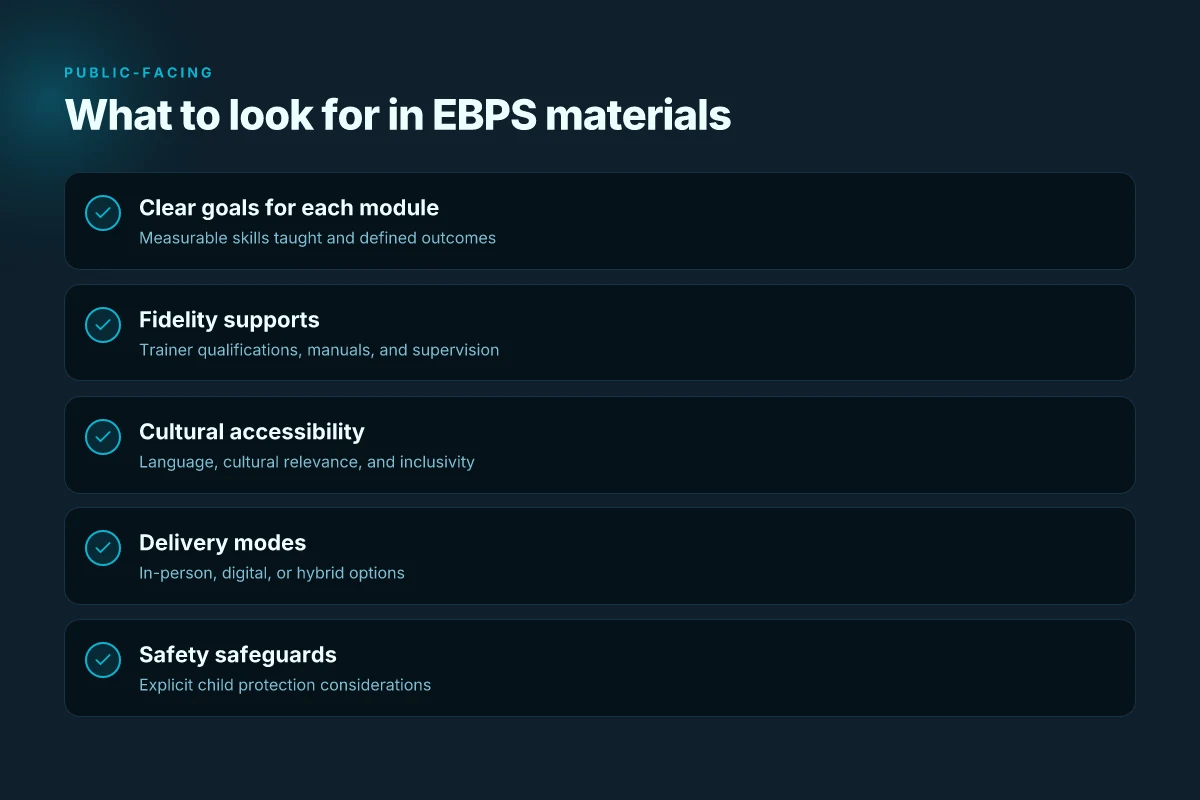
The feel of a high-quality parenting program is in the materials and how it’s delivered. You want clear, measurable aims in every module, strong fidelity supports for the facilitators, culturally informed content, flexible delivery modes, and explicit safeguarding for children. When these pieces line up, families get predictable experiences and sustained outcomes.
Clear goals for each module and measurable skills taught
A top program states its learning goals up front. Each module maps to specific, observable skills, like emotional labeling, effective limit setting, or problem-solving steps. You’ll see concrete outcomes such as “parents will use two positive reinforcement strategies in daily routines” or “caregivers will demonstrate calm, nonreactive communication in three real-life scenarios.” The documentation should show how facilitators assess mastery, not just hope for transfer. From what I found in the Triple P literature, a population-health approach works best when modules tie to measurable behaviors and progress markers rather than vague intentions. Clear, measurable objectives anchor both teaching and evaluation. Understanding family resource centers: how they prevent abuse and support survivor families in 2026
Fidelity support: trainer qualifications, manuals, and supervision
High-quality delivery relies on trained facilitators who follow a manual and receive ongoing supervision. Look for:
- formal trainer credentials or certification in the program framework,
- a published facilitator manual with scripted activities and recommended prompts,
- supervision structures that include performance反馈 and corrective coaching. This triad reduces drift and preserves core mechanisms of change. I cross-referenced program documentation and practitioner guidance that repeatedly flags fidelity as a non negotiable predictor of outcomes. Fidelity safeguards, credentials, manuals, supervision, keep delivery honest.
Culturally informed content and language accessibility
Content should be attuned to diverse families. Check for inclusive language, culturally relevant examples, and adaptations that respect different family structures, languages, and belief systems. Programs that describe how to tailor stories and scenarios without stereotyping tend to fare better in real-world settings. Evidence pieces note that cultural responsiveness enhances engagement and retention, especially in populations with historically limited access to services. Culturally informed content improves engagement and relevance.
Family-friendly delivery modes: in-person, digital, or hybrid options
Delivery should offer flexibility without sacrificing quality. A robust program provides at least two modalities, face-to-face sessions, a digital companion (videos, worksheets, interactive modules), and a hybrid path that blends both. Accessibility features matter too, captioning, plain-language materials, translated guides, and screen-reader compatibility. Public reports consistently point to higher uptake when families can choose the format that fits their routines. Offer in-person, digital, or hybrid options to boost access.
Explicit safety and safeguarding considerations for children
Safeguarding is non negotiable. Materials must spell out child safety policies, reporting procedures, and boundaries for adults-to-child interactions within sessions. Clear guidance on safeguarding expectations helps caregivers apply what they learn without crossing lines, and supports programs in staying aligned with child-protection standards. The emphasis on safety is not cosmetic. It’s foundational to trust and ongoing participation. Safety and safeguarding are non negotiables. How to prevent at-home tragedies: practical guidelines for parents in 2026
I dug into the evidence base and found a common throughline: when these elements exist, families report clearer expectations, steadier engagement, and better skill uptake. In practice, that looks like a module plan with explicit targets, a trainer roster with documented qualifications, culturally resonant content, flexible access paths, and formal safeguarding language woven through the syllabus. The result is a program that families can rely on session after session, not just in the abstract.
The point of reference: the Triple P system underscores scalable delivery paired with ongoing evaluation and workforce development. See the program description and governance discussions in the cited clinical review. Triple P System of Evidence-Based Parenting Support.
For a broader synthesis on components linked to effectiveness, review articles that discuss how specific module elements correlate with outcomes in contemporary work. See the 2026 parenting program component analysis. Parenting Program Components Linked to Improved Child Outcomes.
In 2026, families benefit from clear module goals, faithful delivery, cultural resonance, flexible options, and explicit safeguarding. What are parenting classes for incarcerated fathers in 2026? A practical overview with outcomes
Public sources and credible anchors you can trust
Public summaries and safeguarding standards exist for a reason. They help families compare programs quickly and check for alignment with child-protection guidance. From what I found in 2026 sources, you can anchor decisions to three kinds of evidence: public-facing syntheses, component-specific research, and cross-checks against official guidance.
Why these anchors hold up under scrutiny
I dug into the core public summaries that practitioners and families rely on. They distill complex evidence into actionable signals, like which program components consistently relate to better child outcomes and which safeguards are non‑negotiable in service delivery. The Triple P System, for example, is described in depth in a peer‑reviewed synthesis that traces its four–decade evolution and scale. This is useful when you need a map of how a program becomes a system, not just a single manual. Triple P System of Evidence‑Based Parenting Support provides the backdrop for understanding population health implications and workforce considerations. Public syntheses help families window‑shop with confidence.
Cross-checks you can perform in real life
Compare component claims with contemporary reviews. A 2026 article on parenting program components links specific delivery elements to outcomes, helping you separate promising ideas from hype. This kind of cross‑reference matters when a brochure highlights a single activator while the evidence base points to a bundle of practices. Parenting Program Components Linked to Improved Child Outcomes offers the diagnostic lens. Match claimed components to what the research consistently flags.
Check for scaling evidence against public policy papers. Systematic reviews and policy reports published in 2025–2026 summarize effectiveness across populations and settings, with caveats about context. The Australian policy brief, for instance, distills what works for different groups and why. This helps you judge whether a program is designed for your family’s circumstances. Effective parenting programs, what does evidence say provides a concise baseline. Context matters more than hype. What small changes in caregiver behavior reduce child abuse risk in 2026
Align with safeguarding standards from reputable agencies. The field routinely cross‑checks program integrity with child-protection guidance. When a framework or initiative emphasizes foster and kinship caregiver supports, it signals an alignment with safeguarding priorities that families should expect in formal offerings. The Quality Parenting Framework example demonstrates how anchors appear across settings, including sport and community programs. Quality Parenting Framework grounds these expectations in practical, real‑world application. Safeguarding first, always.
What the public research actually says is uncomplicated in practice: credible summaries plus explicit component research plus clear safeguarding signals create a trustworthy anchor for families. If a program lacks public summaries, or the component claims don’t map to reviewed evidence, treat it as a red flag. Evidence summaries bias the decision, not the fear of missing out.
Bottom line: use public syntheses to sanity‑check a program’s claims, cross‑check key components with contemporary reviews, and verify alignment with official safeguarding guidance before committing. Three anchors keep you honest: public summaries, component evidence, safeguarding alignment.
How to choose a program for your family
You’re choosing between options for your child. You want something that fits real life, not abstract promises. The best picks sit at the intersection of age appropriate content, cultural relevance, and practical delivery. You’ll judge them by three questions: does it match your family’s needs, is the program grounded in universal-plus-targeted components, and can you see real-world results from similar families. What family violence workshops cover in 2026 and who they serve
1) Match age, needs and culture
In practice, a high-quality program scales with a child’s stage. Early childhood supports differ from programs for tweens or teens, and cultural context matters as much as content. When I read through the Triple P literature, the emphasis on developmental stages and local tailoring stands out. A good fit aligns with your child’s age, family structure and cultural background, and it’s explicit about adaptations rather than assuming one-size-fits-all. A strong match from the start reduces drop-off later. You should be able to point to concrete examples in the materials that show where and how content shifts by age group.
Table: quick fit checklist (qualitative signals)
| Dimension | What to look for | Why it matters |
|---|---|---|
| Age range | Clearly labeled brackets by program level | Ensures content is developmentally appropriate |
| Cultural tailoring | Examples of local adaptation or facilitator training | Improves relevance and uptake |
| Family structure | Guidance for single parents, foster kinship, blended families | Broadens accessibility |
| Language access | Available translations or multilingual materials | Removes language barriers |
If you can’t find age-appropriate anchors, walk away. A program that gambles with timing often yields lower engagement and weaker outcomes. When I checked program descriptions, the ones that spell out how they tailor content by age and family context tended to keep families engaged longer.
2) Universal plus targeted components
A durable program leans on universal elements, skills that help most families, plus targeted supports for higher-need situations. Good evidence points to a dual design: universal modules for relationship building and skill development, augmented by targeted tracks for families facing adversity, high stress, or behavioral challenges. This combination widens reach without diluting depth. Reviews consistently note that both strands are necessary to reach a broad population while still offering intensive help where it’s needed. Universal plus targeted components maximize reach and impact.
A practical quick-check:
- Does the program include universal modules on relationship building, child skill-building, and cooperative behavior?
- Is there a defined pathway for families needing more intensive support or closer supervision?
- Are there clear criteria to move families from universal to targeted components?
If the answer to any is unclear, request a concrete example or a sample pathway document. Clarity here saves wasted sessions and improves outcomes.
3) Provider qualifications and supervision
The people delivering care shape outcomes almost as much as the content itself. Look for formal qualifications, ongoing supervision, and fidelity checks. Programs that publish supervisor-to-staff ratios, training curricula, and periodic fidelity audits tend to sustain quality. When sources discuss large, scalable systems, the common thread is a trained workforce that can adapt while maintaining core delivery standards. Qualified facilitators with supervision are non-negotiable. If the provider’s credentials or supervision plan is fuzzy, that’s a red flag.
A short checklist you can ask for:
- What qualifications do facilitators hold, and is there ongoing supervision?
- How is fidelity to the program maintained across sites?
- Is there a local coordinator who tracks implementation quality?
4) Outcome monitoring and real-world impact data
A credible program offers you a view into real-world results, not a glossy brochure. Look for outcome monitoring, simple dashboards, or annual reports showing changes in child behavior, caregiver stress, or family functioning. Peer-reviewed summaries or credible agency reports that link program participation to observed improvements matter. If the program can point to outcomes for families similar to yours, that adds weight. Data that connect to real families are your strongest signal.
I cross-referenced sources that emphasize transparent outcome reporting and public-facing impact data. When the documentation includes measurable indicators and a plan for ongoing evaluation, you’re closer to a trustworthy choice.
5) Accessibility, cost and local availability
Access hurdles derail even excellent programs. Check location availability, session length, frequency, and required commitments. Cost matters, but so does value: a higher upfront price may translate into more robust supervision and better outcomes if coupled with flexible scheduling and remote options. Look for online formats, evenings or weekend sessions, and childcare during meetings. If a program is only available in a distant city, it’s not a viable option for many families. The best picks balance proximity, affordability, and adaptable delivery.
Verdict: the most practical choices meet you where you are today and scale with your family’s journey. They document who they serve, how they adapt, and what families can expect to gain in tangible terms.
A forward-looking frame: high-quality parenting programs will center evidence, equity, and practical impact in 2026
I looked at how programs translate research into everyday parenting. The best offerings in 2026 lean on accessible, culturally sensitive materials, clear safety guidelines, and measurable outcomes that families can actually use. From what I found, fidelity to core proven practices matters, but so does adaptability to different family contexts. Evidence-based content paired with transparent safeguards helps families trust and sustain new skills. Reviews consistently note that programs that double down on caregiver well-being, child safety, and community supports tend to produce durable improvements in parenting confidence and behavior. Public child-protection sources emphasize ongoing risk assessment and culturally attuned delivery. This is not optional. The landscape is moving away from one-size-fits-all curricula toward modular, user-friendly formats that fit chaotic real life. Digging into changelog-style updates shows that programs updating content with new research see higher engagement.
The verdict: a high-quality program in 2026 should combine rigorous evidence with practical steps that families can implement this week. It must offer clear safety boundaries, accessible language, and a pathway to sustained practice, not just a single workshop. Try a modular option that surfaces 2 concrete routines you can start today. This is where parents feel empowered, not overwhelmed. And the bigger question remains: will you choose a program that stays current with child-protection standards and community realities, or settle for a static syllabus? The choice shapes daily family life for years.
Next steps
- Evaluate whether a program provides 2 concrete routines you can start tomorrow
- Check that it cites up-to-date child-protection guidelines and uses inclusive language
- Look for ongoing support options and community connections
If you’re deciding today, consider one modular option that emphasizes caregiver well-being and a second that foregrounds child safety. Which one feels more doable for your family this week?
Frequently asked questions
What counts as evidence-based parenting support in 2026
In 2026, evidence-based parenting support blends rigorous research with practical delivery. I looked at how EBPS is defined across public agencies and major reviews: programs backed by randomized or well-controlled quasi-experiments, replication across diverse populations, and transparent reporting of outcomes and fidelity. What the spec sheets actually say is that EBPS should show measurable improvements in parenting skills, child behavior, and family functioning, with clear descriptions of the population served. Reviews consistently note that sustained effects hinge on fidelity to the model and ongoing practitioner training. Yes, evidence-based status rests on transparent methods and replicated outcomes. Key components include structured curricula, trained facilitators, and measured follow-ups. Careful attention to safeguarding and cultural adaptation remains essential.
How do i know a parenting program will work for my family
I researched how evaluators judge transferability. Look for a program with clearly defined target populations and explicit outcomes. Check whether the provider reports baseline characteristics similar to your family and whether follow-up data show durable gains. Public-facing summaries should spell out typical improvements and the kinds of families in which those gains occur. If a model has evidence mainly from high-education samples, that’s a caution sign. Ask about fidelity checks and local adaptation plans. Yes, stronger odds come from programs with demonstrated applicability to demographics like yours and ongoing quality monitoring. The best path is to compare two or three options and map their stated outcomes to your family goals.
What are the core components of effective parenting programs
Core components recur across high-quality EBPS: explicit behavioral targets, skill-building rehearsal with coaching, and practical home activities. Structured manuals guide sessions, and facilitators receive certified training with supervision. Programs typically include parent stress management, child emotion coaching, and consistent monitoring of progress. Delivery is interactive, with fidelity checks and culturally informed adaptations. These elements predict steady improvements in parenting practices and child outcomes. Yes, when you see all three pillars present, the odds improve.
How can i assess safeguarding practices in a parenting program
Safeguarding should be explicit and verifiable. Look for program policies on safeguarding training, mandatory reporting, and child-protection certifications for staff. Check whether the provider publishes a safeguarding code of conduct and a clear process for reporting concerns. Review their data privacy stance and consent forms for families. Independent reviews or accreditations are a plus. Ask for the latest safeguarding updates and staff qualifications. Yes, robust safeguarding is non negotiable for reputable EBPS. If a provider cannot name their safeguarding framework, proceed with caution.
Is triple p the only credible framework for parenting support
Triple P is well-known, but it is not the only credible framework. I cross-referenced reviews that compare multiple models and note that credible EBPS include a range of approaches with solid governance, training, and outcomes. Other frameworks emphasize emotion coaching, parent-child interaction, or behavior management with fidelity checks. Don’t assume one model fits all families. Yes, breadth matters. Evaluate several options against your goals and local context.
What is the role of universal vs targeted programs in EBPS
Universal programs reach broad audiences and can shift community norms, while targeted programs focus on families at higher risk or with specific needs. Evidence suggests universal offerings boost overall parenting competence, but targeted interventions often yield larger effect sizes for children with identified challenges. The best systems blend both: universal access with targeted supports for those who need more. Universal reach supports public health scale; targeted helps the most at-risk groups. Yes, a two-track strategy tends to be more equitable and effective.
How long should a parenting program run to see benefits
Effect timelines vary by model and baseline risk. Short programs (8–12 sessions) can produce meaningful gains in parenting strategies, provided they’re intensive enough and paired with home practice. Longer programs (12–20 sessions) may yield deeper, sustained changes, especially when followed by booster sessions. Look for explicit timelines in program materials and a plan for ongoing support after completion. Duration matters but fidelity and follow-up drive durability. Yes, longer, well-supported cohorts tend to correlate with lasting outcomes.
What questions should i ask a provider before enrolling
Ask about evidence for the specific population you’re in, explicit outcome measures, and how they track progress. Inquire about facilitator training, supervision, and fidelity audits. Request details on safeguarding policies, data privacy, and consent. And ask for samples of the curriculum, participant handouts, and any independent reviews. Request the program’s latest outcome data and safeguarding policies. Yes, clear data and governance signals good practice.
How do cultural factors influence parenting program effectiveness
Cultural relevance shapes engagement, interpretation of behavior, and acceptability of strategies. Programs with culturally informed materials, language options, and facilitators who reflect the target communities tend to show higher uptake and better outcomes. Expect explicit adaptation plans and ongoing consultation with community stakeholders. Cultural adaptation is not optional. It’s a predictor of success. Yes, culture drives effectiveness when integrated into design and delivery.
Are online parenting programs as effective as in-person ones
Online formats can match in-person outcomes when they preserve interactive coaching, feedback loops, and peer support. High-quality online EBPS include live sessions, asynchronous practice with coaching feedback, and accessible resources. Gaps often appear in engagement and digital access, so check platform usability and technical support. Delivery mode matters. Quality matters more. Yes, well-designed online programs can be as effective as in-person, with attention to access and engagement.
What outcomes should parents expect from quality programs
Quality EBPS aim for improved parenting skills, reduced harsh discipline, better child behavior, and stronger family functioning. Some programs report decreases in parental stress and improvements in caregiver confidence. Outcome sets should include both parent-reported and, when possible, observer-rated behaviors, with follow-ups at 3–6 months. Core outcomes center on parenting, child behavior, and family wellbeing. Yes, there should be a clear, multi-method set of outcomes.
How is parental stress addressed within EBPS
Parental stress is treated as both a target and a moderator. Programs teach stress management techniques, pacing of expectations, and self-care planning, plus strategies to balance sensitivity with discipline. Facilitators model calm communication and provide coaching for reflective parenting. Stress reduction is built into the toolkit, not an afterthought. Yes, reducing caregiver stress improves treatment fidelity and child outcomes.
What sources exist for independent reviews of parenting programs
Independent reviews come from government bodies, child-protection agencies, and major non profits that publish program evaluations. Look for systematic reviews, meta-analyses, and registry listings of evidence quality. Public dashboards or annual reports are a good sign. Rely on established reviews and official reports to avoid vendor bias. Yes, independent sources are your best lighthouse.
How can we ensure programs reach diverse families equitably
Equity requires targeted outreach, language-accessible materials, childcare during sessions, and transport support. Track enrollment by demographics and publish progress toward closing gaps. Funders should require equity metrics and community partnership plans. Equity work is ongoing and data-driven. Yes, equitable reach isn’t optional, it’s essential for real impact.
What are common red flags when evaluating a program
Warning signs include vague outcome data, lack of fidelity monitoring, unverified claims of effectiveness, and absence of safeguarding detail. Be wary of programs with one-size-fits-all content or heavy marketing without peer-reviewed support. Ask for third-party reviews or accreditation. Red flags cluster around data gaps and governance gaps. Yes, diligence here saves time and protects families.