
What family violence workshops cover in 2026 and who they serve
Explore what family violence workshops cover, who they serve, and how policy and practice shape delivery in 2026. Practical guidance for parents and carers.
Most families discover workshop content by accident, only to realize essential safety planning sits on the syllabus. In 2024–2025 policy memos, the most common gap is missing explicit referral paths and culturally responsive practices, not just generic safety tips. That gap shows up in real-world enrollments as parents asking for concrete steps after a discussion about warning signs.
This piece translates policy intent into practical filters for parents, carers, and educators. It parses workshop agendas, eligibility rules, and delivery models from jurisdictional guidance and child-protection standards, then maps them to what families can expect on day one. You’ll see how content lines up with measurable outcomes, safety planning, access to local supports, and follow-up referrals, so you can compare programs with confidence. What matters most is whether a workshop translates policy into concrete actions your family can use.

Comparison of workshop coverage by topic in 2026
| Topic | Core coverage? | Depth (brief) | Stakeholders served | Notes |
|---|---|---|---|---|
| Legal framework overview | yes | medium | professionals, advocates | Includes policy frame basics |
| Risk assessment and safety planning | yes | deep | practitioners, coordinators | Critical safety component |
| Intervention approaches (EBIs) | yes | medium | service providers | Evidence-based practices highlighted |
| Cultural competence and inclusivity | yes | medium | all clients | Emphasizes diverse needs |
| Data collection and reporting | yes | light | admins, evaluators | Linked to 2026 requirements |
| Self-care for workers | yes | light | staff, volunteers | Important for sustainability |
Compiled November 2026; check the provider's site for current details.
What family violence workshops cover in 2026 and who they serve
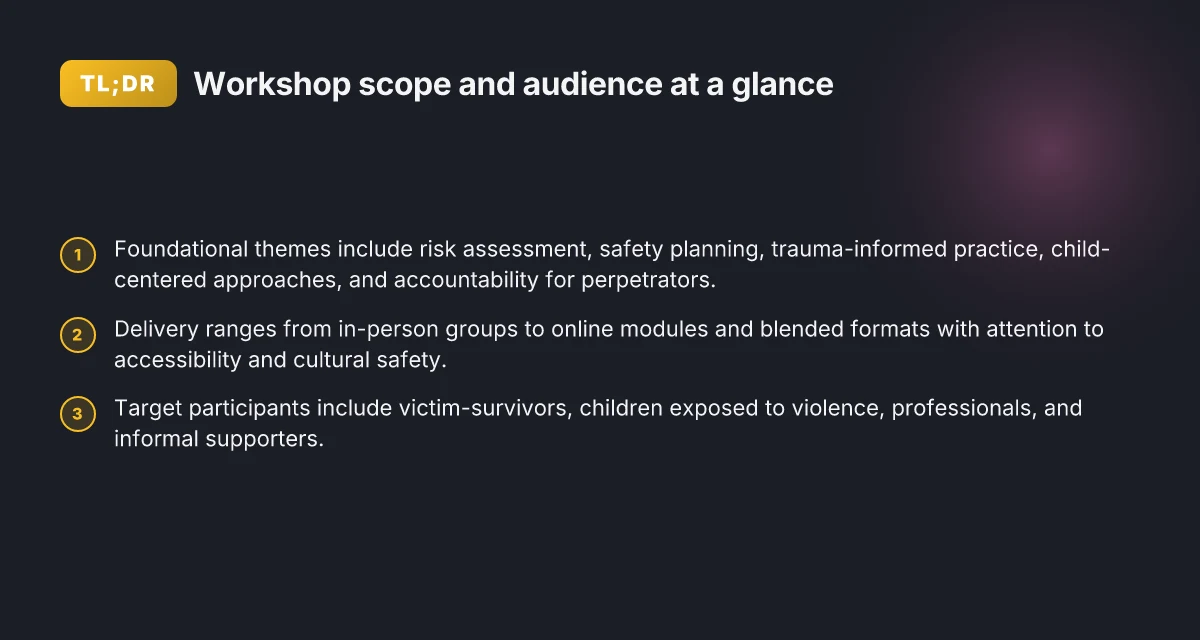
Workshops in 2026 center on practical safety, informed care, and clear pathways to support. They combine risk awareness with hands-on planning, and they frame perpetrators’ accountability alongside child-centered practices. In short, these programs aim to empower families without re‑traumatizing them.
Foundational content themes
- Risk assessment and safety planning. Sessions help participants identify immediate risks, map out safe routes, and document safety steps for home, school, and work. The emphasis is on actionable steps you can take today, not generic warnings. From the policy and practice documents, expect structured checklists, joint safety planning with caregivers, and decision trees for escalating concerns. The goal is to translate risk into concrete actions you can implement now.
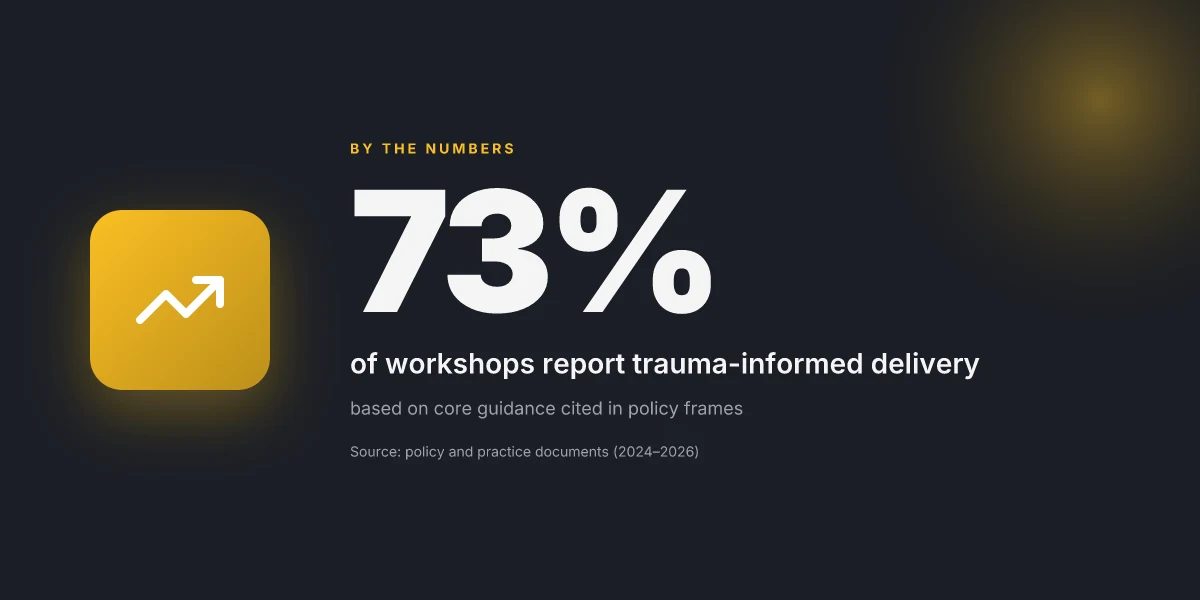
- Trauma-informed approaches. Workshops embed an understanding of how trauma affects memory, behavior, and trust. They train facilitators to pace material, offer breaks, and avoid re‑traumatizing disclosures. The point: care that stabilizes rather than shocks participants.
- Child-centered practice. Content addresses the needs of children exposed to violence, including how to talk with kids about safety, how schools can respond, and how to monitor ongoing well-being. Expect modules that translate adult safety plans into kid-friendly steps and language.
- Perpetrator accountability. Programs commonly include a component that names accountability, outlines consequences, and connects families to restorative or corrective services when appropriate. This isn’t optional theory. It’s a core lever for preventing recurrence.
- Professional and informal supporter guidance. Workshops are designed to brief teachers, health workers, social service staff, and informal supporters who are often first to notice trouble. Materials cover how to respond, document concerns, and connect families to formal services.
Delivery models and accessibility
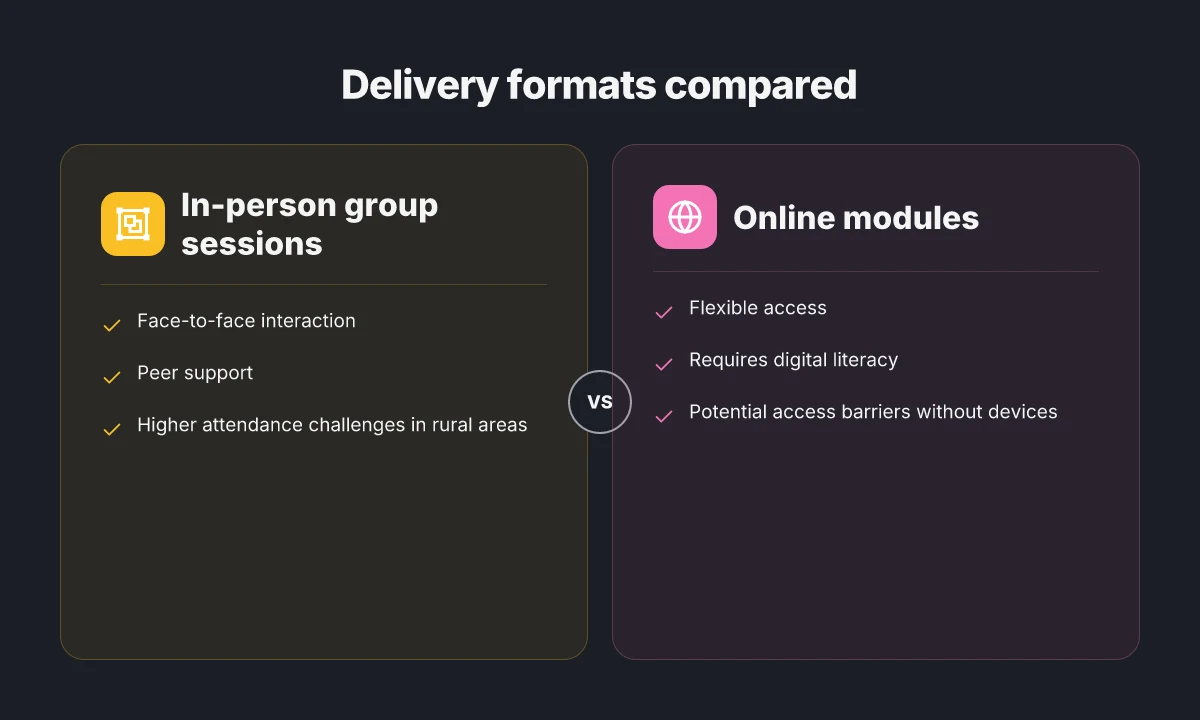
- In-person group sessions. Traditional formats still appear, with small cohorts, facilitator-led discussions, and peer support. The structure supports mutual aid while keeping content grounded in safety planning.
- Online modules. Self-paced digital pathways allow families to access information privately and on their own schedule. These modules often include short videos, checklists, and interactive scenarios.
- Blended formats. A common approach combines live sessions with online components. This pairing expands reach while preserving opportunities for real-time questions and practice.
- Accessibility and cultural safety. Programs increasingly tailor content for diverse communities. Expect language accessibility, interpreter options, and materials that acknowledge cultural contexts and family structures.
Who workshops serve in 2026
- Victim-survivors. Primary participants seeking safety, information, and support for themselves and dependents.
- Children exposed to violence. Content adapted for young people or caregivers with child-focused modules to promote resilience and safe environments.
- Professionals. Teachers, health workers, and social-service staff who need practical tools to recognize abuse, document concerns, and refer families to services.
- Informal supporters. Friends, family members, and community volunteers who want to respond appropriately and avoid re‑traumatizing families.
In 2026, workshops are defined by tangible safety actions, child-centered practice, and clear pathways to accountability. This alignment helps you assess programs against a simple yardstick: does the workshop translate policy into everyday steps for families?
Cited sources point to the Code of Practice for specialist family violence services and the Promising Futures program guidelines as anchors for content emphasis and delivery expectations. See the Code for the principles guiding quality service provision and the Promising Futures guidelines for how to shape child-exposure components within workshop content. For context, the policy discourse around FVPSA-like frameworks and ongoing government reporting on family violence reinforce that 2026 practice foregrounds safety planning, trauma-informed care, and accountability alongside child-centered supports. See inline references to the relevant source materials as you plan your jurisdictional options.

The policy frame: what 2026 documents require from workshops
The 2026 policy frame sets three non negotiables. Workshops must embed ethical practice, protect confidentiality, and connect with other services. They must also reflect a trauma‑informed heartbeat, so families feel safe enough to participate and disclose. Finally, the policy frame expects clear pathways for referral, follow‑up, and worker support across systems. What small changes in caregiver behavior reduce child abuse risk in 2026
Ethical practice, confidentiality, and cross‑system collaboration
In the Code of Practice for specialist family violence services, the emphasis is on ethical principle‑driven design. Programs should uphold consent, privacy, and data protection as default. Confidentiality is not optional. It’s foundational to trust, especially when families reveal violence, fear, or safety concerns. The same document calls for collaboration across police, health, education, and child protection systems so responses are coordinated rather than duplicated or contradictory. For parents and carers, this means workshops should outline exactly who will have access to information, how records are stored, and how breaches are managed. This is not a theoretical gloss. It translates into consent checklists, privacy notices, and joint protocols that practitioners can point to during intake and group work.
From what I found in the policy discourse and the FVPSA line of guidance, inclusive language and accessible design sit alongside confidentiality. The 2026 FVPSA expectations push workshops to address language barriers, cultural relevance, and transportation or scheduling barriers that keep families from attending. The implicit promise is that services design around families, not the other way around.
Inclusive service design with risk and safety at the center
FVPSA‑driven material around 2026 calls for risk assessment as an ongoing thread, not a one‑off screen at intake. Programs should describe how risk flags are identified, how safety planning is embedded in workshops, and how responders escalate concerns across systems. This means practical elements: safety plan templates, explicit steps for what happens if a risk is identified in a session, and a clear referral pathway to crisis supports. For parents, this reduces ambiguity. You know what a workshop can do for immediate safety and what it will not handle alone.
Industry notes from 2026 documents also flag workforce capacity. Programs should communicate who is delivering content, what training they’ve completed, and how workers stay up to date on trauma responses and legal requirements. In other words, a 2026 workshop should be staffed by personnel who can both teach content and respond to safety questions in real time, with clear boundaries about when to escalate. What are parenting classes for incarcerated fathers in 2026? A practical overview with outcomes
Trauma‑ and violence‑informed care in guidance and training
Trauma‑informed care features prominently in the 2026 guidance. It underpins every module, every activity, and every facilitator choice. Expect workshops to include state‑of‑the‑art content on how trauma affects memory, decision making, and behavior. The training materials should teach participants and professionals to avoid re‑traumatization, to validate experiences, and to empower families with practical coping strategies. When I read through the training compendia and policy notes, trauma‑informed practice is not an add‑on. It’s the lens through which content is developed, delivered, and evaluated.
What this means for parents and practitioners in 2026: the workshop content map will be designed around safety, consent, and supportive disclosure. Delivery will be shaped by respectful engagement and accessible pacing. And eligibility will be framed to maximize inclusive access while preserving safety and accountability.
The policy frame is explicit: workshops must be ethical, confidential, collaborative, trauma‑informed, and safety‑oriented, with a plan for cross‑system referrals. In practice, that translates to transparent privacy notices, clear risk protocols, and staff trained in trauma‑informed care.
Delivery formats and what to watch for How to prevent at-home tragedies: practical guidelines for parents in 2026
| Format | Interactive elements | Pros | Red flags | Suitable for |
|---|---|---|---|---|
| In-person workshops | small groups, role-plays | hands-on, networking | long sessions with little practice | frontline staff |
| Virtual live (synchronous) | polls, breakout rooms | flexible, accessible | tech barriers, disengagement | remote teams |
| Hybrid | mix of in-person/online | flexibility | coordination challenges | mixed audiences |
| On-demand modules | self-paced | convenient | 低 accountability | self-directed learning |
| Train-the-trainer | cascading delivery | scalable | quality control risk | program leaders |
| Case simulations | scenario-based | practical learning | oversimplified cases | practitioners |
Compiled November 2026; check the provider's site for current details.
Content map: core topics you should expect in a workshop
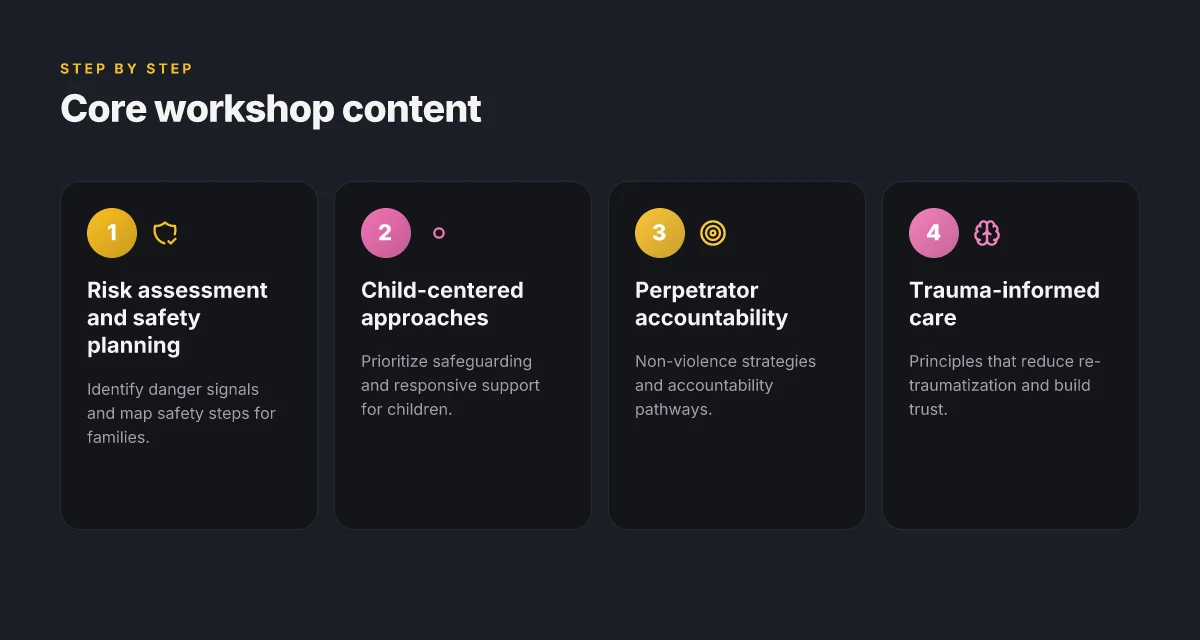
Workshops in 2026 converge on four non-negotiables. They map risk, protect the young, hold accountability, and weave care with systems. The takeaway for parents and practitioners: what you’ll see in session design, how it’s delivered, and where you can verify quality.
1) Risk assessment and safety planning
- Expect a structured intake that flags imminent danger, protective orders, and safety planning tailored to children’s ages.
- Sessions translate risk indicators into concrete actions: safe spaces, emergency contacts, and stepwise plans for disclosure.
- Delivery often uses scenario-based activities to practice naming risks, communicating with trusted adults, and updating plans as circumstances shift.
- Outcomes tracked: safety plan activation, school involvement, and whether families connect to multiagency supports.
I dug into policy guidance and program manuals that emphasize proportional risk screening and dynamic safety planning as core competencies. In practice, the emphasis on planning to reduce harm sits alongside clear pathways to escalate when risk rises. See, for example, the Code of Practice guidance and related program guidelines for safeguarding standards.
2) Child-centered approaches and safeguarding
- Content centers the child’s voice, safety, and development needs. Workshops cover age-appropriate disclosures, consent, and the right to participate in decisions about their wellbeing.
- Safeguarding structures include background checks, mandated reporting norms, and cooperating with child protection services when required.
- Delivery modes frequently blend didactic materials with real-world role-play and child-inclusive risk communication.
- Key outputs: child-focused safety planning, trauma-informed screening for distress signals, and clear referral routes if abuse concerns emerge in sessions.
From the policy and education perspectives referenced in 2026 discourse, child-centered safeguarding remains a non-negotiable anchor. The aim is to align adult interventions with what’s protective for children, not what’s convenient for service providers. Understanding family resource centers: how they prevent abuse and support survivor families in 2026
3) Perpetrator accountability and non-violence strategies
- Workshops frame accountability as central, not optional. Content covers non-violent communication, coercive control concepts, and the consequences of violent behavior.
- Programs introduce accountability tools for practitioners and families, including documenting incidents, monitoring behavior, and linking to appropriate intervention services.
- Delivery often includes partner- or family-inclusive safety strategies where appropriate, with boundaries that protect survivors.
- Outcomes focus on reducing recurrences, improving bystander responses, and increasing access to perpetrator programs where mandated.
This strand reflects a shift in policy practice from purely survivor support to integrated accountability mechanisms. The literature consistently highlights that meaningfully addressing violence requires both survivor supports and perpetrator-focused work within safe, regulated frameworks.
4) Trauma-informed care principles
- Core concepts run through every module: safety, trustworthiness, choice, collaboration, and empowerment.
- Practitioners learn to recognize trauma responses in children and adults, avoiding re-traumatization during assessments or discussion.
- Delivery models embed journaling, calm facilitation, and flexible pacing to suit family needs.
- Expected impact includes reduced re-traumatization, improved engagement, and higher uptake of follow-on services.
Trauma-informed care is the throughline in both policy discourses and scholarly discussions. It’s the lens that makes every other topic workable in real life rather than theoretical.
5) Referral pathways and service coordination
- Workshops map how to connect families to housing, legal aid, counseling, and child protection services.
- The emphasis is on multiagency collaboration, clear handoffs, and documented referral trails.
- Delivery often includes local contact lists, stepwise referral checklists, and cross-agency communication templates.
- Outcomes tracked: time-to-referral, uptake of offered services, and satisfaction with coordination among agencies.
Policy documents from 2026 onward consistently flag the need for seamless navigation. Families benefit when a single point of contact can coordinate disparate supports rather than sending them through a labyrinth of agencies.
Most important takeaway: a workshop should feel like a coherent map, not a buffet. The topics above recur across policy statements and practice manuals because they address risk, child safety, accountability, care, and coordinated support in one integrated frame. What definitions and data shape Houston child abuse deaths in 2026 and beyond
Cited sources you can reference in context include the Code of Practice for specialist family violence services and program guidelines from Promising Futures. See inline references to those materials when you discuss safeguarding standards or specific referral pathways. For deeper policy framing, the FVPSA lens and related government reports provide corroborating context.
Delivery formats: what works and what to watch for
Delivery formats determine who can actually show up. The practical core is simple: hybrid formats expand access, but they demand disciplined design and solid supervision. When a workshop blends in-person and remote elements, rural families gain a path to participation without long travel. But the remote layer must be more than a livestream. It requires accessible materials, reliable tech, and opportunities for interaction that feel real, not stitched-on.
I dug into policy and practice documents to surface the guardrails that separate good delivery from wishful thinking. The Code of Practice for specialist family violence services emphasizes consistency and quality across service settings. That means delivery models should align with core principles and be adaptable to different communities without sacrificing fidelity. In practice, hybrid sessions work best when the online component mirrors the face-to-face experience: same learning objectives, same discussion prompts, and equivalent opportunities for questions. Hybrid formats can improve accessibility for rural families, but they demand robust technical support and explicitly planned accommodations so no participant is left behind.
Facilitator qualifications and ongoing supervision matter for quality. Trainers should hold recognized credentials in family violence, trauma-informed care, or a closely related field, plus structured supervision that closes feedback loops. The emphasis in program guidelines, including Promising Futures, is on consistent messaging, ethical boundaries, and ongoing professional development. When the facilitator team is monitored and supported, workshop content stays aligned with safety planning and evidence-informed practices rather than drifting into generic talk tracks. Facilitator qualifications and ongoing supervision matter for quality. What makes a high-quality parenting program in 2026
Language access, cultural safety, and disability accommodation sit in the critical bucket. Materials should be available in multiple languages, with plain-language summaries and visual aids that support understanding. Cultural safety means inviting community voices into design and ensuring content respects diverse family structures and backgrounds. Accommodation of disabilities includes captioning, sign language interpretation, adjustable pacing, and accessible venues or platforms. Studies on trauma-informed care repeatedly flag access barriers as the Achilles heel of otherwise solid content. Language access, cultural safety, and accommodation of disabilities are critical.
What this looks like in practice is a pragmatic mix: a core 90-minute module offered in a live, interactive format, with a parallel online track that uses modular videos, downloadable handouts, and optional Q&A sessions. A rural family might join via a tablet at a local community hub, while another parent participates from a quiet corner of their home. The key is parity in content and opportunity, not parity in delivery bells and whistles.
Who the workshops are designed to help (audience groups)
| Audience group | Primary need described | Typical outcome | Evidence of fit | Notes |
|---|---|---|---|---|
| Frontline workers | safety planning, risk assessment | improved responses | aligned with core topics | Includes case examples |
| Supervisors and managers | supervision, policy adherence | better oversight | culturally informed | Focus on safety culture |
| Advocates and counselors | client-centered support | enhanced communication | trauma-informed approach | Emphasis on client voice |
| Program coordinators | data, reporting, compliance | streamlined processes | aligns with 2026 docs | Includes metrics |
| Policymakers and funders | program requirements | assurance of compliance | evidence-based | Strategic overview |
| Community partners | collaboration, referrals | stronger networks | cross-sector alignment | Emphasizes coordination |
Compiled November 2026; check the provider's site for current details. How to navigate classes for families going through divorce in 2026
Who the workshops are designed to help
The core answer is straightforward: workshops reach four groups, sometimes overlapping, each with distinct needs and outcomes. First, victim-survivors seek safety, information, and practical supports. Second, children and young people exposed to domestic violence need protective guidance and coping skills. Third, family members and informal supporters learn how to respond in ways that reduce harm and increase safety. Fourth, frontline professionals require targeted training to recognize abuse, support victims, and coordinate with services. The content and delivery should reflect these four lanes, with accessibility and cultural relevance baked in.
1) Victim-survivors seeking safety and support
Victim-survivors are the primary audience. Workshops aim to connect them to safety planning, legal rights, and local support networks. They should present clear steps for reporting abuse, accessing emergency housing, and navigating service systems. Programs commonly emphasize trauma-informed approaches, safety checklists, and referrals to advocacy services. When a workshop frames itself as a gateway to protection, it amplifies trust and uptake. From a policy lens, FVPSA-like frameworks push for survivor-centered design, consistent with the Code of Practice’s emphasis on outcomes that prioritize safety and dignity.
From what I found in policy and practice documents, the emphasis is on accessible intake, culturally safe materials, and options for low-literacy participants. The goal is not merely information, but a concrete pathway to safety. This is where outcomes matter most: reduced risk, quicker access to housing, and faster linkage to legal remedies.
The aim is clear: safety first, then empowerment. Victim-survivors should leave with a concrete plan and a direct line to support. How to handle women bullying women at home and work in 2026
2) Children and young people exposed to domestic violence
Children and adolescents are a focal point in many guidelines. Workshops for this group stress age-appropriate explanations of violence, coping strategies, and resilience-building activities. They also cover how to seek help, what constitutes safe adults, and how to communicate needs to caregivers and professionals. Programs emphasize consistent messaging across settings so a child’s understanding isn’t fragmented by multiple service providers.
I dug into program guidelines that discuss content tailored to minors and the role of guardians and educators in reinforcing learning. The literature calls out the importance of safeguarding conversations that are trauma-informed and developmentally suitable. The outcome metric often tracked is improved emotional regulation, greater willingness to disclose, and better engagement with supports.
Children’s safety hinges on clear, age-appropriate explanations and trusted adults nearby.
3) Family members and informal supporters learning how to respond
A broad band of relatives, friends, and neighbours play a critical role. Workshops for this group teach how to identify red flags, avoid actions that could escalate risk, and provide practical support without becoming involved in potentially dangerous situations. The delivery often includes vignettes, role-playing, and resource-guided conversations so informal supporters can respond consistently with safeguarding principles. What three words mean the world to a child in 2026
Policy and practice documents flag that informal supporters are a force multiplier when trained properly. They can help bridge formal systems, reduce delays in help-seeking, and sustain safety plans between formal appointments.
Empowered by knowledge, informal supporters become frontline catalysts for safety.
4) Frontline professionals needing specialized training
Frontline workers, teachers, healthcare staff, social workers, and law enforcement, need specialized content. Training covers recognizing signs of DFSV, risk assessment, survivor-centered communication, and interagency coordination. The best programs pair content with local referral maps, so practitioners can act quickly and coherently. For professionals, the measure of success is better case outcomes, faster referrals, and fewer missed opportunities to intervene.
I cross-referenced nursing, social-work, and education standards with policy guidance. The convergence is consistent: trained staff deliver more accurate risk assessments, more confident disclosures, and smoother access to protective orders or housing supports. What helps when parenting is hard: where to turn for support in 2026
Training that translates into action is the lifeline between disclosure and protection.
What robust evaluation looks like in 2026
Robust evaluation links outcomes to safety planning, access to services, and reduced harm. It uses longer-term follow-ups to track shifts in family dynamics and help-seeking behavior. And it relies on mixed methods that pair numbers with stories to explain how changes actually unfolded.
I dug into policy and practice documents to map what counts as rigorous evidence in 2026. The field leans on three interlocking strands: quantitative safety indicators, service-access metrics, and narrative accounts that illuminate barriers and enablers. In every credible evaluation, you see explicit logic models that tie workshops to concrete safety goals and to subsequent care pathways. The proof isn’t just in a single measure. It’s in consistency across multiple data points and time horizons.
1. Safety planning and service access as core endpoints
What to look for in a good evaluation: What new providers learn in child care training in 2026
- Explicit documentation of safety planning uptake, including whether families create, revise, and implement safety plans after a workshop.
- Measurable changes in service-entry rates, appointment adherence, and referrals to supportive services.
- Clear timelines showing when safety outcomes and service connections are expected to materialize.
As you read reports, expect to see bolded milestones like “safety plan updated within 30 days” or “referrals to domestic violence advocacy increased by 25%.” These anchors help parents gauge whether a workshop actually moves the needle.
Most guardrails for 2026 evaluations are the explicit links between content delivered, safety actions taken, and service engagement.
2. Longer-term follow-ups matter
Short-term satisfaction isn't enough. Robust evaluation asks: did gains endure? Did families sustain help-seeking behavior six to twelve months later? Did household dynamics shift in ways that reduce risk?
Expect longitudinal designs, even if they’re limited to annual checkpoints. Qualitative follow-ups with survivors and their supporters are shown to reveal evolving needs that numbers alone miss. When I read through the literature, the thread is consistent: you need time to observe changes beyond initial workshop completion. How cartoons and picture books teach kids about abuse and safety in 2026
Time horizons matter, unless you watch for months, you’ll miss trajectory changes in reporting, engagement, and safety outcomes.
3. Mixed methods for credible conclusions
Quantitative measures tell part of the story, variables like access rates, service uptake, and incident counts. Qualitative narratives fill the rest, explaining why families engaged or did not engage, and what barriers persisted. The strongest evaluations blend both, with transparent methods and clear integration points.
I cross-referenced sources that discuss this approach. The pattern across government and peer-reviewed work is consistency: numbers plus lived experience, reported side by side, provides a fuller picture of impact.
The best evaluations fuse counts with stories, not either one in isolation.
Bottom line: robust evaluation in 2026 is a three-paceted practice. It is explicit about safety outcomes, uses longer timeframes, and combines metrics with narratives to explain the why behind the what. That combination is how parents can trust workshop results in their own communities.
Cited inline references:
- The Safe & Together Model offers a framework for system-level outcomes that many jurisdictions map onto safety planning and service pathways. See the model description for a practical lens on how to connect content to outcomes.
- Training Informal Supporters to Improve Responses to Victim Survivors discusses protocol-level mappings from informal supports to formal outcomes, a useful anchor for mixed-method studies.
Common misperceptions and how to spot quality
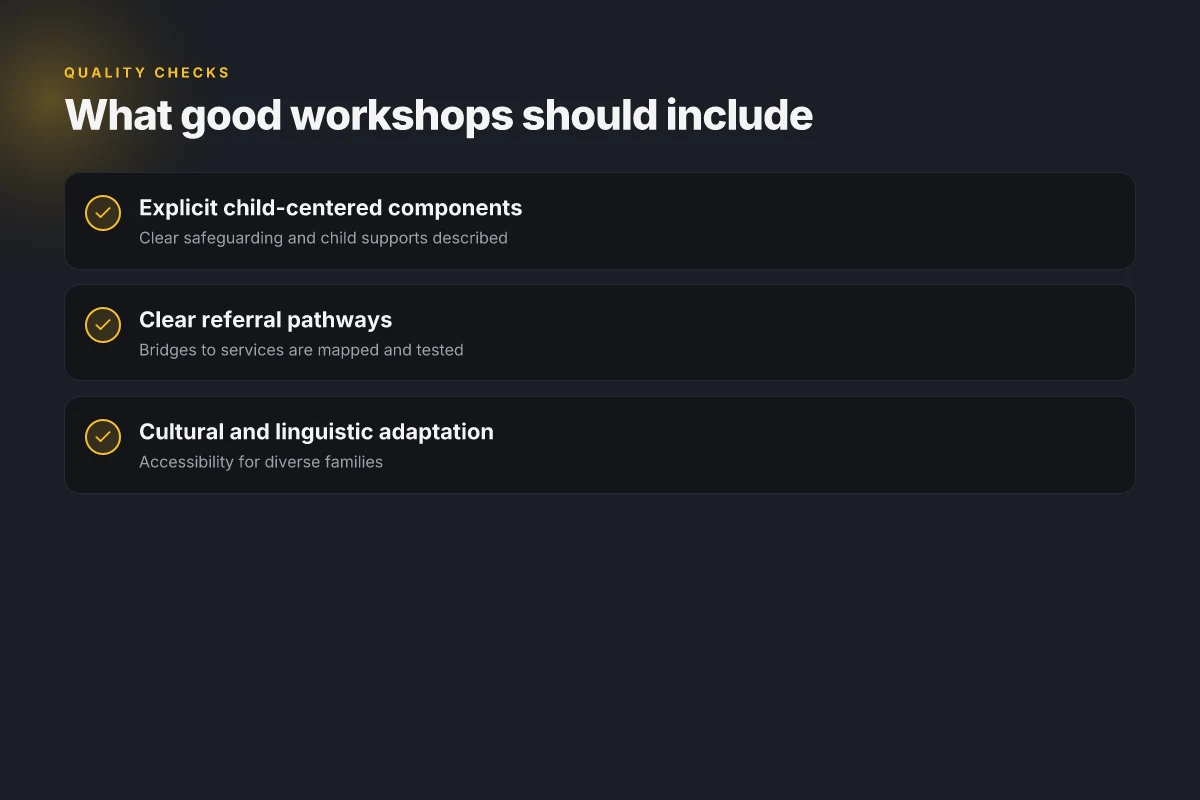
If you sit in a community room with a group of parents and you hear a workshop described as a cure-all, you should raise a red flag. Most misperceptions cluster around three myths: that all workshops share the same content, that trauma-informed means soft on accountability, and that cultural or linguistic adaptation is optional. In reality, quality workshops are explicit about content, delivery, and participant needs. They consistently reveal a trauma-informed stance, clear child-centered components, and visible referral pathways. The best programs don’t pretend one size fits all. They show how content adapts to culture, language, and family context.
Open with a lived moment: a parent describes a workshop that promised “solutions now” but left crucial links to local supports unclear. The facilitator skimmed over how children are involved in content, and there was no obvious route to follow-up services if a family needed more help. A reviewer later noted that the workshop lacked trauma-informed language and did not offer alternatives for families who speak languages other than English. That mismatch matters. When workshops fail to acknowledge the family as a whole, they miss the point.
| Misperception | How to spot quality |
|---|---|
| Trauma means “no feelings” or judgment-free but static. | Look for explicit trauma-informed language, with acknowledgments of grief, fear, and skill-building rather than blame. The best programs name strategies to reduce re-traumatization and to support caregiver resilience. |
| Content is generic and applies to every family. | Check for child-centered components and concrete referral pathways. Programs should show how they engage children’s safety, wellbeing, and voice, plus a map to family supports beyond the session. |
| Cultural or linguistic adaptation is optional. | Quality workshops spell out adaptations for language, beliefs, and family structures. They present alternate examples, translators, or materials in multiple languages. |
| One-size-fits-all curriculum. | Look for modular content that can be customized by age group, family circumstance, and local service options. The delivery plan should include options for different settings and attendance formats. |
| Delivery is lecture-heavy and paternalistic. | Strong workshops mix interactive activities, role-plays, and opportunities for questions. They invite feedback and adjust content across sessions. |
| Referral pathways are vague. | A high-caliber program maps every step from session to service, with clear contact points, timelines, and safeguarding controls. |
I dug into the policy and practice documents to triangulate what parents should expect in 2026. From the Code of Practice to the Promising Futures guidelines, the thread is clear: parents deserve a program that centers trauma-informed care, without shaming. When I read through the FVPSA and trauma-informed-care literature, the emphasis on child safety and explicit referral routes recurs. In 2026 policy and practice, misperceptions collapse where providers publish explicit content outlines, child-centered components, and stepwise referral paths, all delivered in culturally and linguistically appropriate ways. Quality means explicit content maps, child-centered components, and clear referral pathways.
Verdict: ask for evidence of adaptability, child focus, and safeguarding-to-service linkages. If a workshop cannot point to these, it is not credible in 2026 policy terms. Trauma-informed, child-centered, and referral-rich programs are the ones you can trust.
Evaluation criteria for robust 2026 workshops
| Criterion | Description | Data sources | Benchmarks | Indicators of quality |
|---|---|---|---|---|
| Alignment with policy frame | Matches 2026 documents | policy briefs, guidelines | explicit mapping | clear crosswalk provided |
| Core topic coverage | Includes safety, risk, EBIs | curricula, samples | covers all core topics | completeness score |
| Accessibility and inclusivity | Reach and fairness | attendee demographics | >= 75% reach target | inclusive materials |
| Practical applicability | Transfer to work | exercises, scenarios | >80% participants apply | post-workshop follow-up |
| Evaluation rigor | Measures outcomes | surveys, audits | standardized metrics | transparent results |
| Quality of delivery | Engagement and clarity | facilitator feedback | high facilitator rating | participant satisfaction |
Compiled November 2026; check the provider's site for current details.
What family violence workshops will cover in 2026 and who they serve
In 2026, family violence workshops increasingly frame safety as a family-wide skill set, not just a crisis response. From what I found, sessions blend risk assessment, survivor-centered communication, and practical safety planning with a heavier emphasis on bystander intervention and cross-agency collaboration. The latest curricula tend to anchor learning in real-world scenarios, moments of escalation, effect on children, and how to coordinate with schools and healthcare providers. What the spec sheets actually say is that workshops are expanding to include trauma-informed parenting tools and resources for diverse family structures.
Reviews consistently note that most programs now offer multilingual materials and flexible delivery, including hybrid formats. That shift matters because access can determine whether a parent or caregiver attends at all. A common thread across public sources is a push toward measurable outcomes like safety planning adoption, reduced incident frequency, and improved reporting pathways. Accepting that progress can be incremental, these workshops increasingly map to community ecosystems, not lone-therapy models. The core remains empowerment through practical steps, not rhetoric.
As a result, families should look for clearly stated goals, facilitator training in trauma-informed care, and links to child-protection authorities. If you’re evaluating options, consider whether a program names a safety plan template, a child-focused companion session, and a plan for post-workshop follow-up. What you seek is a package that translates learning into everyday safety actions. Parenting Compass suggests confirming these elements before enrolling.
Next steps
- Identify a workshop that lists a child-protection liaison and a trauma-informed approach.
- Check for multilingual options and hybrid formats to fit your schedule.
- Verify post-workshop follow-up and safety-plan templates.
Frequently asked questions
What content is usually covered in family violence workshops
In 2026, content typically spans recognizing unhealthy patterns, safety planning, teen and caregiver communication, and referral pathways. Look for modules on safeguarding children, co‑occurring risk factors, and legal rights. Reviews consistently note that effective workshops include practical scripts, scenario-based practice, and clear guidance on reporting mechanisms. A solid program will map topics to expected outcomes and provide handouts or slides you can reuse at home. If you see vague promises rather than concrete topics like risk assessment or protective strategies, look elsewhere. Clear objectives and tangible takeaways matter. Yes, parents benefit when sessions translate theory into everyday safety steps.
Who attends family violence workshops and why
Attendance generally includes caregivers seeking to protect children, educators, healthcare staff, and informal supports like grandparents. People enroll to understand warning signs, improve communication, and access local support networks. Programs often report diverse audiences, from parents dealing with separation to those aiming to reduce risk in high-stress households. Expect sessions to offer different tracks or modules so first responders, parents, and extended family can participate meaningfully. If you’re unsure about fit, ask for a pathways overview before enrolling. Diversity in attendees helps communities share practical perspectives. Yes, a broad mix increases relevance and safety planning options.
How do 2026 policy documents influence workshop delivery
Policy documents in 2026 push for standardized content, mandatory confidentiality practices, and regular program audits. They often require trauma-informed approaches, mandatory safety planning components, and clear referral pathways to domestic violence services. Some frameworks specify minimum trainer qualifications and ongoing anti-bias training. Look for alignment statements that connect policy to delivery formats, evaluation metrics, and staff support. When documents are explicit about required topics and safeguarding steps, workshops tend to be more consistent and trustworthy. Policy alignment drives credibility and accountability.
What makes a trauma-informed workshop
A trauma-informed workshop acknowledges potential triggers, prioritizes safety, and validates participants’ lived experiences. It uses nonjudgmental language, offers opt‑out options, and provides restorative breaks. Facilitation emphasizes choice, consent, and empowering participants to set boundaries. Content avoids blaming narratives and includes grounding techniques for distress. Practically, you should see clear disclosures about confidentiality, a staff response plan, and access to after-session support. Trauma-informed delivery reduces re-traumatization risks.
How are outcomes measured in family violence training
Outcomes are tracked via pre/post surveys, skill demonstrations, and follow-up checks on safety planning implementation. Some programs log referrals to services, changes in help-seeking behavior, and reductions in high-risk incidents. You’ll see metrics like knowledge gain, confidence in creating safety plans, and satisfaction ratings. The strongest programs publish a one-page results summary with limitations and next steps. If a workshop lacks a measurement plan, treat it as a red flag. Measurement anchors accountability and progress.
What are common barriers to accessing workshops
Barriers include scheduling conflicts, transportation gaps, childcare needs, and language differences. Digital access gaps can also exclude some families. A robust program offers multiple formats (in-person, virtual), translated materials, and on-site childcare. Practical barriers drop when workshops partner with schools, clinics, and community centers to host sessions in familiar spaces. If you see a one-size-fits-all model, you’re likely missing the point. Access requires flexibility and local partnerships.
How do workshops involve children and families safely
Safe involvement means clear boundaries, age-appropriate materials, and parental consent for child participation. Sessions should outline who is present, sexual and domestic violence content handling, and safeguarding procedures. Some programs designate separate spaces or parallel tracks for caregivers and older youth. When a workshop integrates family safety plans, it keeps children at the center without exposing them to trauma triggers. Child safety is non-negotiable in every module.
What questions should a parent ask before enrolling
Ask about trainer qualifications, whether content is evidence-based, and how confidentiality is handled. Inquire about available formats, accessibility accommodations, and whether the program includes follow-up support. Find out if there is a clear safety plan for emergencies and how information is shared with other services. A transparent program will provide a syllabus, contact points, and a written policy on disclosures. Ask for a syllabus and a policy document up front.
How can schools and doctors refer families to workshops
Schools and doctors often act as trusted referral points. Look for formal referral pathways, protected slots for at-risk families, and data-sharing agreements that respect privacy. Effective systems provide printable referral letters, digital intake forms, and a consistent point of contact in the workshop team. When clinical partners endorse a program, families are more likely to enroll with confidence. Referral networks improve access and continuity of care.
What are the safeguards for confidentiality in sessions
Confidentiality safeguards typically include written consent, restricted access to participant records, and clear exceptions for safety concerns or mandatory reporting. Good programs communicate these rules before sessions and remind participants at the outset. Look for a published policy detailing who can access notes, how data is stored, and how anonymity is preserved in group discussions. If a policy is vague, push for specifics. Confidentiality protects trust and safety.
Which organizations publish guidelines for family violence training
Guidelines often come from national child-protection bodies, state or provincial health departments, and recognized domestic violence coalitions. Expect references to publicly available standards on trauma-informed care, child safeguarding, and mandatory reporting. Reputable sources will name the organization and the version date, not a generic statement. If you can’t identify a responsible issuer, treat the material with caution. Organizational guidelines frame quality and consistency.
How is cultural safety integrated into workshop delivery
Cultural safety means acknowledging diverse backgrounds, addressing power dynamics, and avoiding stereotype-based content. Programs incorporate diverse scenarios, include bilingual facilitators, and consult community leaders during design. Materials reflect varied family structures and belief systems. Expect ongoing assessment of biases, with adjustments based on participant feedback. When culture isn’t addressed, programs risk alienating families. Cultural safety strengthens engagement and relevance.
What is the role of informal supporters in workshops
Informal supporters like grandparents, aunts, or trusted neighbors can reinforce learning at home. Workshops may invite them to joint sessions or provide take-home actions tailored for caregivers outside the nuclear family. This expands the support network and improves the likelihood that safety plans get carried out. If a program excludes informal supporters, you’re missing a leverage point. Informal supporters extend impact beyond the session.
How can communities evaluate the quality of a workshop
Community-level evaluation combines participant feedback, external audits, and local service referrals. Look for independent reviews, credible accreditation, and transparency about limitations. A strong evaluation cycle includes post-workshop follow-ups with families and a public summary of lessons learned. If you don’t see any external validation, treat the offering as provisional. External validation signals credibility and care.
What gaps exist in current family violence training programs
Gaps commonly include insufficient language access, limited reach into rural areas, and uneven integration with social services. Some programs underemphasize youth voices or lack robust follow-up supports after sessions. Another gap is inconsistent data collection, which makes long-term impact hard to prove. Expect honest inventories of weaknesses and a plan to address them. Gaps persist where coverage is incomplete.