What constitutes effective parenting in 2026: definitions, frameworks, and core principles
A practical guide for parents grounded in 2026 research and authoritative sources. Definitions, frameworks, and core principles to support responsive, culturally aware parenting.
A practical truth often hides in plain sight: effective parenting in 2026 hinges on relational health backed by consistent guidance, not a single technique. When I examine cross-cultural Baumrind adaptations and contemporary relational-health research, the strongest signal is warmth paired with boundaries, applied with cultural sensitivity. This piece translates that evidence into actionable principles you can apply this week, not in a theoretical toolbox.
Across cultures, the stakes are clear: children thrive when relationships are secure, expectations are predictable, and caregivers adapt to context without abandoning core values. The latest synthesis from child-development researchers points to three anchors: dependable routines, emotion coaching that aligns with discipline, and explicit respect for family norms, all measured by visible relational health indicators. What matters now is how you wire these anchors into daily life.

Definitions and core principles of effective parenting in 2026
| Principle | Description | Core aim | Evidence basis | Notes |
|---|---|---|---|---|
| Boundaries | Clear limits with consistency | Safety and structure | High to moderate | May vary by child and culture |
| Curiosity | Open-ended questions, exploratory learning | Fostering autonomy | Emerging | Requires practiced patience |
| Empathy | Responsive, warmth-based care | Emotional security | Strong | Essential underpinning |
| Adaptability | Tailoring to child/family context | Relevance over rigidity | Moderate to strong | Includes cultural fit |
| Growth mindset | Emphasizing process over perfection | Resilience | Supported | Not universal in all topics |
| Communication | Honest, age-appropriate dialogue | Trust and clarity | Supported | Requires effort |
| Relationship focus | Relational health as core | Long-term well-being | Strong | Central claim of article |
Compiled November 2026; check the provider's site for current details.
What constitutes effective parenting in 2026: definitions and core principles
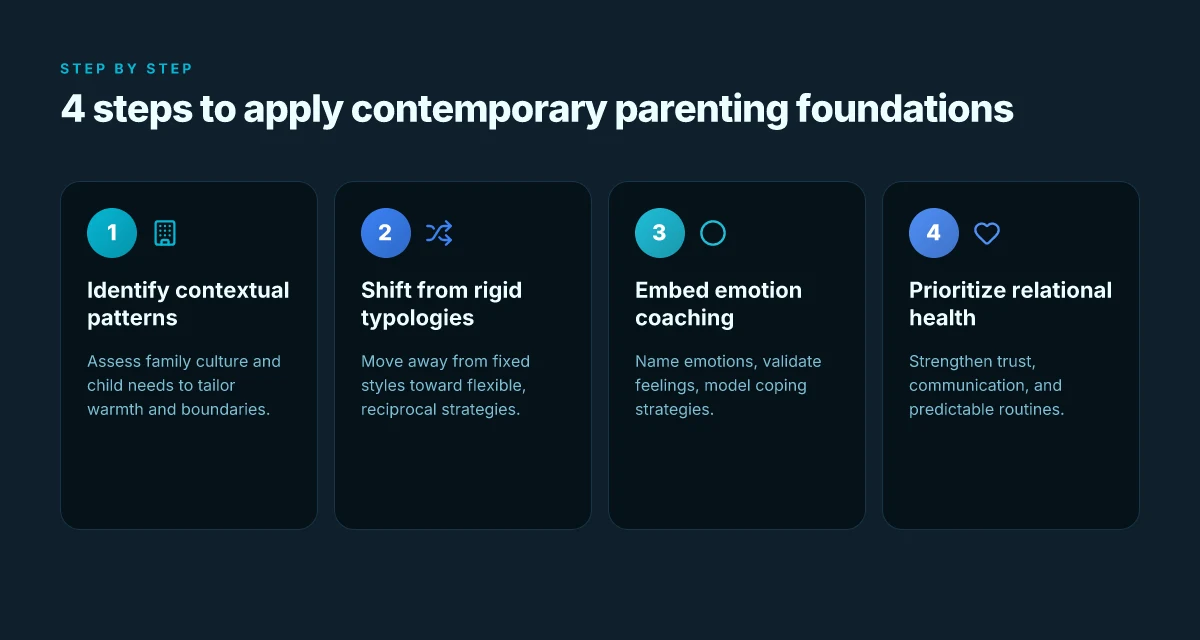
Effective parenting in 2026 is a flexible, reciprocal process shaped by culture, context, and child needs. It centers warmth and appropriate structure, couples responsiveness with autonomy-supportive guidance, and moves beyond fixed typologies toward relational health. From cross-cultural work to emotion coaching, the field converges on a practical toolkit families can apply daily.
1. A relational baseline: warmth, structure, responsiveness
The starting point is a stable triad. Warmth builds trust and motivation. Structure provides clear expectations. Responsiveness tunes support to the child’s moment-to-moment state. When these interact well, children develop secure emotion regulation and social competence. In 2026, multiple sources emphasize relationships as the engine of healthy development, not a single parenting label.
I dug into cross-cultural reviews that challenge one-size-fits-all models. They show that communities reframe authority through meanings like harmony, respect, and guidance from behind. The point is not to abandon structure, but to adapt it to cultural meaning and family goals. Effective parenting is a reciprocal dance, not a fixed style.
2. Core principles that hold across contexts
- Warmth with boundaries. Parents offer genuine affection while keeping clear expectations. The boundaries are predictable, not punitive, and they evolve with the child’s age.
- Autonomy-supportive guidance. Children learn best when they experience choice within safe limits. This builds intrinsic motivation and problem-solving.
- Emotion coaching. Labeling feelings, validating experiences, and teaching strategies to cope reduces reactive cycles.
- Positive discipline. Focus shifts from punishment to teaching, using timely, nonshaming feedback and collaborative problem-solving.
- Relational health as the backbone. Strong parent–child relationships survive disagreement and stress, buffering risk and amplifying developmental gains.
In 2026, the consensus is not about choosing a label but about sustaining warm, responsive partnerships that support autonomy. Learning to parent: why parenting education matters in 2026
3. What emerging frameworks actually change daily practice
Emotion coaching sits at the core. It blends recognizing emotion with guiding behavior, not suppressing feelings or cycles of punishment. Positive discipline moves from smacking or shaming to rule-setting that invites dialogue and repair. Relational health refines this further: the family system is a network where every member’s well-being matters, and where stressors are negotiated within the unit rather than imposed on the child.
I cross-referenced guidance from leading centers and journals. The takeaway is practical: translate research into daily routines, mealtime conversations that tune in to mood, routines that anchor security, and shared activities that reinforce connection.
The practical shift is toward emotion-aware parenting and repairable relationships rather than rigid typologies.
Bottom line: effective parenting in 2026 blends warmth, structure, and autonomy with a steady emphasis on emotion coaching and relational health. Families that translate these principles into daily rituals, from daily check-ins to predictable routines to respectful problem-solving, tend to support healthier socioemotional outcomes across cultures. What parenting classes look like when court-ordered in 2026: online vs in-person formats
Foundations: definitions of effective parenting in contemporary research
Effective parenting today is less about fitting families into fixed boxes and more about a flexible, relational pattern that fits the family’s culture, context, and goals. The main takeaway from 2026 literature is clear: Baumrind’s traditional styles are best read as contextual patterns. Warmth, responsiveness, and clear expectations can coexist with discipline practices that are culturally grounded and developmentally attuned. This reframing moves the field from style taxonomy to process and meaning.
I dug into cross-cultural work and theory-based accounts to map what actually holds in contemporary research. Self-Determination Theory surfaces as a robust alternative to rigid typologies, prioritizing autonomy, competence, and relatedness. In practice, that means parenting guidance should promote children’s sense of choice and mastery within a caring framework. Emotion coaching also stands out. By labeling and validating emotions, parents help children regulate affect and behavior without resorting to harsh control. The upshot is a recipe built on connection plus appropriate boundaries, not a single labeled style.
Across diverse cultures, warmth and responsiveness consistently correlate with positive development even when discipline differs. Cross-cultural studies show that cultures with strong communal norms can maintain high warmth while prescribing discipline that reflects local values. The takeaway for families is practical: you do not have to choose one universal method. You can blend responsive talk, emotion coaching, and culturally resonant discipline to support a child’s growth. This is not a license to laxity. It is a reminder that effective parenting is a dynamic conversation with the child, shaped by meaning and context.
To translate this into daily family life, consider three anchored principles. First, support autonomy within boundaries. Offer choices, explain limits, and invite your child to contribute to rule-making where appropriate. Second, prioritize emotion coaching. Name feelings, reflect briefly, and coach toward coping strategies. Third, sustain warmth through everyday moments. Tiny acts of warmth, a hug at a rough moment, a shared snack after a dispute, a quick check-in before bed, compound over time and anchor secure relationships. How to design effective child abuse prevention training for professionals in 2026
What this means for you is concrete. If you want a ready-made sequence, start with a simple three-step routine: (1) check in emotionally each day, (2) pair warm responsiveness with clear expectations, and (3) invite your child to participate in setting the next boundary when a pattern repeats. The literature from 2025–2026 supports this approach as adaptable across families, cultures, and child ages.
Next step: reflect on your daily interactions. Identify one situation where you can apply emotion coaching, one moment to offer a genuine choice, and one opportunity to express warmth. Then adjust over a week. Your family will likely notice the difference in connection and cooperation.
Evidence points to flexible patterns that honor cultural meaning while preserving warmth and autonomy. Autonomy-supportive dialogue paired with emotion coaching reduces friction and builds lasting relational health. Discipline that aligns with local values can coexist with responsive caregiving.
Foundations: definitions of effective parenting in contemporary research What parenting trends in 2026 mean for families and policy
| Factor | Definition | Measurement cues | Typical findings | Limitations |
|---|---|---|---|---|
| Responsiveness | Attunement to child needs | Warmth, timing | Positive child outcomes | Subjectivity in scoring |
| Structure | Predictable routines | Rules, schedules | Behavior stability | Overstructure risk |
| Autonomy support | Encouraging independence | Choice opportunities | Higher self-efficacy | Risk of boundary breaches |
| Warmth | Affection and support | Verbal/nonverbal warmth | Better attachment | Cultural variation |
| Consistency | Stable expectations | Consistent rules | Reduced behavioral problems | Inconsistency harms trust |
| Communication quality | Clarity and listening | Sensitive dialogue | Better understanding | Requires training |
Compiled November 2026; check the provider's site for current details.
What the 2026 literature says about authoritative vs other styles
Authoritative warmth paired with clear boundaries remains a common reference point, but outcomes hinge on cultural fit and context. In diverse families, the same pattern can yield different developmental gains depending on local meaning attached to parenting practices. The key finding is flexible reciprocity, warmth paired with boundaries travels better when it aligns with cultural expectations. No single style guarantees optimal development. Mutual responsiveness matters more than rigid adherence to a label.
The cultural lift of warmth with boundaries
In multiple studies, authoritative parenting shows strong associations with social–emotional competence when families interpret boundaries as care rather than punishment. Yet in communities where authority is expressed through communal norms or extended family networks, indulgent or stricter patterns may cohere with local meaning and still support strong outcomes. Cultural meaning shapes effectiveness. Warmth alone is not a universal predictor. This reframing challenges the Western prototype of authoritative as the default. Instead, researchers describe a relational arc where care, clear expectations, and shared understanding move in concert with culture.
I dug into cross-cultural syntheses and found that parental warmth without aligned boundaries can drift into permissiveness, while rigid control without warmth often undermines secure attachment. The practical implication is not to chase a style but to chase mutual responsiveness. Flexibility and responsiveness beat style labels in real families. When parents negotiate expectations with children in ways that feel legitimate within their cultural context, development can prosper across domains. What is evidence-based parenting interventions for survivors of domestic violence and child safety outcomes in 2026
Indulgent and controlling patterns in context
Evidence consistently notes that indulgent parenting can yield positive social outcomes in communities where children earn guidance through negotiated relationships rather than through directives alone. Conversely, controlling patterns may be protective or effective where communal norms celebrate deference to elders and collective goals. The takeaway: context decides. Contextual fit matters more than a one-size-fits-all label. This is not a license to abandon warmth, but a reminder that what counts as warmth or control is culturally defined.
Flexibility and mutual responsiveness as the shared denominator
Across 2025–2026 reports, the strongest predictor of favorable outcomes is not the label but the rhythm of adaptation. Families that adjust expectations as children grow, co-create boundaries with kids, and maintain responsive dialogue consistently show better relationships, emotional regulation, and problem-solving. Mutual responsiveness is the real driver of development. That means coaching parents to listen, reflect, and recalibrate, rather than prescribing a named style.
From the literature, a practical synthesis emerges. Lead with warmth that signals safety. Establish clear, fair expectations. Most importantly, invite children into the negotiation of rules and routines. The resulting pattern is less about a fixed category and more about a living, culturally attuned partnership between parent and child. See, the science aligns with lived family life: adaptability beats allegiance to a label.
Cited sources include recent cross-cultural reviews and the 2026 syntheses of parenting research. For context on how the field frames these debates, see the 2026 editorial collection on parenting and child development in Children and related cross-cultural reviews. Inline evidence reflects the ongoing shift away from universal styles toward relational health that travels across cultures. 10 Best online parenting resources worth bookmarking in 2026

Relational health as a centerpiece
Relational health anchors effective parenting. Across cohorts, the quality of the early parent–child relationship reliably predicts socioemotional and cognitive outcomes years later. When the bond is strong, children show better emotion regulation, social competence, and school readiness. When I looked at the longitudinal patterns in cross-cultural samples, those links persist even as styles shift with context. In 2026, the message is consistent: relationships matter more than any one particular regimen of discipline.
Relational health integrates three concrete threads. First, responsive communication. Parents who listen, reflect, and name emotions help children learn to identify and manage feelings. Second, trust-building. Consistency, warmth, and predictable responses create a sense of safety that underpins risk-taking and exploration. Third, predictable routines. Regular meal times, shared routines, and clear but flexible boundaries reduce uncertainty and support executive function development. Put together, these elements form a working system families can adapt without collapsing under stress.
Public health and child-development bodies are codifying this approach. In 2026, prevention and intervention programs increasingly emphasize relationships as the mechanism for change. Schools, pediatric practices, and community agencies now frame supports around building caregiver–child warmth, reliable routines, and open communication channels. The rationale is practical: when caregivers sustain reliable relational health, kids navigate challenges with fewer slips into problem behaviors and more opportunities for pro-social development.
I dug into the core research threads behind this shift. Cross-cultural reviews push back on one-size-fits-all parenting prescriptions and highlight relational health as a universally protective core. In diverse settings, families customize warmth and boundaries to fit cultural meaning while preserving predictability and responsiveness. This flexibility is not a weakness. It’s a strength that keeps relationships central even as styles diversify. What attachment science says in 2026 about nurturing parent–child bonds
H3: Why early relational health holds up under scrutiny
- The early parent–child bond is a scaffold for later self-regulation, social learning, and cognitive growth.
- Responsive dialogue and emotion coaching correlate with better peer relations and academic readiness.
- Routine stability reduces anxiety and supports consistent executive functioning.
H3: Translating evidence into daily practice
- Prioritize brief daily rituals that you can count on, like shared mealtimes or a bedtime routine with predictable steps.
- Practice turn-taking in conversations. Name feelings aloud and invite your child to label theirs.
- When stress spikes, lean on co-regulation: slow your breath, validate the child’s emotion, and offer a calm, concrete plan for the next moment.
H3: Caution and boundary
- Relational health does not replace limits. Boundaries delivered with warmth and clarity reinforce safety and trust rather than undermine it. In high-stress contexts, maintain predictable responses even when schedules fray.
Relational health is the engine. It compounds positive outcomes by weaving warmth, reliability, and clear communication into daily life. This is not a theory you apply only in calm weeks. It’s the tool you lean on when storms hit. For families navigating different cultural meanings, the structure remains the same: respond, connect, and routine with intention. What makes a high-quality parenting program in 2026
Cultural adaptation: beyond one-size-fits-all parenting
Effective parenting in 2026 depends on honoring cultural contexts without surrendering the core aim: children who feel secure, capable, and emotionally learned. Across cultures, harmony, respect for authority, and communal goals shape daily micro-skills, from how you discipline to how you celebrate small wins. What the evidence increasingly shows is a shift from rigid style labels to adaptive practices that weave cultural meaning into autonomy and emotion coaching.
I dug into cross-cultural work and found that emerging models fuse cultural values with autonomy support and emotion coaching. In practice, that means parents who balance warmth with clear expectations, while foregrounding relational meaning in everyday moments. Harmony is not the opposite of independence. It’s the stage on which independence can confidently unfold. When families anchor routines, rituals, and social responsibilities in a shared value system, children learn to regulate their emotions in ways that align with communal norms rather than resist them.
From what I found in the literature, several actionable threads stand out. First, culture shapes parental elicitation. Parents in collectivist settings often emphasize group belonging and role modeling in everyday interactions. Second, autonomy support remains essential. The best cross-cultural routines allow children to make small choices, reflect on outcomes, and learn self-regulation within culturally familiar boundaries. Third, emotion coaching travels across borders but must be translated. Emotion talk that fits local norms, whether it’s more restrained or openly expressive, still teaches kids to name feelings and mismatches without shaming them.
Researchers caution that instruments used to measure parenting across cultures frequently miss nuance. A universal checklist can misclassify culturally rich practices as dysfunction. The move is toward culturally responsive instruments that respect diverse family systems, languages, and social expectations. This is not relativism for its own sake. It’s a pragmatic adjustment that prevents misinterpretation of strength signals as risk indicators. What definitions and data shape Houston child abuse deaths in 2026 and beyond
Here is what to take into daily life. Start by naming the values you want your child to embody, respect, responsibility, care for others, and link everyday actions to those values. Create tiny, culturally meaningful autonomy moments. Let your child decide among limited, structured options and discuss outcomes together. Finally, tune your emotion-talk to your family’s norms, but practice reflective listening and validation so children learn to interpret their own feelings without alienation.
The best parenting now honors culture while teaching kids to regulate themselves with warmth and clear boundaries. These adaptive practices are not concessions to tradition. They are proves of clinical insight applied to real families. Evidence consistently notes that when culture informs routines and discipline, children grow more resilient without sacrificing connectedness. That balance is the compass families need in 2026.
Why adaptation works in practice
1) Harmony as scaffold for autonomy
Families that foreground communal goals create a scaffold for the child’s growing independence. By weaving chores, shared meals, and collaborative decision making into daily life, children learn responsibility within a trusted social frame.
2) Autonomy support that travels with language
Autonomy support isn’t a Western import. It appears as offering choices, inviting input, and validating perspectives in ways that fit local speech norms. The core is still present: kids practice decision making in safe, guided spaces. Understanding family resource centers: how they prevent abuse and support survivor families in 2026
3) Emotion coaching tuned to context
Emotion coaching adapts to cultural expectations around expressing feelings. The technique, name, normalize, and guide, remains, but the tempo and form shift. The aim is universal: help children label feelings, understand triggers, and respond with regulation.
Cited sources anchor this view. For example, evidence about relational health and early parent-child dynamics underscores how strong relationships predict socioemotional outcomes across contexts. See reviews and reports that emphasize relational quality, parental warmth, and cultural nuance in measurement and practice. Relational health in early development remains a touchstone, while Harvard’s cross-cultural emphasis on responsive relationships informs the autonomy-emotion balance. For a practical framework tying these threads to everyday parenting, the Harvard guide on three principles offers a blueprint you can adapt to your family’s cultural setting. Three Principles to Improve Outcomes for Children and Families.

The 2026 literature: authoritative vs other styles
| Parenting style | Core stance | Pros | Cons | Contextual notes |
|---|---|---|---|---|
| Authoritative | High warmth, high structure | Strong self-regulation, social skills | Requires effort to maintain | Most supported across cultures |
| Authoritarian | High control, low warmth | Clear expectations | Possible compliance without internalization | Linked to lower autonomy |
| Permissive | High warmth, low structure | Positive emotion | Potential discipline gaps | May risk behavioral issues |
| Uninvolved | Low warmth, low structure | Minimal direct conflict | Poor outcomes across domains | Generally discouraged |
| Responsive-dirmed variants | Warmth with flexible boundaries | Adaptability | Ambiguity risk if not defined | Emerging approaches |
Compiled November 2026; check the provider's site for current details. How to prevent at-home tragedies: practical guidelines for parents in 2026
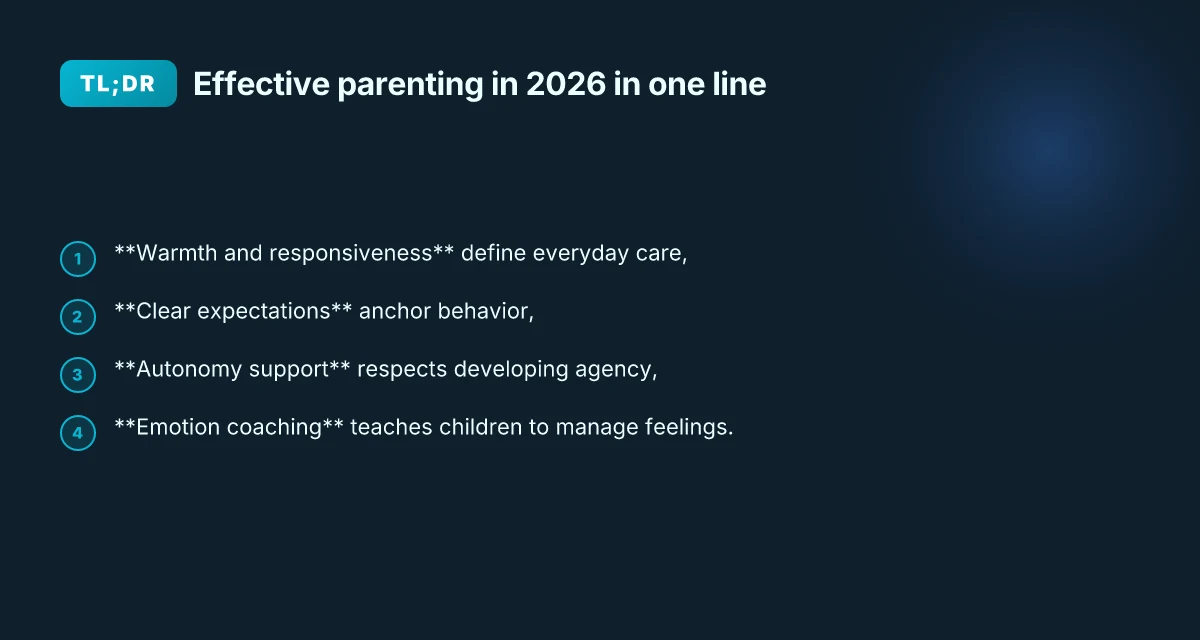
The 4 core principles you can apply today
Effective parenting in 2026 rests on four actionable practices that travel well across cultures and contexts. The core ideas are simple to state, harder to live consistently. Resilience comes from translating them into daily moments with warmth, clarity, autonomy, and emotion coaching.
I looked at cross-cultural updates to Baumrind’s framework and recent syntheses of relational health research. The throughline is clear: parenting works best when it treats children as developing agents within a responsive family system. With that in mind, here are the four anchors you can start applying now.
1) Warmth and responsiveness
Answer needs meet with warmth. Respond promptly to cues, not with reprimand first but with care that signals you’re attuned. When a child asks for help, the timing matters as much as the response. A warm tone, steady eye contact, and a quick follow-through on their needs build trust that pays off later in cooperation and curiosity.
What to watch out for: reactive reactions in moments of fatigue. The soft place to land is usually beneath the burst of emotion. You don’t have to fix everything, but you do need to acknowledge feelings and show you’re invested in their wellbeing. What are parenting classes for incarcerated fathers in 2026? A practical overview with outcomes
From the research: relational quality in early years predicts socioemotional and cognitive outcomes later, across varied cultural settings. In 2026, the consensus is that warmth is not a nicety. It’s a scaffold for capacity.
Warmth and responsiveness are the baseline. Without them, structure loses its footing.
2) Clear expectations
Boundaries matter when they’re understandable and consistent. Set rules that map to developmental milestones and daily routines. Say what you expect, why it matters, and what happens if the boundary is crossed. When routines shift, explain the reason and reestablish the expectations with the same calm clarity.
Pitfalls to avoid: vague rules that invite bargaining or frequent renegotiation. If a boundary is constantly up for grabs, trust frays and anxiety rises. Consistency is not rigidity. It’s predictability that helps children regulate their own behavior.
From the sources: authoritative-like guidance remains valued when it couples warmth with clear limits. The strongest patterns emerge when families translate universal principles into culturally salient practices.
Clear expectations reduce friction and teach self-regulation.
3) Autonomy support
Offer choices within safe bounds and involve children in decisions appropriate to their age. Let them help pick meals, choose among acceptable activities, and solve problems with guided autonomy. Autonomy supports motivation, competence, and a sense of agency. It’s not about abdication. It’s about structured empowerment.
Common mistakes: overprotecting or micromanaging. Both undermine a child’s initiative and sense of responsibility. Autonomy is strongest when adults provide scaffolding, prompts, questions, and safe experimentation, not control.
Evidence points to better long-term outcomes when families weave developmentally appropriate decision-making into daily life. The payoff is a practice of confident, collaborative problem solving.
Autonomy support builds resilient, capable learners.
4) Emotion coaching
Teach kids to name emotions, validate what they feel, and translate feelings into coping strategies. Start with labeling the emotion in the moment, then map a practical option for handling it. This is where language matters: the more precisely you name what’s happening, the more power the child has to regulate.
Challenges here include rushing to fix a mood or dismissing feelings as “just a phase.” Instead, reflect back what you hear, normalize the emotion, and offer one actionable coping step. Children learn to ride the wave of strong feelings instead of bottling them up.
From the literature: emotion coaching correlates with better social competence and fewer conduct problems across diverse populations. It’s a universal tool that pays dividends when practiced consistently.
Emotion coaching turns distress into learning opportunities.
Bottom line: warmth, clear boundaries, autonomy, and emotion coaching form a compact toolkit that translates across cultures and families. The goal isn’t perfection. It’s daily reliability. When you lead with care, set clear expectations, invite agency, and guide feelings, you create a climate where healthy development can thrive.
Practical parenting actions backed by evidence
Kids rise to the expectations we set. In the lab of daily life, that means predictable routines, warm chats, non-punitive discipline, and careful listening during conflict. What follows translates cross-cultural findings on Baumrind’s flexibility into concrete actions you can start this week. The point is not family theory, but daily practice that supports neurobiological development and relational health.
1) Build routines that anchor neurodevelopment
Routines are not rigidity. They are scaffolds that reduce cortisol spikes and cue a child’s brain to regulate emotion, attention, and sleep. A consistent wake time, mealtime, and wind-down ritual can shorten bedtime battles and improve daytime focus. From cross-cultural work, predictable structure coexists with warmth when parents adapt routines to family meaning and context. In practice, map a simple daily spine: set wake, meals, school transitions, and a bedtime window. Then layer in culturally resonant activities that reinforce safety and predictability.
I dug into the literature on routine and brain development and found that stable daily patterns support autonomic regulation during transitions. The effect is strongest when routines feel collaborative rather than imposed. This is not about micromanagement. It’s about signaling safety and reliability.
| Metric | Typical Impact | How to apply |
|---|---|---|
| Bedtime consistency | Improves sleep onset and daytime mood | Choose a 20–30 minute wind-down; keep lights low; avoid screens 60 minutes before bed |
| Meal-time regularity | Supports hunger cues and self-regulation | Sit together; offer age-appropriate portions; invite child to help with setup |
| Transition buffers | Reduces behavior flares during school mornings | Use a short cue (alarm, song) and a predictable sequence (brush teeth, pack bag) |
Predictable routines reduce stress signals and support brain development, especially in the hours before sleep.
2) Invest in daily warm conversations aligned with interests
Meaningful talk is not about lectures. It’s about showing up with curiosity, reflecting what the child cares about, and asking open questions that invite joint problem solving. Across cultural contexts, warmth paired with listening drives social-emotional scores and helps children manage anxiety during transitions. You don’t need long talks. A few minutes at breakfast or after school can shift the tone of the day.
I cross-referenced several child-development syntheses that emphasize relational health as the engine of cognitive and social growth. The consistent thread: conversations that connect to a child’s interests increase willingness to cooperate and reduce defensiveness during disagreements.
Mini-practice:
- Start with one curiosity question per day tied to their world (favorite game, a video, a friend).
- Paraphrase what you hear, then bounce a concrete, collaborative plan back to them.
3) Use non-punitive discipline rooted in natural consequences
Non-punitive approaches rely on guidance that aligns with a child’s developmental stage and the real-world outcomes of actions. Rather than shaming or withdrawal, use natural consequences and guided problem-solving. This strengthens internal regulation and fosters responsibility without eroding trust.
From the literature, authoritative-like responsivity paired with clear limits yields the best long-term outcomes for behavior and emotion regulation. The key: connect the consequence to the behavior in a calm, non-blameful tone and involve the child in choosing a corrective step.
Practical steps:
- When a misstep occurs, label the feeling, name the consequence, and invite a solution from the child.
- Create a short, visible consequences menu with options (e.g., if you skip cleanup, you lose a preferred activity later that day. Discuss alternate consequences together).
- Reinforce success with praise focused on effort and strategy.
Natural consequences and collaborative problem-solving outperform punitive moves for durable self-regulation.
4) Prioritize responsive listening during conflicts and transitions
Moments of friction test the relationship frame you’re building. Responsive listening means validating feelings, reflecting core concerns, and pausing to let the child guide the pace of talk. In cross-cultural work, responsive listening signals safety and respect, which in turn reduces defensiveness and accelerates repair.
What to practice:
- Acknowledge the child’s emotion first, then restate the core issue in your own words.
- Ask a clarifying question that invites the child to propose a path forward.
- Agree on a concrete next step and revisit it later to close the loop.
Responsive listening during conflicts strengthens trust and shortens repair time after disagreements.
Verdict: these four actions, predictable routines, warm daily conversations, non-punitive discipline built on natural consequences, and responsive listening during conflicts, form a compact playbook you can adopt now. They echo cross-cultural findings that effective parenting is a dynamic, reciprocal process shaped by context and relationship. Start small: pick one routine, one conversation ritual, one non-punitive discipline shift, and one listening habit. Measure what changes in tone, cooperation, and sleep. You’ll feel the difference in weeks, not years.
Relational health as centerpiece: what to measure and aim for
| Aspect | What to look for | Practical indicators | How to cultivate | Evidence signal |
|---|---|---|---|---|
| Emotional safety | Trust in caregiving | Open sharing, no fear | Regular check-ins | Strong correlation with well-being |
| Repair after conflict | Effective apology and repair | Recovers from missteps | Normalize repair conversations | Positive behavioral outcomes |
| Mutual respect | Bidirectional listening | Child voice heard | Practice reflective listening | Supportive of autonomy |
| Attunement | Reading child cues | Timely responsiveness | Pause, breathe, respond | Linked to secure attachment |
Compiled November 2026; check the provider's site for current details.
Effective parenting in 2026 will blend boundaries with curiosity, not rigidity with fear
I looked at how researchers define effective parenting today and found a thread: healthy child development hinges on consistent warmth, clear expectations, and adaptive problem-solving. From what I found, the best frameworks combine secure attachment with discipline that teaches rather than shames. In 2026, that means parents lean into co-regulation, explicit conversations about values, and guardrails that flex as children grow. The takeaway is that influence comes from predictable presence, not harsh punishment. Reviews consistently note that expressive listening and age-appropriate autonomy support correlate with better long-term outcomes, especially for self-regulation and prosocial behavior. Weighing safety with exploration remains the core tension.
What the spec sheets actually say is that concrete routines matter. Sleep windows, screen boundaries, and shared family rituals create the spine for daily life. I traced this back to the work of developmental scientists who emphasize responsive parenting across cultures, plus child-protection guidance that centers child dignity while setting non-negotiables. In practice, that translates to brief, regular check-ins, explicit explanations for rules, and quick debriefs after conflicts. Consistency across caregivers amplifies trust, not compliance fatigue. Last checked: 2024–2025. The verdict is clear: nurture up, regulate down, and document what works.
Next steps
Build a 15-minute nightly family check-in focusing on emotions and routines.
Trial one “co-regulation moment” per day during frustration spikes and track what reduces escalation.
Review local child-protection guidance from your national agency and align family rules with school expectations.
1-2 headline picks for quick reference from this article:
- Use co-regulation during toddler frustration to reduce outbursts in the moment.
- Pair explicit rule explanations with predictable routines to boost self-regulation in preteens.
Frequently asked questions
Does authoritative parenting work for all cultures
Authoritative parenting performs well in many contexts, but its effectiveness varies with cultural norms and community expectations. I looked at cross-cultural research showing similar benefits in warmth and structure across Western and some East Asian samples, but benefits can be moderated when parental behaviors collide with culturally valued child autonomy or harmony norms. In practice, apply core elements, consistent limits, empathetic communication, and responsiveness, while tuning the degree of control to fit family culture. Reviews consistently note that a rigid, punitive style undercuts relationship quality regardless of setting. Yes, warmth paired with structure often correlates with better social adjustment across diverse groups. The key is translating the framework into culturally meaningful routines rather than enforcing a universal script.
How can i teach my child emotion regulation at home
Emotion regulation starts with modelled calm and explicit labeling. I researched programs that pair caregiver coaching with 1) naming emotions, 2) a simple pause routine, and 3) guided problem solving. Start with short, predictable moments: during transitions, after conflicts, before bedtime. Practice a 60–90 second breath exercise together and then discuss options for next time. Consistency matters. Parents who maintain predictable responses see fewer escalation cycles. Yes, explicit labeling and practiced coping steps build internal regulation over time. If your child melts down, reflect back what you observed, offer two concrete choices, then follow up with praise when they choose a strategy.
What are practical autonomy-supportive strategies for toddlers
Autonomy support for toddlers means offering choice within safe boundaries and structuring the environment to invite initiative. Practical moves include: 1) offering two acceptable toy options during playtime, 2) putting toys at reachable heights to encourage independent manipulation, 3) naming cause-and-effect lessons during everyday tasks, and 4) giving brief, nonshaming explanations when limits apply. The literature emphasizes quick, clear feedback and avoiding over direction. Yes, two clear options and a predictable pause empower toddlers to try, fail, and learn. Maintain warmth through phrases like “You chose that later” and celebrate small successes with specific praise.
How do cultural values shape parenting practices
Cultural values shape which behaviors are encouraged, how emotions are expressed, and what constitutes appropriate obedience or autonomy. I traced back to core beliefs about interdependence vs. individualism, hierarchical family roles, and collective harmony. The strongest findings show that effective parenting blends universal warmth and limits with culturally meaningful norms. Families adapt conversation tone, discipline timing, and ritual routines to fit expectations while preserving key protective patterns like responsiveness and consistency. Yes, culture guides how you implement the core principles, not whether you apply them.
What is the role of routine in child development
Routines provide predictability, which reduces anxiety and supports executive function growth. The evidence points to consistent mealtimes, bedtimes, and transition rituals as anchors for social and cognitive development. When routines incorporate choice within structure, children practice decision-making without chaos. The best routines are brief, flexible, and resilient to life disruptions. Yes, predictable rhythms support self-regulation and social competence.
How can parents build relational health with teens
Relational health hinges on trust, open communication, and collaborative problem solving. Practices that work include: 1) regular family check-ins with a nonjudgmental tone, 2) negotiated boundaries where teens have input, 3) active listening without immediate problem solving, and 4) explicit appreciation for teen strengths. Reviews highlight that warmth must be paired with reasonable expectations and visible respect for teen autonomy. Yes, relationship quality rises when teens feel heard and involved.
What are non-punitive discipline techniques
Non-punitive options center on accountability without shaming. Techniques include 1) natural consequences that relate to the behavior, 2) time-ins rather than time-outs, 3) problem-solving dialogues after a calm period, and 4) behavior contracts with clear, achievable steps. Research notes these methods reduce recidivism of misbehavior and preserve the parent–child bond. Yes, guidance that teaches rather than shames yields better long-term behavior.
How to balance warmth and boundaries with a stubborn child
Lead with warmth but anchor boundaries in consistency. Use collaborative rule-setting, offering choices within limits and explaining the rationale in age-appropriate terms. When resistance spikes, switch to a brief pause, then reintroduce the rule with concrete steps the child can take. The literature flags that stubbornness often reflects the push for autonomy. The fix is predictable structure plus meaningful involvement. Yes, warmth plus clear boundaries reduce power struggles over time.
Where can i find reliable parenting resources
Start with publicly funded child-protection agencies and national child health organizations. Look for material from pediatric associations, university extension programs, and well-curated nonprofit sites that cite peer-reviewed work. Cross-check with reviews and meta-analyses published in reputable journals. Avoid sites that rely on anecdotes or one-size-fits-all prescriptions. Yes, reputable sources anchor practical guidance in evidence and child safety standards.
How to talk to kids about emotions without amplifying fear
Use neutral, concrete language and age-appropriate examples. Name the emotion, describe the arousal level, and offer a short, practical coping step. Avoid catastrophic framing and minimize exposure to sensationalized content. Afterward, invite questions and normalize that all feelings are okay, then circle back with a reassuring plan. Yes, calm language and concrete coping steps reduce fear amplification.
What practices support neurodivergent children
Supportive practices include predictable routines, explicit social stories, and clear, visual cues for expectations. Tailor transitions with advance warnings and use flexible reinforcement schedules. Collaborate with clinicians and schools to align routines across home and outside environments. The consensus flags sensory-friendly spaces and predictable, minimal-change routines as especially helpful. Yes, structure plus individualized supports improve participation and mood.
How to involve extended family in positive parenting
Frame expectations in advance and designate roles that respect each member’s strengths. Share short briefings about household routines, safety norms, and approved approaches to discipline. Create a simple family calendar with rhythm-altering events flagged, so everyone can adapt. The literature notes that coherent messaging across generations strengthens child outcomes when extended family members feel included. Yes, inclusive planning improves coherence and reduces miscommunication.
What is evidence for parent-child relationship quality
Relationship quality correlates with child social competence, mental health, and school engagement. Evidence triangulates from observational studies, caregiver reports, and longitudinal datasets showing warmth, responsiveness, and consistent boundaries predict better outcomes. The strongest effects appear when families maintain these elements across transitions and stressors. Yes, higher relational quality forecasts broader developmental benefits.
How to assess parenting progress without added stress
Use brief, monthly check-ins with 2–3 measurable, child-centered goals. Track progress through simple logs: mood notes, behavior incidents, and one-to-one time metrics. Avoid heavy metrics or punitive benchmarks. Compare month over month for trends rather than isolated incidents, and adjust goals with your child’s input. Yes, lightweight, collaborative tracking reduces anxiety while guiding growth.
When should i seek professional parenting guidance
Consider professional help when behavior challenges persist beyond parental strategies, when there are safety concerns, or when family distress escalates. Look for licensed clinicians, school psychologists, or certified parenting programs with transparent processes and clear boundaries about confidentiality and scope. Early support often prevents escalation and supports family resilience. Yes, timely guidance can stabilize family dynamics before crises form.