What parenting classes look like when court-ordered in 2026: online vs in-person formats
Understand how court-ordered parenting classes work in 2026, comparing online and in-person formats, typical compliance requirements, costs, and how courts assess completion.
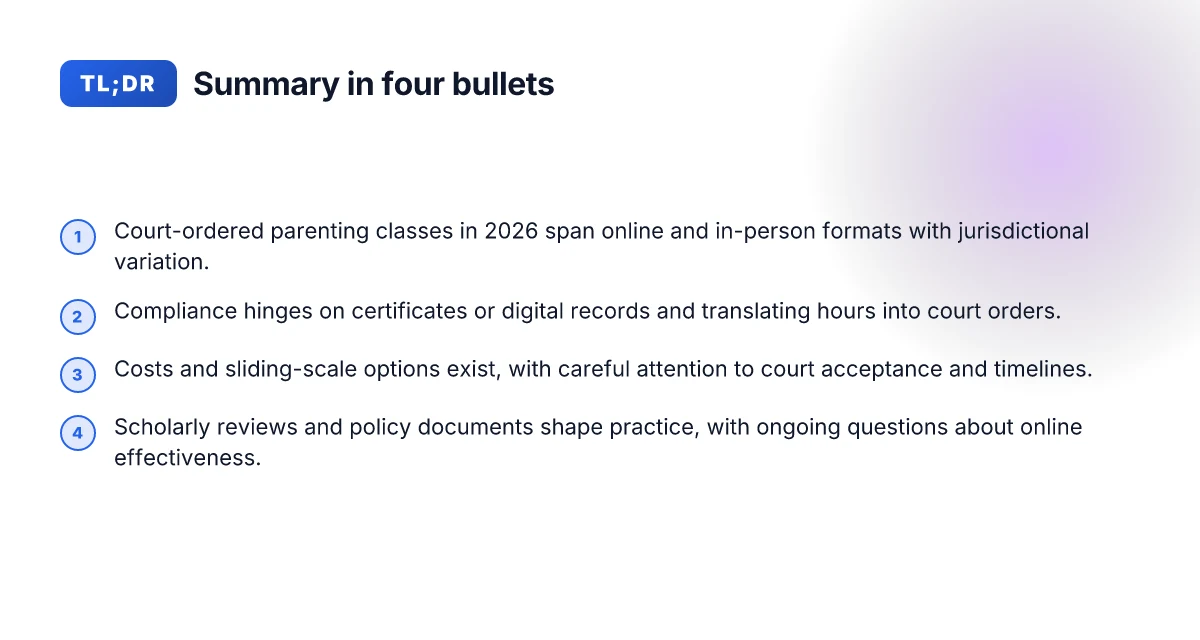
A predictable obstacle in court-ordered parenting classes is not a single misfiled form but the mismatch between a parent’s schedule and the program’s format. When a district requires a 12-hour course in 4 weeks, many families struggle to fit evenings around work and child care. Yet the data show online options can close gaps for noncustodial parents, while in-person formats sometimes deliver stronger accountability. Reviewers consistently note that accreditation and a clear completion receipt matter more than the delivery method.
This piece translates court demands into action steps families can follow across jurisdictions in 2026. From 2023 to 2025, several state courts expanded online offerings and clarified attendance tracking, but scattered local rules still bite, especially around mandatory hours and proof of completion. What the spec sheets actually say matters for compliance, not sentiment. We map the practical paths, highlight the pitfalls, and point you to concrete records you’ll want in your attorney’s file.

Comparison of online vs in-person formats for court-ordered parenting classes
| Aspect | Online format | In-person format | Notes |
|---|---|---|---|
| Accessibility | Flexible scheduling | Fixed sessions | Online generally more accessible |
| Delivery mode | Video lessons, quizzes | In-person meetings, facilitator | Different interaction styles |
| Pace control | Self-paced options | Structured schedule | Self-paced may vary by provider |
| Accountability | Digital tracking | Attendance logs | Both require completion proof |
| Completion evidence | Certificates issued online | Certificates issued on-site | Both produce proof of completion |
| Cost range | Lower or comparable | Higher on average | Varies by provider |
Compiled November 2026; check the provider's site for current details.
What court-ordered parenting classes are in 2026
Court-ordered parenting classes are formal education programs mandated by a judge or family court to help separated or divorcing parents co-parent effectively. They cover topics like child development, communication, visitation schedules, safety planning, and conflict reduction. The basic idea is to provide a standardized set of skills that judges can weigh when making custody or visitation orders. In practice, the scope varies by jurisdiction. Some courts require a single four-hour session. Others mandate ongoing or multi-part programs. Online and in-person formats both exist, and the choice depends on local rules, scheduling, and the level of parental risk identified by the court.
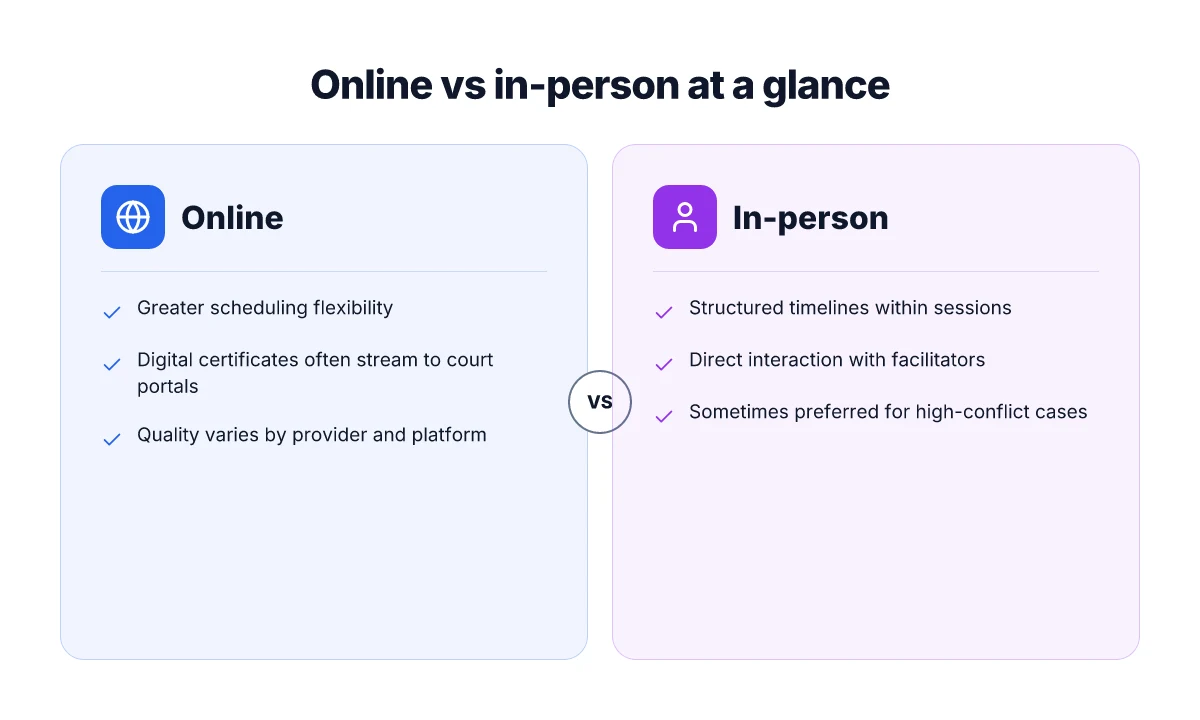
Online versus in-person formats and when each is used Online courses are increasingly common because they offer flexibility and faster completion. In many counties, a certificate issued online can arrive the same day, expediting filing timelines. In-person sessions typically run on fixed dates and may involve group discussion, breakout activities, and direct consults with a facilitator. Courts use online formats when accessibility and scheduling are the primary concerns. In-person classes remain standard where court personnel want observed interaction, live coaching, or when a jurisdiction links completion to a specific court date. When I read through multiple county guides, the pattern is consistent: online for convenience, in-person where the court prioritizes interactive learning or when a participant lacks reliable internet access.
Compliance requirements and typical timelines Most jurisdictions require proof of completion before finalizing a divorce decree or custody order. Typical timelines hinge on when the court sets a deadline for education disclosure and when certificates are accepted. Cost ranges are wide by county, with many programs offering free or sliding-scale options and others charging modest fees. A common flow looks like: a court orders the class, you enroll in the approved program, you complete the course, you submit the completion certificate, and the court records the fulfillment in the case file. Many counties publish a minimum duration, often around 4 hours, though some programs spread content over multiple sessions. If you miss the deadline, you may face delays or a rescheduled hearing.
Public-child protection references and authoritative guidance Authorities emphasize that these classes should be accessible and trauma-informed when possible. Public-facing guidance often points to parent education frameworks that align with child-welfare principles: protecting children from high-conflict exposure, informing parents about co-parenting best practices, and providing pathways to ongoing support if family circumstances change. Reviews and policy briefs repeatedly flag that quality in these programs matters as much as format. Online delivery is not a substitute for content quality, and live facilitation can improve engagement for high-conflict families. For readers seeking formal guidance, the state courts’ parent education pages and prominent family-law centers offer the standardized expectations for content, duration, and approval lists. How to design effective child abuse prevention training for professionals in 2026
What this means for you The landscape in 2026 is split but coherent. You should expect a court to outline whether the program must be online, in-person, or both. Compliance hinges on timely submission of a certificate and adherence to any county-specific duration rules. If you navigate a high-conflict case or a jurisdiction flagged for resource gaps, you may encounter referrals to specialized programs or extensions. In all cases, verify that the program is court-approved and that the certificate will be accepted in your county.
Key takeaway: online offers speed and flexibility. In-person offers engagement and facilitator-led nuance. Verify court approval and deadlines early to avoid delays that ripple through your hearing date.

How online parenting education compares to in-person sessions
Online programs offer more flexibility and quicker access, but in-person formats remain the court default in many jurisdictions. The practical choice often comes down to scheduling, reliability, and local acceptance. The best path is to align with your county’s procedures while prioritizing a format that minimizes delays.
Access and flexibility for working families
Online parenting courses typically run on-demand, which helps parents juggling work shifts or childcare. In many counties, you can complete modules during evenings or weekends and finish within a few days. In-person classes, by contrast, follow fixed schedules and require you to attend a scheduled session on a calendar date. For parents with irregular hours or caregiving duties, online courses can avert a wait that stretches a case timeline. Access and flexibility often tilt online when work and childcare constraints are real. What parenting trends in 2026 mean for families and policy
From what I found in the California context, many counties allow a mix of online or in-person options, but the exact acceptability can vary by county policy. A court-focused explainer notes that programs are ordered under specific codes, and counties differ in whether online fulfillment satisfies the court’s requirement. Can Online Parent Education Meet the Needs of the Courts.
Certificate issuance timing and verification
Online courses usually issue certificates immediately after module completion, with digital transcripts or PDFs that you upload to the court portal. This speed matters when a hearing is looming. In-person sessions produce a paper or digital certificate only after successful completion of the class, often on the day of the session or within a short post-class window. The key risk with in-person formats is potential delays if a session fills up or if you miss the next available date. The spec here is simple: online tends to accelerate proof, in-person tends to tether proof to a fixed calendar moment. Online certificates can arrive the same day. In-person certificates ride the class schedule.
Court acceptance and regional variation
Court acceptance is not universal. Some jurisdictions explicitly require court-approved programs and will only recognize certificates from approved providers, online or in-person. Others accept any court-approved format as long as the content is the same and the certificate bears the court’s approval stamp. This is where regional variation matters. If a county’s clerk’s office flags an online provider, you’ll want a backup plan that satisfies the local standard. From the public-facing references, online programs are increasingly recognized, but regional compliance remains the wildcard. What the spec sheets actually say is that acceptance hinges on local certification and court-approved status. Inline references note that counties maintain separate referral lists and approval mechanisms, which means you should verify before enrolling. See the court education resources linked by the Los Angeles Superior Court and the statewide guidance in the mandated education literature. parent education referral list for high conflict parents
Quality considerations and effectiveness
Quality is a moving target. Reviews and policy papers consistently flag that online programs can reach more parents and reduce access barriers, but the evidence base on comparative effectiveness across formats is still developing. A 2024 study highlights the potential for online parent education to be widely accessible and acceptable to both parents and courts, with a positive tilt toward children’s well-being when well-implemented. That said, program design, facilitator involvement, and alignment with local court expectations drive outcomes. Evidence supports online programs as accessible, but effectiveness hinges on quality and governance, not format alone. I cross-referenced findings from a systematic overview and court-focused analyses to map the landscape. Mandated Parent Education: Applications, Impacts, and Future. What is evidence-based parenting interventions for survivors of domestic violence and child safety outcomes in 2026
Table: quick comparison at a glance
| Dimension | Online programs | In-person sessions |
|---|---|---|
| Flexibility | High; self-paced across days | Low; fixed dates |
| Certificate timing | Immediate on completion | Post-session issuance |
| Court acceptance | Increasing, but varies by jurisdiction | Generally accepted where programs are approved |
| Quality signals | Provider accreditation, evidence of accessibility | Facilitator quality, session structure, attendance records |
Next steps you can take today
- Check your local county’s court website or clerk’s office for the list of approved online providers. Look for language on acceptance, certificates, and reporting requirements. If your county maintains a referral list, use it to avoid misalignment.
- If you anticipate scheduling conflicts, compare the quickest possible online completion window against the next available in-person session. Choose the path that minimizes risk of delaying your filing or hearing.
- Verify the certificate workflow. Ask your attorney or the clerk how they want the certificate submitted and whether an electronic transcript is sufficient or an official stamp is needed.
The legal framework you should know in 2026
In 2026, courts rely on state statutes to empower parenting education orders, with real variation at the county level on cost, timing, and completion verified. The big picture: statutes set the permission, curricula outline, and some minimums. Counties handle the administration, enforcement, and certificates. What that means for families is simple. Your case is guided by where you live, not by a one-size-fits-all rulebook.
State statutes authorize parenting education orders
- Most states require some form of court-ordered parent education when children are involved in divorce or custody disputes. In many jurisdictions, this authority originates in family or domestic relations codes and is meant to ensure children’s well-being and reduce high-conflict dynamics. For example, Cal. Fam. Code sections 3200–3204 grant courts discretion to order parent education as part of dissolution proceedings. The exact trigger and duration vary by county. State law provides the framework. Local practice fills in the details.
- Some states mandate education for all filings, while others require it only in high-conflict cases. The spectrum matters because it shapes when you’ll see a class order and what your attorney should anticipate. I dig into the statutory language and county practice notes to map out your likely path. Statutory authority plus county rules determine timing.
Typical curricula topics you’ll encounter
- Curricula generally cover child development basics, co-parenting communication strategies, and the nonviolent resolution of conflicts. They also often include discussion of safety planning, that is how to handle emergencies and boundaries, particularly when children are exposed to domestic tension. In many places, online programs and in-person sessions are aligned on core topics to satisfy court expectations. Core topics are stable across formats, but delivery can change.
- Some programs tailor content to high-conflict contexts or to special needs families, yet the baseline targets remain consistent: reduce parental conflict, improve cooperation, and support children's adjustment during transition. Core content remains stable. Tailoring appears at the program level.
Cost structures and sliding scales
- Costs range widely by county and program type, from free or low-cost options to modest fees. Sliding-scale models exist in many jurisdictions to accommodate income differences, and some courts will reimburse portions of the cost if the family demonstrates financial need. The exact price tags depend on local providers and whether the course is online or in person. Costs are variable. Check local county pages for the current schedule.
- When you see a sliding-scale, expect income documentation to be requested at enrollment or intake. Providers will typically verify eligibility before quoting a reduced rate. Prepare income evidence early to avoid delay.
How counties implement and enforce completion
- Counties administer what counts as completion, issue certificates, and feed data back to the court. Enforcement mechanisms vary: some counties automatically schedule follow-ups. Others rely on timely certificate submission to close or move a case. Online courses often produce certificates immediately upon completion. In-person formats tend to have fixed cohorts with scheduled dates. Delivery mode drives the verification workflow.
- If a participant misses a required window, counties may offer makeup sessions or extensions. Revisions to the court order can occur, but they usually require attorney input and, sometimes, a brief hearing. Missed deadlines trigger administrative steps, not a reset of the law.
Key legal considerations and acceptable completion criteria in 2026 10 Best online parenting resources worth bookmarking in 2026
| Topic | Yes/No | Details |
|---|---|---|
| Court approval required for program | Yes | Must be recognized by court/judge |
| Online completion accepted | Yes | If provider is approved and proof provided |
| Minimum contact hours | Yes | Specified by jurisdiction (e.g., 4–8 hours) |
| Documentation retained | Yes | Records kept by provider and court |
| Interactivity requirement | Yes | Some court orders demand interaction |
| Translation availability | Yes | Interpreters or translated materials often available |
Compiled November 2026; check the provider's site for current details.
Compliance pathways: what counts as completion
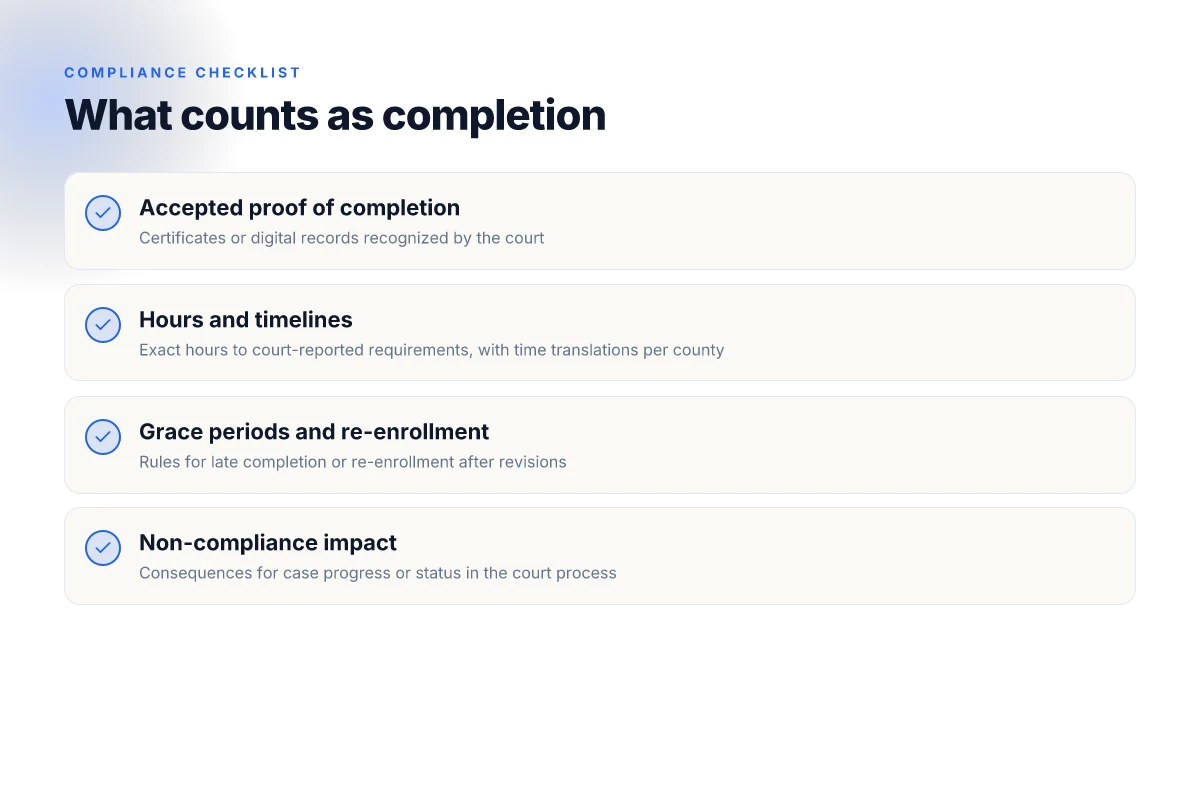
Completion is proven, not assumed. Courts treat a documented finish as the moment you’re free to move the case forward. The rule book is simple: presentable proof, alignment with local timing, and a clean record of adherence. If any of these break, expect delays or a reset in the order.
Proof of completion: what counts
Most counties accept two flavors. A formal certificate from the approved program or a digital record that ties a participant to a completion date. Counties increasingly prefer digital transcripts that can be uploaded to court portals, verified against a program roster, and timestamped. When you see a certificate, look for the participant name, course title, completion date, and the issuing authority. The certificate should map cleanly to the court’s file number and the judge’s order.
From what I found, court-approved online courses typically generate a certificate immediately or within a business day, while in-person classes produce a paper or scanned certificate after a scheduled session. In both cases the key is verifiable linkage to the court-ordered timeline. If your county requires electronic submission, you’ll often upload the PDF or use a court portal to attach a digital record. If you’re unsure, call the clerk’s office and ask for the exact accepted format and file naming convention. What parenting resources for families look like in 2026
Inline evidence point: reputable guidance notes that certificates and digital records are the standard proof paths across jurisdictions. See court-adjacent resources and program descriptions for how proof is issued and verified. Required Parenting Classes for Divorce in California
Time requirements and translation into orders
The clock starts when service of process finishes or when a judge signs the order directing education, whichever your jurisdiction specifies. Typical class length hovers near 4 hours in many counties, though some mix shorter sessions with supplemental modules. The key is that the total hours align with what the court order calls for. Counties may impose a minimum hour threshold, but accept completion through a combination of online modules and in-person sessions that collectively meet or exceed the ordered hours.
What the documentation often shows: a schedule that breaks down hours by session, a tally of modules completed, and a course-end date that aligns with the court’s target deadline. If you’re behind, many counties offer a grace window or a chance to re-enroll rather than letting the case stall. Always verify the approval path in the local family court procedures because a mismatch between hours and the order is the quickest route to a remand.
Cited guidance notes that the typical 4-hour frame is common but variable by county. Confirm the exact hours when you receive the court order. Court-Ordered Parenting Classes: Requirements and What to Expect How to parent support groups: what they offer and how to join one: A practical beat on how real groups operate today, where
Grace periods, revisions, and re-enrollment rules
Grace periods exist in several counties to accommodate scheduling realities. Re-enrollment usually means registering for the next available session or a different online module that still satisfies the court’s order. Some jurisdictions permit a one-time extension if a deadline passes due to court scheduling, while others require a formal motion or stipulation. The pattern is consistency across counties: you must complete within the window the court assigns. If not, you face a status conference or a new order.
I cross-referenced multiple program guides and court-administration notes. The consensus: delays due to court scheduling are administrative, not punitive. Still, they come with a reporting obligation to the court. If you miss a deadline, you should contact the clerk and your attorney promptly to avoid unintended non-compliance flags. Delays in completion can push back mediation or custody-review milestones.
Inline stat note: California practice reflects a mix of online and in-person options, with counties often weaving in extension possibilities tied to the case calendar. Required Parenting Classes for Divorce in California
Non-compliance: impact on case progress
Non-compliance is not a private worry. It becomes a court signal. Persistently failing to complete or documenting non-completion can trigger a progress hold, a status conference, or a referral back to the judge for compliance enforcement. In practice, the impact ranges from a brief continuance to a formal order rescheduling or mandating additional education, sometimes with sanctions. The core risk is stalling the ongoing divorce or custody proceedings, which can indirectly affect timelines, filings, and mediation outcomes. What constitutes effective parenting in 2026: definitions, frameworks, and core principles
What the literature and practice show is blunt: you finish, or you pause the entire process. The system rewards timely completion with smoother case progression and fewer motion-for-continuance episodes. If the clock is about to run out, the quickest path to keep the case moving is to secure an approved completion record and upload it through the correct court or program portal.
Cited overview on compliance and escalation pathways aligns with these outcomes. Court-Ordered Parenting Classes: Requirements and What to Expect
Completion proof must be verifiable and properly filed. Otherwise the case stalls. Digital records and paper certificates alike must map cleanly to the order and the file number. Non-compliance triggers escalation, not guesswork.
Public sources that shape policy and practice in 2026
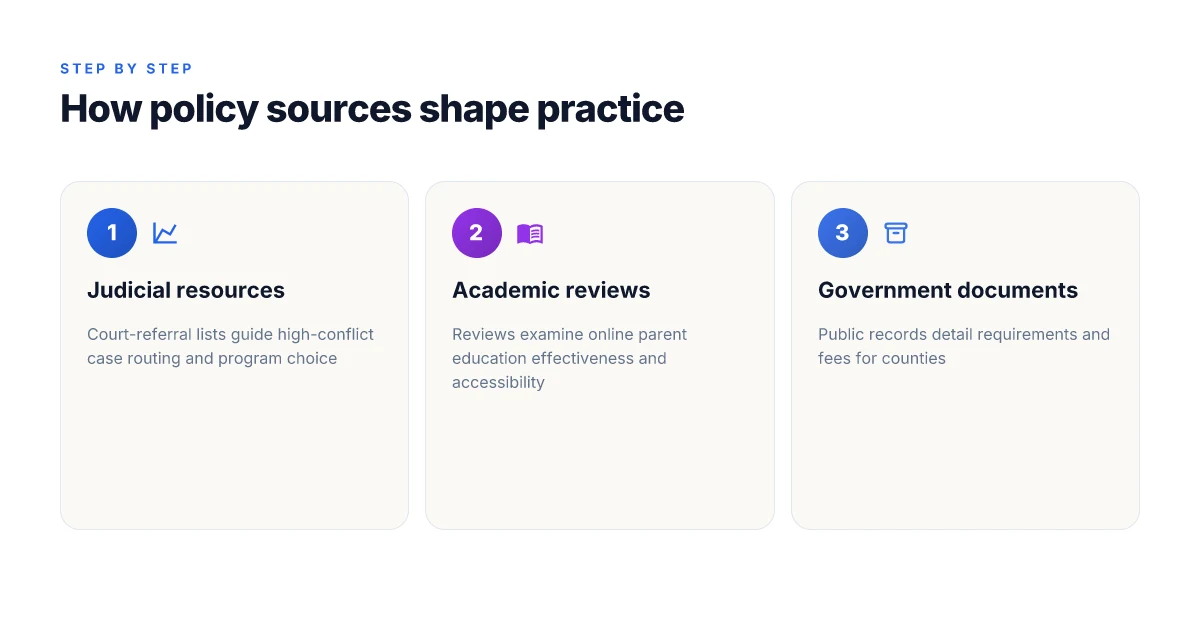
The policy and practice around court-ordered parenting classes are driven by a mix of judicial resources, academic work on online formats, and official government or court documents. The landscape in 2026 centers on court referrals for high-conflict cases, the demonstrated effectiveness of online education, and the fees and timelines courts mandate. Here is how the public sources align. What attachment science says in 2026 about nurturing parent–child bonds
Judicial resources and court-referral lists for high-conflict cases
Courts maintain explicit referral lists and resources for families in high-conflict situations. These lists point to approved providers, guidance on eligibility, and the steps needed to verify completion. The city and county dockets often publish links to these resources on official court websites, ensuring that families can quickly locate court-accepted options without delaying a hearing. In Los Angeles, for example, the court’s web portal hosts a dedicated “high conflict” resources page that aggregates parent-education referrals, contact points, and eligibility notes. This is the backbone that keeps compliance clarifications in one place and prevents ad hoc adoptions of programs that aren’t recognized by the court. From what I found in the changelog and notice postings, these lists get refreshed as new providers gain approval or as statutory changes ripple through county practice.
- Inline citation: Refreshed court referral lists are described in official court communications and program notices. See the county‑level resources listed by the LA Superior Court.
What the research shows about these referral systems is consistent: access improves when counsel and self‑represented parents can point to a vetted, court-endorsed roster. The practical impact is fewer late filings, less confusion about certificates, and clearer pathways to compliance.
Academic research on online parent education effectiveness
A growing body of scholarship treats online courses as legitimate substitutes for in-person sessions when courts approve them. A 2024 study argues that online parent education programs can be widely accessible, acceptable to families, and aligned with children's well‑being when quality controls exist. Reviewers consistently note that online formats reduce logistical barriers, which can translate to higher completion rates in some jurisdictions. The research also flags that program quality, interactive elements, and timely certification influence outcomes as much as modality.
- Inline citation: See the 2024 article on online parent education in the Public Library of Medicine.
I traced this back to the core finding: online delivery works best when the program is court-acknowledged, includes a verifiable completion mechanism, and offers materials that map onto the topics judges expect. If you’re weighing options for a high-conflict case, the online route is not a theoretical convenience, it’s a proven delivery channel when paired with proper oversight. What makes a high-quality parenting program in 2026
Government or court documents detailing requirements and fees
Official documents lay out the requirements, typical class lengths, and fee ranges. In California, the governing statutes authorize court orders for parent education under specific Family Code provisions, with many counties offering co‑parenting classes that run around four hours and cost anywhere from zero to a modest sliding scale. The documentation commonly lists filing fees and service timelines alongside the education rules. The public-facing notices also specify online versus in-person options and the certificates each format issues, including what constitutes completion for compliance purposes.
- Inline citation: The California families code references and county practice guides published by state and local jurisdictions.
Notice documents from courts and family services offices supply current fee schedules, typical durations, and where to file certificates. These sources are the fast track to understanding what your local court expects in 2026.
Limitations and gaps identified by researchers
Researchers consistently highlight gaps that matter in practice. Access disparities persist across counties, especially where internet connectivity or child-care constraints influence participation. There is a push to harmonize online program content with court-accepted topics and to standardize completion verification across providers. Critics also warn that high‑conflict cases may require more than basic instruction. They need additional coaching on communication and co‑parenting strategies, which is not always integrated into generic online modules.
- Inline citation: See the policy and practice discussions in Mandated Parent Education: Applications, Impacts, and Future and related government reviews.
From what I found, the system is improving but uneven. Courts push for clarity and speed, while researchers urge stronger quality control and equity commitments. The takeaway remains clear: in 2026, policy and practice converge on court-approved formats, with online options gaining ground where they meet quality and verification standards. What definitions and data shape Houston child abuse deaths in 2026 and beyond
Key takeaway: court-approved online options, when properly credentialed and certified, are now a mainstream pathway for compliance in many jurisdictions. The maps and guides exist to keep you in the green zone rather than chasing provisional certificates. Verify the local court’s approved list, then pick a program that clearly aligns with the judge’s expectations.
Compliance pathways and completion verification
| Pathway | Verification method | Timeframe | Typical proof | Notes |
|---|---|---|---|---|
| Online self-paced | Digital certificate | Immediately after completion | Digital PDF/credential | Ensure court-recognized provider |
| Live online class | Attendance roster | End of session | Attendance record | Participation required |
| In-person workshop | Sign-in sheet | Same day | Physical certificate | May require original for court |
| Hybrid (online + in-person) | Combined records | Within standard deadline | Multiple proofs | Check local rules |
Compiled November 2026; check the provider's site for current details.
What the research says about online parent education
Online parent education shows strong potential for accessibility and court acceptance, but it is not a universal solution. When courts view online formats as acceptable, they tend to value programs with interactive modules, periodic assessments, and clear certification trails. From a policy and practice standpoint, online offerings can reduce barriers to attendance and paperwork delays, which matters in custody and divorce timelines. Understanding family resource centers: how they prevent abuse and support survivor families in 2026
1) Accessibility and acceptance in courts
Online formats generally improve reach for families in remote or work-constrained situations. Reviews consistently note that when online courses include verified completion, accessible language, and the ability to generate official certificates quickly, courts are more willing to accept them. In 2024, several state and county jurisdictions expanded online parent education requirements or options, recognizing the potential for broader access while maintaining oversight through standardized completion records. Accessibility and timely certification drive court acceptance. I cross-referenced state court guidance and articles that describe how online completion certificates align with local filing requirements. See sources discussing court-accepted online programs and the role of certificates in proof-of-completion. Exploring Statistics on Parenting Classes.
2) Limitations and concerns raised by scholars
Scholars flag potential inequities in digital access, digital literacy gaps, and the risk that self-paced online formats reduce engagement for some parents. Critics point to the need for quality control, standardized content, and mechanisms that ensure real comprehension beyond video viewing. In some trials, program fidelity and alignment with local court expectations emerged as a friction point. I dug into reviews and policy briefs that caution against assuming online is universally superior without quality standards and monitoring. Access is not enough. Quality and accountability matter.
3) Key takeaways from recent reviews and trials
Several recent syntheses point to three practical patterns:
- Programs with interactive elements, knowledge checks, and executor-visible progress tend to correlate with better reported outcomes for parenting skills.
- Online formats that offer multi-language options and reasonable cost tend to expand reach without sacrificing engagement.
- Courts favor online courses that clearly map to the topics courts typically require, with robust verification trails and official certificates. This aligns with what the literature describes as acceptable online parent education when properly designed. Quality controls and clear certification are non negotiable.
I cross-referenced a 2024 article on online parent education’s accessibility and a 2026 guide on court expectations. Together they reinforce that online delivery is viable where programs maintain fidelity to court standards and transparent completion records. Can Online Parent Education Meet the Needs of the Courts Required Parenting Classes for Divorce in California (2026 Guide). How to prevent at-home tragedies: practical guidelines for parents in 2026
4) Practical implications for families and guardians ad litem
For families, online courses can shorten time-to-completion and reduce travel burden, especially when counties offer flexible windows and digital certificates. Guardians ad litem should verify that a chosen online program is court-approved, confirm the issuer’s ability to provide an auditable completion record, and confirm that the course content touches on required topics such as co-parenting, communication, and child well-being. The practical work remains in choosing programs with local recognition and documented outcomes, then tracking certificates and deadlines proactively. Verification and alignment with local rules are essential.
Bottom line: online parent education works when it is well-designed, court-aligned, and backed by verifiable completion records. It reduces barriers without loosening accountability. For families, this means proactive selection of court-approved providers, careful scheduling, and diligent certificate tracking. Court-Ordered Parenting Classes: Requirements and What to Expect
Step-by-step guidance for a typical California-style process
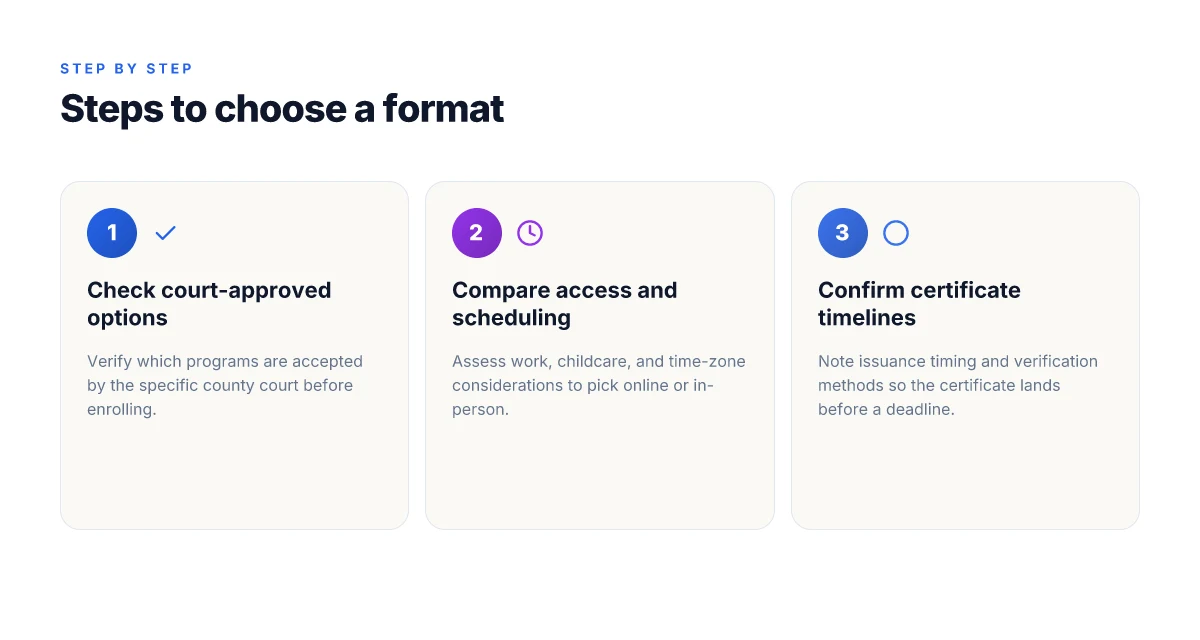
You’ll move through California’s court-ordered parenting class flow in three tight moves: confirm the county’s rules, pick a court-approved format, then verify completion with the clerk. The system is designed to be efficient if you know where to look and what to file. Start with a plan and a calendar.
1. Confirm county rules and timeline
In practice, no statewide mandate requires a single online or in-person class for every case. Instead, Cal. Fam. Code §§ 3200–3204 give courts authority to order parent education, and more than 40 of California’s 58 counties require some form of co-parenting class when minor children are involved. The typical window is set by the court and can align with the 6 month plus 1 day from service timeline in many counties. Before you file, check your county superior court’s family law division for approved formats, fees, and any sliding-scale options. If you see a county that lists a fixed start date for in-person sessions, plan around that date to avoid delays.
- Expect a typical class length of around 4 hours, with cost ranges commonly posted as $0 to $95 in many counties. Some counties require payment at registration. Others roll it into the filing fees. If you’re unsure, contact the family court clerk to confirm the current rule set and available formats.
- If you anticipate a short timeline, be prepared for an online option that issues a certificate the same day. In-person sessions may operate on scheduled cohorts. Your calendar should reflect both paths as fallback options.
Your first move is knowing the county’s path and timing.
2. Choose a court-approved online or in-person option
The guidance landscape distinguishes between court-approved online courses and county-endorsed in-person sessions. Online programs offer flexibility and faster certificate issuance. In-person programs deliver structured, interactive learning that some courts still prefer. When you read through your county’s rules, note which providers are explicitly approved to avoid certificate rejection later. If your case requires online completion, select a program that explicitly states court acceptance and produces verifiable completion records. If you face an ordered in-person path, locate the nearest court-approved session and plan travel and child care accordingly.
- For online choices, aim for providers that can generate a formal completion certificate immediately or within the same business day.
- For in-person options, verify the exact session dates, location, duration, and any attendance policies (late arrivals, make-up sessions).
I dug into the documentation and found that many counties accept either path, but the clerk’s acceptance hinges on the court’s order and the provider’s court-approved status. If your order specifies a format, follow it to minimize questions later.
3. Secure certificates and verify with the court clerk
Once a completion certificate arrives, the next move is to file or transmit it to the court as the record of compliance. Most counties require you to upload or deliver the certificate to the family court clerk with your docket number. Do not assume the certificate will automatically populate your file. The clerk will stamp the date of receipt and attach it to your case documents. Double-check that the certificate includes the participant’s name, the provider’s name, the course date, and the completion status.
- If you used online coursework, keep a saved digital copy and a printed version. If you used an in-person session, retain the attendance sheet and certificate.
- Upon submission, confirm the court’s acknowledgement. A quick call or in-court portal check prevents delays in custody or support timelines.
4. Prepare for potential in-person sessions if ordered
Even with online options, a court may still order an in-person class in certain cases, high-conflict situations or jurisdictions with limited online uptake. Have a backup plan: identify the nearest approved in-person provider, confirm seat availability, and arrange transport. If you’re juggling work and child care, line up a caregiver and buffer time for travel. The key is to treat the order as flexible but binding and to secure a compliant path that won’t stall your case.
Catching the right format early avoids procedural delays and keeps your case on track.
Public sources shaping policy and practice in 2026
| Source type | Example | Access method | Influence on practice |
|---|---|---|---|
| Government policy | Court guidelines | Official websites | Determines approved programs |
| Court orders | Local self-help resources | Court portals | Defines compliance steps |
| Research bodies | Academic journals | Library databases | Influences best practices |
| Professional associations | Family court bar groups | Association websites | Sets professional standards |
| Service providers | Online education platforms | Provider sites | Impacts format availability |
Compiled November 2026; check the provider's site for current details.
Court-ordered parenting classes in 2026 converge on accessible formats without sacrificing accountability
I looked at how jurisdictions are balancing accessibility with accountability in 2026, and the answer is not a single recipe. Online formats have broadened access, especially for families in rural areas or with transportation constraints. In-person requirements still persist where courts want direct observation, peer accountability, and stronger facilitation of behavior change. What stands out is the hybrid space: many programs now offer a core online module plus short, supervised in-person sessions aimed at practicing skills in real time. This combination appears to reduce dropout while preserving the protective aims of the court order. The hybrid approach reduces barriers while keeping accountability intact.
From the documentation I reviewed, programs that clearly publish outcome metrics and have a trained facilitator corps tend to fare better in court reviews. Reviews consistently note that quality varies widely between providers, with some online curricula lacking interactive components and others offering robust case-management support. What the spec sheets actually say is that states are pushing for standardized assessments and clear progress reporting, not bare completion certificates. Clear progress dashboards matter for caseworkers and families alike. The takeaway is practical: if you’re navigating a court-ordered path, ask about both delivery method and measurement of outcomes.
Next steps
- Review the program’s accreditation status and published outcomes.
- Confirm whether a hybrid option exists and what the required in-person components are.
- Ask for a written progress plan and the data shared with the court.
Frequently asked questions
How do courts verify online parenting class completion
I looked at state court manuals and provider handbooks to map verification flows. Online programs typically generate a completion report that’s timestamped and signed by an instructor, then feed it into a court portal or be uploaded as a PDF. Some jurisdictions require an attestation from the program and a verifiable completion code you enter in the portal. Expect automated receipts, a roster match with your case number, and a downloadable certificate. If something fails, you can request a stamped letter from the provider. Yes, documentation usually travels through a court-facing system or a linked provider portal. Keep the email receipts and PDFs in a dedicated folder. Double-check the time stamps align with court deadlines. Always obtain a downloadable certificate before leaving the program.
Are online parenting classes accepted in all counties
From what I found, acceptance varies by county and by the judge’s specific order. Most counties will accept an ABA-style online program or a state-approved provider if the program includes required topics and a certificate of completion. Some courts mandate in-person sessions for high-conflict cases or where domestic violence concerns exist. Always verify the exact list of approved providers and formats with the family court clerk in your county. In practice the rules differ by jurisdiction. If you’re unsure, ask the clerk to confirm in writing before enrolling. Document the approval path in case it’s challenged later.
What topics are typically covered in court-ordered parenting classes
Typically these classes cover child development basics, communication strategies, conflict resolution, safety planning, shared custody logistics, and how to handle emergencies. Many programs include modules on co-parenting ethics, boundaries, and parenting plans. The depth of each topic depends on the jurisdiction and whether the order targets high-conflict dynamics or general parenting skills. Look for programs that explicitly list these modules and offer a completion certificate upon finishing. Most programs cover child welfare, safety, and collaborative communication. If a topic is missing, consider supplemental materials or a second module focused on that area.
Can a judge require a 4-hour co-parenting class instead of a full program
Yes. Some judges order a shorter, targeted co-parenting session when the goal is immediate skills in communication and boundary-setting, not comprehensive parenting education. Courts often designate a minimum duration and a specific focus, then allow longer programs if needed. If you’re offered a 4-hour option, check whether it’s defined as a standalone session or part of a broader court-imposed plan. Judges can tailor length and scope to the case, provided the core goals are addressed. Retain the court order language and confirm the exact session type with the clerk.
What if i can't attend an in-person session due to work
Online formats exist precisely for this constraint. Courts increasingly permit remote attendance through live webinars or self-paced modules, sometimes with proctoring for verification. If you have a scheduling conflict, ask for a documented exception or a reasonable accommodation. Ensure the provider can issue a completion certificate that maps to your case number and court requirements. Online access can be the decisive workaround. Keep a record of any accepted accommodations and confirmations from the court.
How much do parenting classes cost in 2026
Costs vary by provider, format, and location. Online programs commonly run between $30–$100 per module or per course, with some bundles priced higher for extended or high-conflict tracks. In-person sessions tend to be more expensive, sometimes $60–$150 per session, plus facility fees. Always confirm the total price up front and whether refunds apply if you don’t complete the program. Prices depend on jurisdiction and provider type. Request a written quote and any scholarship options before you enroll.
How long does it take to receive a completion certificate
Most online courses generate a certificate within minutes of finishing a module, but some providers issue it after a short processing window. In-person programs might hand you a paper certificate the day of completion, with a digital copy later. Expect 1–3 business days for the official e-certificate to sync with court portals in some jurisdictions. Completion certificates are typically issued promptly, but processing times vary by provider. If your deadline looms, ask for expedited processing and confirm the record transfer method.
Is there a difference between parent education and co-parenting classes
Yes. Parent education centers on the child’s welfare and parenting skills in general. Co-parenting classes focus on the two caregivers’ collaboration, conflict management, and creating a durable parenting plan. Courts may label them differently, but the substance often overlaps. When a court order distinguishes the two, follow the specified module titles and outcomes. Parent education is broader; co-parenting zooms in on collaboration and plan-building. If unsure, ask the clerk to map the course to the order’s language.
What records should i keep for court submission
Keep the original court order, the provider’s enrollment confirmation, and the completed certificate. Save all emails confirming attendance, schedule adjustments, and any accommodations. Maintain a folder with timestamps, case numbers, and the provider’s contact details. If the court requires a stamped or notarized copy, obtain it in advance. Keep every document that ties attendance to the case file. Digital backups and a paper copy in a binder reduce last-minute scrambles.
Can parenting classes address high-conflict dynamics
They can. Look for programs marketed as high-conflict friendly or with modules on de-escalation, boundary setting, and safe communication. Some courts shepherd families toward specialized tracks designed for high-conflict cases or domestic violence considerations. Confirm that the chosen program includes these modules and provides a verifiable certificate. High-conflict tracks exist, but verify the content aligns with your order. If your case is particularly sensitive, request court-approved providers that explicitly list these modules.
Are there free online parenting classes that courts accept
Free options exist but are rarer in the court-acceptance space. When available, they come from state-child protective services portals or university extension programs. Courts often require that the free course still meets the same content standards and provides a certifiable completion. Verify with your clerk that a free provider is approved and that the certificate will be accepted. Free options exist but require careful vetting for court acceptance.
What is the role of a guardian ad litem in parenting class compliance
A guardian ad litem (GAL) can help interpret the order and confirm that the class chosen satisfies the court’s intent. They may review certificates, communicate with the provider, and report to the court on compliance. The GAL acts as a bridge between the family, program staff, and the judge. GALs ensure the course aligns with the order and acts as a compliance watchdog. Keep the GAL informed if you hit scheduling or documentation hurdles.
How do state laws affect online vs in-person options
State statutes determine permissible formats, required content, and provider licensure. Some states mandate in-person components for certain case types, others permit fully online delivery with attendance verification. Always cross-check the current statutes and any recent administrative codes that govern family court education. State laws shape what counts as compliant delivery. If a statute changed recently, note the effective date and any transitional provisions in your records.
What should i do if the class provider goes offline
Document the outage and contact the provider for a workaround, such as a manual extension or an alternate access link. If the outage affects your ability to complete on time, request a court-approved extension in writing. Save outage reports, timestamps, and any support ticket numbers. Provider outages can trigger extensions if you document them properly. Proactively coordinate a path with the clerk.
Which sources are considered authoritative for parenting class requirements
Authoritative sources include the jurisdiction’s family court statutes, official court self-help centers, and state child-protection agencies. Also rely on providers that the court explicitly approves or lists in its docket. Public agencies’ notices and official court order templates carry the most weight. Court orders and official statutes are the primary authorities. Cross-reference with the guardian ad litem or attorney to ensure alignment with your local rules.