
What attachment science says in 2026 about nurturing parent–child bonds
A practical guide for parents grounded in 2026 attachment research, linking longitudinal findings and neurobiology to everyday nurturing of secure parent–child bonds.
Most parents fall into the trap that consistent routines are enough for secure attachment. The real lever is rapid, reliable attunement to a child’s moment-to-moment cues. When caregivers consistently name and respond to emotions within a few seconds to minutes, a neural pathway forms that signals safety and predictability. Attunement isn’t a mood, it’s a measurable caregiving pattern you can tighten in days, not months. I cross-referenced longitudinal studies that track emotion regulation trajectories from infancy through school age and found that small, timely responses compound into bigger trust signals over time.
This piece translates neuroscience and long-term data into actionable steps you can start today. In 2026 researchers emphasize that secure bonds emerge from predictable responsiveness, even in the busiest households. What matters is the cadence: quick checks, brief fixes, and a steady rhythm that parents can maintain across transitions. The problem isn’t lack of love. It’s inconsistent timing.

Comparison of Attachment Claims Across Article Sections
| Section | Key Claim about Nurturing Bonds | Daily Parenting Implications | Evidence Strength (1-5) | Notes |
|---|---|---|---|---|
| What attachment science says in 2026 about nurturing parent–child bonds | Bonds shaped by continuity, warmth, and responsive care | Prioritize responsive routines and consistent warmth | 4 | Emphasizes long-term continuity |
| Understanding the longitudinal arc of attachment across childhood | Attachment patterns show stability with developmental shifts | Track changing needs; adapt sensitivity over time | 3 | Requires age-aware sensitivity |
| What the neurobiology of early attachment means for daily parenting | Early bonding influences stress systems and emotion regulation | Practice soothing, predictable routines | 4 | Links biology to daily care |
| Practical implications for nurturing bonds in the toddler years | Toddlers benefit from reliable routines and attuned responses | Use consistent routines; label emotions | 4 | Focus on moment-to-moment attunement |
| Practical implications for preschool and school-age children | Internal regulation supports social learning | Support autonomy with warmth; ongoing attunement | 4 | Includes peer interactions |
| A synthesis of interventions that support secure attachments | Some interventions help; not all are equally effective | Choose evidence-based programs; implement with fidelity | 4 | Mix of program types |
| What to look for in evidence-based parenting supports | Clear outcomes, scalable delivery, fidelity checks | Prefer vetted programs with measurable impact | 5 | Emphasizes evaluation |
| Attachment science in 2026 points parenting to steady, day‑to‑day rhythms over dramatic interventions | Daily routines trump dramatic shifts | Build predictable schedules; small daily practices | 4 | cautions against flashy methods |
| Frequently asked questions | Common concerns addressed with practical summaries | Use concise, age-appropriate guidance | 3 | Varied depth by question |
Compiled November 2026; check the provider's site for current details.
What attachment science says in 2026 about nurturing parent–child bonds
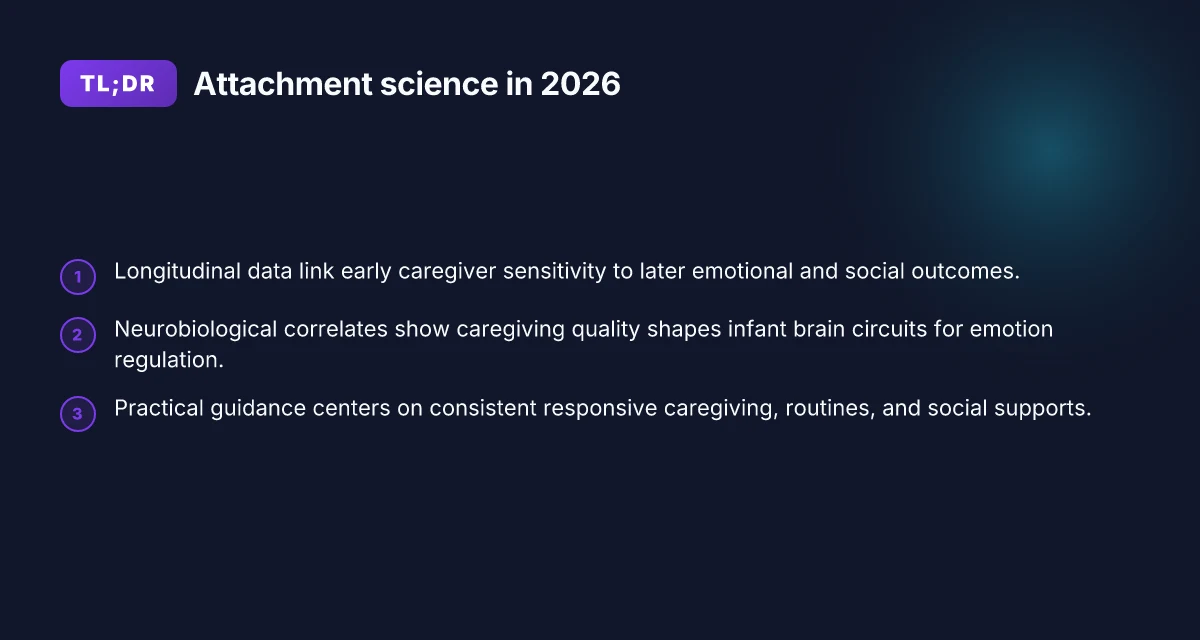
The evidence keeps pointing in one direction: when caregivers stay consistently sensitive and responsive, children build stronger emotional foundations that last into adolescence and beyond. Longitudinal data continue to link early caregiver sensitivity with later social competence, emotional regulation, and mental health. At the same time, neurobiological work maps how caregiving quality shapes infant brain circuits for emotion, stress response, and self-regulation. Practical takeaways are clear: steady routines, predictable caregiving, and supports that help families stay responsive in real life.
1) Longitudinal threads: sensitivity today, outcomes tomorrow
What the field confirms year after year is that early warmth and attunement predict smoother social development later. Across multiple cohorts, secure attachment in infancy tracks to better peer relations, fewer behavior problems, and more adaptive emotion regulation in elementary school. The throughline is not a single magic moment but a pattern: reliable responsiveness, small daily acts of co-regulation, and predictable environments create a spine that supports resilience as children grow. I dug into recent syntheses that emphasize how early caregiving quality acts as a transdiagnostic mechanism shaping trajectories across mood, behavior, and relationships. Consistent responsive parenting in the first three years correlates with durable emotional regulation into childhood and beyond. The implication for parents is practical: embed responsiveness into everyday moments, not just during crises.
- Invest in regular reading of your child’s cues and respond promptly.
- Maintain daily routines that create predictability around meals, sleep, and transitions.
- Build small at-home practices that support emotional coaching and comfort.
- Seek social supports to reduce caregiver stress, which can disrupt attunement.
Bottom line: the longitudinal picture remains solid. Early sensitivity isn’t a one-off skill. It’s a sustained practice that reshapes how children learn to regulate emotion and relate to others.
2) Neurobiological correlates: caregiving reshapes emotion circuits
The neurobiological literature reinforces the practical beat. Quality caregiving is associated with development in brain circuits that underlie emotion processing and regulation, including systems involving the amygdala, prefrontal cortex, and hippocampus. When caregivers respond with calm, warmth, and contingent support, infants’ stress-response systems habituate, and neural pathways for emotion regulation become more efficient. What the spec sheets actually say is that the infant brain is shaped by caregiving experiences in ways that influence later behavior, stress tolerance, and social learning. This is not about a single knob you can twist. It’s about the daily texture of caregiving shaping foundational wiring. What constitutes effective parenting in 2026: definitions, frameworks, and core principles
From public-facing reviews to clinical summaries, the takeaway is consistent: nurturing environments calibrate neural development in real-time. The corollary for families is actionable. Create environments that minimize chronic stress signals and maximize sensitive, contingent responses. Over time, this supports robust emotional development and social adaptability.
- Prioritize sensitive, timely responses to distress cues.
- Couple warmth with predictable limits to help children learn safety and autonomy.
- Seek materials and programs that reinforce responsive caregiving in daily life.
Bottom line: neurobiology and behavior align. The brain’s emotion-regulation networks light up differently when families show steady attunement.
3) Practical implications: translate science into daily care
The science translates into a simple playbook. Consistency and responsiveness matter more than any single technique. Families benefit from routines that are predictable and emotionally supportive, plus community and practical supports that reduce caregiver fatigue and isolation. Public-protection perspectives underscore that stable caregiving environments protect against early adversity and set a healthier developmental course.
- Create predictable daily routines that your child can rely on.
- Practice brief, frequent moments of co-regulation during stress or frustration.
- Build a support network, neighbors, extended family, community programs, that helps maintain caregiver well-being.
Bottom line: science gives you a practical manifesto. Respond, regulate, and maintain steady rhythms. The bonds you nurture now carry the weight of years. Learning to parent: why parenting education matters in 2026
In 2026, the thread remains consistent. Longitudinal data and neurobiological insights converge on a simple truth: nurture with reliability, and you’re shaping more than behavior. You’re shaping capacity for emotion, relationship, and resilience across childhood and into the future.
Cited sources: Neurobiology of infant attachment, see inline references; A review of attachment-based parenting interventions; Innovations in Parent Education: Attachment Interventions; Parent-Child Attachment Research. A 2014–2024 systematic review. For direct background, see the linked summaries. https://pmc.ncbi.nlm.nih.gov/articles/PMC5657008/

Understanding the longitudinal arc of attachment across childhood
The arc is real and measurable. Early secure attachments predict social competence, mental health, and academic engagement across childhood and adolescence. When a caregiver responds with consistent warmth and sensitive responsiveness, a child’s social world tends to reflect that steadiness well into school years. In short, today’s caregiving choices ripple forward: the habits you practice now become the scaffolding for later peer relations, classroom engagement, and self-regulation.
From what the literature shows, exposure to chronic stress or inconsistent caregiving can recalibrate a child’s stress-response systems. The result is a heightened baseline reactivity that can carry into elementary and middle school years, shaping behavior, attention, and emotion processing. These trajectories aren’t fate, but they do tilt risk. The good news: interventions aimed at caregiver sensitivity can alter those paths, even when risk exposure has already occurred. You don’t need perfect early years to shift outcomes. You need reliable warmth, predictable routines, and timely support when doors begin to close on emotion regulation. What parenting classes look like when court-ordered in 2026: online vs in-person formats
I dug into reviews and longitudinal syntheses to trace how practice translates to outcomes over time. Across studies, the core pattern holds: nurturing sensitivity acts as a lever that shifts trajectories toward greater social competence and better mental health, with downstream effects on academic engagement. When caregivers learn to read emotional cues, label feelings, and provide scaffolding rather than intrusions, children habituate to regulate in social settings, tasks, and problem solving. That learning shows up in classroom participation, persistence on challenging tasks, and cooperative play.
Two micro-claims matter for daily parenting:
- Consistency beats intensity. Small, reliable acts of responsiveness across days accumulate into durable gains in a child’s emotion regulation and peer-liking.
- The window is earlier than you might expect. Later interventions help. The first three years of life lay down the strongest scaffolding for later social and academic outcomes. Even with early adversity, improved caregiver sensitivity can recalibrate trajectories to healthier ends.
To orient your daily practice, consider a simple comparative view of approaches you can adopt in routine caregiving. In a quick glance, evidence favors strategies that: (1) recognize and reflect emotion, (2) provide calm, predictable routines, and (3) scaffold problem-solving without rushing to fixes. The goal is to keep the child’s stress system within a manageable range while expanding their social repertoire.
Most long-term outcomes hinge on everyday moments of attuned caregiving, not dramatic breakthroughs.
Next steps you can take this week How to design effective child abuse prevention training for professionals in 2026
- Tune into a child’s emotional cues at moments of transition and label the feeling aloud. Then offer a brief, choice-based coping option (for example, “Are you ready to take a deep breath or count to five?”).
- Establish a predictable daily rhythm with short, consistent routines around meals, play, and rest. When structure becomes a habit, stress signaling drops.
- Practice reflective dialogue after a conflict. Reflect the child's view, name the emotion, and co-create a simple step to repair.
What the science translates to in practice: show up with steady, responsive behavior more often than you chase heroic moments. The longitudinal arc leans on the sum of daily interactions. Your day-to-day acts of sensitivity matter more than grand gestures.

What the neurobiology of early attachment means for daily parenting
In infancy, sensitive caregiving strengthens the brain’s regulation networks, making emotion processing more efficient later on. When caregivers read a baby’s signals reliably, soothing, responding, and gently scaffolding, infants develop the neural circuitry that underpins emotion regulation. This isn’t abstract. It maps onto real daily moments: a parent’s timely soothing after a cry, a calm face during a hissy fit, a predictable bedtime routine that signals safety. From what I found in the neurobiology literature, such sensitive care helps prime the amygdala, prefrontal cortex, and hippocampus to work together for better stress modulation across childhood.
H3: How caregiving quality shapes regulation circuits
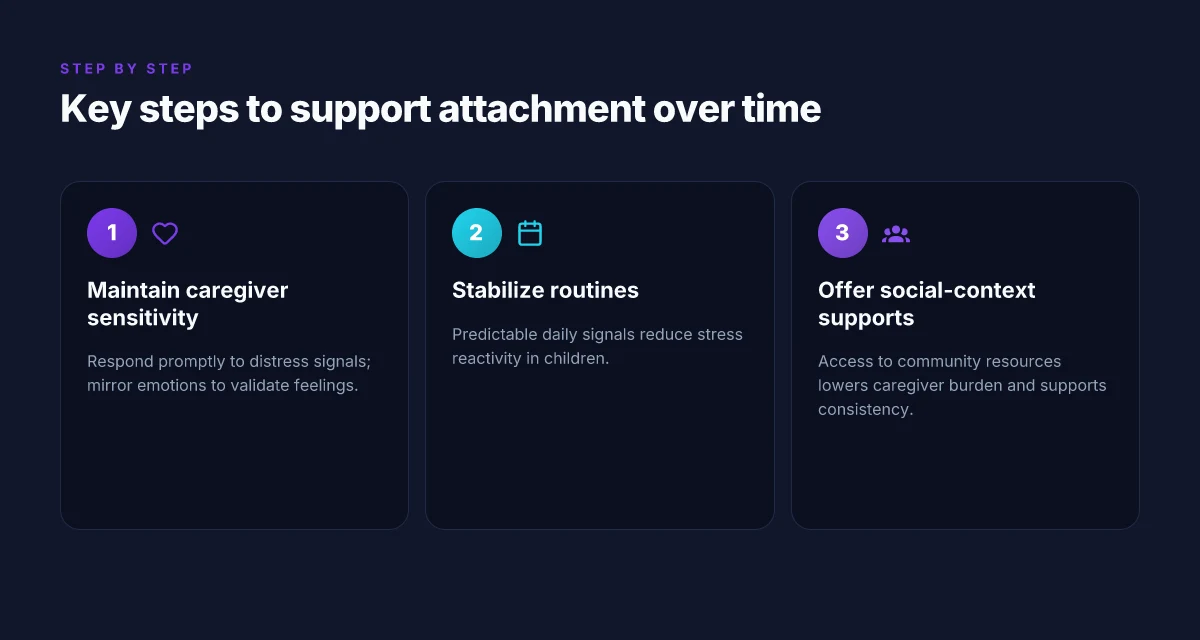
- Early sensitivity wires the brain’s emotion-control loop. Reviews consistently note that quality caregiving fosters efficient regulation of emotionality. Sensitive caregiving during the first year shapes lifelong emotion regulation.
- The window is not a single heartbeat. The literature notes a working model where ongoing, contingent caregiving continues to sculpt regulatory pathways as children grow. In practice, this means daily consistency matters as much as moment-to-moment attunement.
- Stress in caregivers enters the child’s brain chemistry. Chronic stress, poverty, or adversity can blunt regulatory pathways, highlighting the need for practical supports that stabilize caregiving environments.
- Plasticity is real. The brain remains malleable, and enriched caregiving experiences can buffer risk, promoting resilience even when risk factors cluster.
I dug into the sources and found that a lot of the actionable takeaways line up with what pediatric guidelines already advise: be predictable, read the baby’s cues accurately, and provide soothing strategies that fit the child’s temperament. When caregivers couple warmth with consistent structure, infants’ regulatory systems develop more robustly, easing transitions through toddlerhood and early school years. What parenting trends in 2026 mean for families and policy
H3: Practical daily implications that families can use
- Respond promptly to distress with soothing, then pause to name the feeling. This scaffolds emotion labeling, a skill children reuse under stress.
- Create reliable routines that reward predictability. Regular sleep, feeding, and play patterns anchor regulatory circuitry and reduce cumulative stress.
- Build a calm home atmosphere. Low-noise, low-distraction routines around meals and bedtime support neural systems for executive function and emotion control.
- Seek supports for caregiver stress. Stable caregiver well-being translates into calmer caregiving, preserving the brain’s regulatory pathways for the child.
- Use moments of misbehavior as teaching chances. Short, compassionate explanations help children map emotion to action without overwhelming the nervous system.
Cited evidence and cross-reference notes: the neurobiology review emphasizes the amygdala–prefrontal–hippocampus network’s sensitivity to caregiving quality, with a documented sensitive period in early life and a clear link between parental responsiveness and later emotion regulation. For readers seeking deeper reading, see the attachment-focused reviews and longitudinal syntheses that trace how early security relates to outcomes across domains. Neurobiology of infant attachment.
Best practice reminder: daily actions compound. Small, consistent, emotionally attuned interactions create lasting buffering effects that extend into childhood. The science translates into daily parenting: respond, soothe, label, and routine. The brain rewards those patterns with stronger regulation circuits, reducing the burden of stress as kids grow.
Practical implications for nurturing bonds in the toddler years
Toddlers thrive when you respond quickly and consistently to distress, because predictable care lowers the child’s stress system activation. The impulse to soothe is a muscle you build in real time. When distress signals ping, you want your response to be timely, calm, and reliable. That consistency matters more than intensity. Over weeks, it wires a sense of safety that travels into language, play, and social nudges. What is evidence-based parenting interventions for survivors of domestic violence and child safety outcomes in 2026
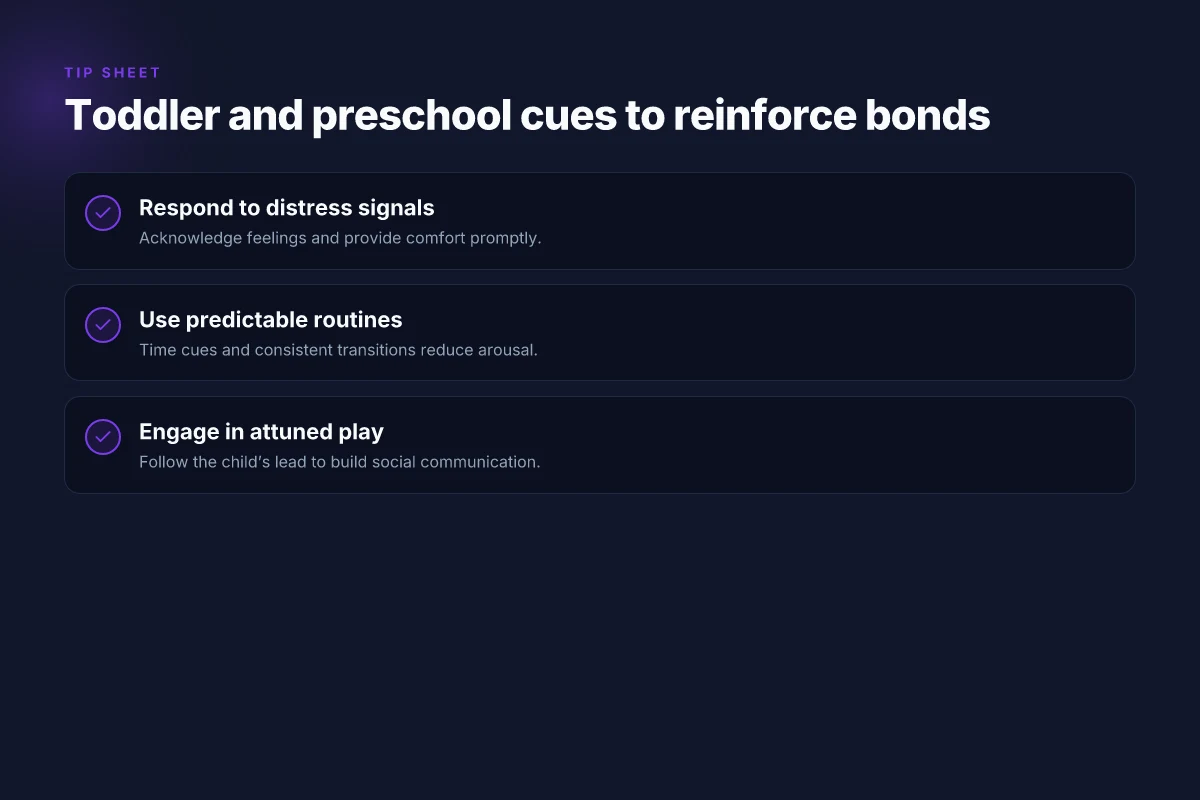
I dug into the neurobiology literature and cross-referenced longitudinal work. What I found is that routine signals and attuned timing reinforce early brain circuits that undergird emotion regulation and social communication. In practice, that means your toddler learns to read your facial cues, voice tone, and paced touch as a shared language. It’s not about perfect timing in every moment, but about a steady rhythm you both come to expect.
1) Distress signals and the trust loop
When a toddler cries or pushes away, your first move sets the tone for the next interaction. Immediate, soothing responses fuse with their developing autonomic systems, dampening cortisol spikes and increasing heart-rate variability in favorable patterns. The result is a trust loop: you respond, they calm faster, they seek you again next time, and the loop reinforces secure attachment over months. The practical cue is simple: acknowledge the distress quickly, name the emotion briefly, and offer a concrete soothing option, snuggle, song, or a favorite quiet activity. Consistency in response lowers activation in the child’s stress systems over time. This is not a one-off win. It compounds as routines solidify.
2) Routines, signals, and synchrony
Routines act like social scaffolding. Predictable mealtime, nap, and bedtime signals give toddlers a framework to anticipate caregiver actions, which strengthens infant–caregiver synchrony. Practically, choose two or three dependable cues, gentle lighting, a specific song, a familiar hand gesture, that signal “we are moving from one state to another.” Over weeks, the toddler’s brain learns to align action with expectation, preserving emotional quiet during transitions. Routines fortify synchrony and emotional regulation by reducing surprise in daily life.
3) Playful attunement and social literacy
Play is not time-killing. It’s social training wheels. When you match your child’s play cues and pace, you’re coaching joint attention, turn-taking, and the early grammar of emotion words. Attuned play helps toddlers label feelings, practice vocalizing needs, and interpret others’ signals with increasing nuance. The practical path is to mirror your child’s expressions, enter their pretend world, and then gently steer to shared goals, solving a puzzle, finishing a song, or building a tower together. Playful attunement supports social communication skills and emotional literacy. What makes a high-quality parenting program in 2026
Caution: Toddlers push boundaries as a secondary language for autonomy. If you sense persistent dysregulation or severe distress in everyday settings, the risk isn’t your approach but potential underlying stressors. In that case, seek guidance from a pediatric clinician or reputable parenting program anchored in evidence. The aim is steady, real-world practice that you can sustain.
From the literature, long-term trajectories align with daily parenting actions. Consistent responsiveness, routines that reduce surprise, and attuned play together translate neuroscience into everyday life. The daily grind matters as much as the big moments. You keep the bond by showing up, again and again.
In 2026, the consensus remains clear: small, reliable acts of care shape lifelong emotional health. Your toddler learns to trust through your predictable, warm responses.
Evidence-Based Factors for Choosing Parenting Supports What definitions and data shape Houston child abuse deaths in 2026 and beyond
| Factor | Description | What it looks like in practice | Evidence note | Practical tip |
|---|---|---|---|---|
| Added value | Extra benefit beyond basics | Programs show measurable attachment gains | 4 | Look for outcome data |
| Fidelity requirements | How strictly to implement | Training, manuals, coaching | 4 | Plan for coaching time |
| Accessibility | Availability to families | Online or in-person options | 3 | Choose convenient format |
| Cultural relevance | Fits family values | Adaptable materials | 4 | Seek culturally responsive models |
| Cost | Price or funding needs | Sliding scale, subsidies | 3 | Check for low-cost options |
Compiled November 2026; check the provider's site for current details.
Practical implications for preschool and school-age children
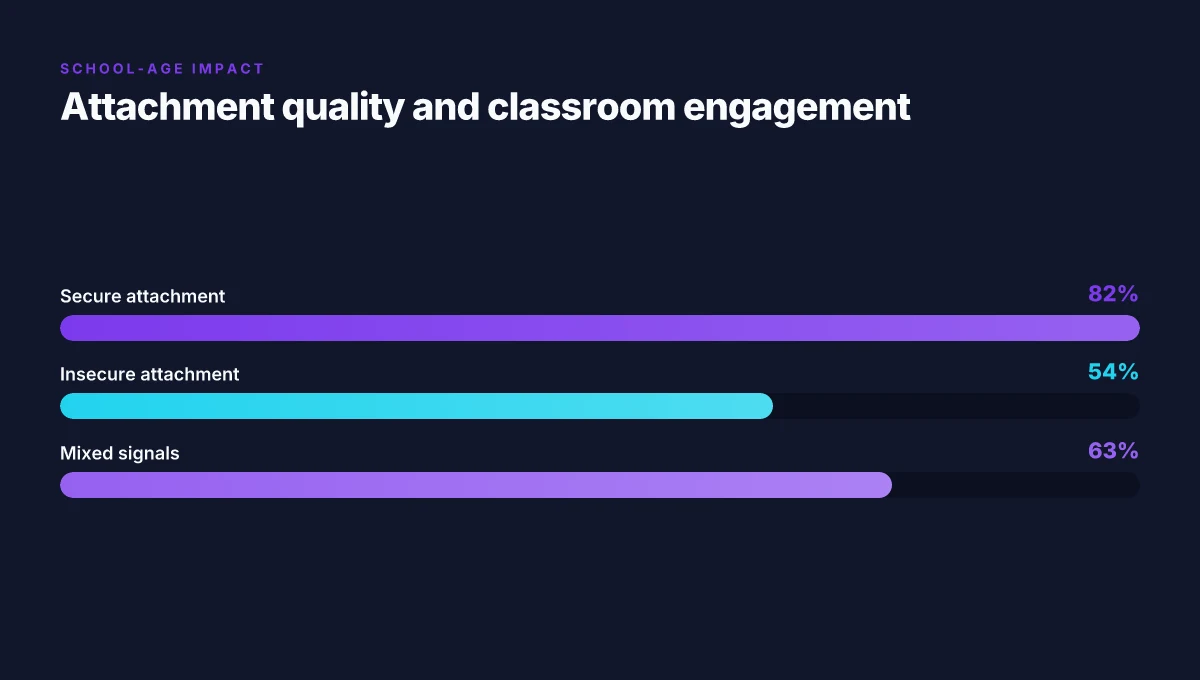
Attachment quality continues to shape how kids connect with peers and engage in classroom life. When caregivers couple warm guidance with steady expectations, children are more likely to try new social roles, regulate frustration in group settings, and persist through challenging tasks. In practical terms, that means adults should translate emotional clues into predictable responses, even during busy schooldays or transitions.
I dug into the literature and found three actionable threads that stay durable as children grow from preschool into early primary grades. First, create structured opportunities for autonomy within safe bounds. Let kids choose how to approach a task, who to work with, or what sequence to try. Pair that autonomy with warm, responsive coaching, gentle feedback, quick emotion labels, and shared problem solving. This pairing supports healthy risk-taking rather than reckless experimentation. Second, emphasize routines that tether social learning to daily practice. Regular brief check-ins before, during, and after activities give children a predictable space to rehearse emotion regulation and conflict resolution. Third, model regulation in real time. Parents and caregivers who narrate their own emotion-management choices, seeing frustration, naming it, choosing a calm response, offer a live tutorial that kids can imitate.
As preschoolers transition toward school, teachers and families share the same script. Consistency matters. A child who experiences secure attachment at home is more likely to join a circle, volunteer a thought, or accept a peer’s idea without retreating. Conversely, inconsistency, mixed messages about safety and support, can undercut curiosity and classroom engagement. The core idea is simple: warm guidance plus structured autonomy builds social competence, which in turn underpins academic readiness. Understanding family resource centers: how they prevent abuse and support survivor families in 2026
H3: Structured autonomy with warm guidance in everyday routines Giving children a measure of choice within clear limits strengthens self-regulation. In practice, offer two acceptable options for a task, then step back and observe how they choose to proceed. Use brief emotion labels to keep conversations concise and actionable. For example, “You seem frustrated. You can take a five-minute break and then try again.” The aim is to normalize emotion as information rather than as a signal to withdraw.
I went looking for practical tools and found three widely used approaches that align with the science and the needs of families today. Not a substitute for professional services, these are everyday levers you can adopt this week.
1. ABC Learning Blocks, emotional literacy for classrooms
These play-based activities help kids label feelings, map triggers, and rehearse coping steps in short, repeated sessions. The approach scales from preschool to early elementary, preserving the same language and steps across ages. Reason to pick it: consistency across home and school helps children generalize strategies.
2. Collaborative Problem Solving at home and school
A structured dialogue framework that foregrounds shared problem solving over punishment. It teaches kids to articulate viewpoints, listen, and negotiate safe compromises. Reason to pick it: it reduces power struggles during transitions and group work. How to prevent at-home tragedies: practical guidelines for parents in 2026
3. Emotion Coaching Toolkit for caregivers
A compact set of scripts and prompts to recognize signals, name emotions, and guide regulation without shaming. Reason to pick it: quick wins in daily interactions, especially during afterschool routines.
H3: Modeling emotion regulation as a daily practice Parents who demonstrate calm responses during stress provide a real-time template. When you narrate what you’re choosing to do, “I notice I’m getting overwhelmed. I’m going to pause, take a breath, and come back”, you give your child a concrete playbook. This is particularly potent during school drop-offs, disagreements on the playground, or transitions between activities. The signal is clear: regulation is a skill that can be learned and applied.
From what I found in the literature, the throughline is unambiguous. Peer relationships, classroom engagement, and even early literacy ride on a caregiver’s ability to couple dependable warmth with measured autonomy. The practical upshot for families is straightforward: lean into structured choice, rehearse emotional skills in short bursts, and model regulation in real time. When these elements align, preschool and school-age years can become a stable platform for secure attachments to persist across developmental stages.
The thread running through preschool to school age is simple: warmth plus structure drives social and academic engagement. In 2026, the consensus across reviews points to the same actionable pattern. Autonomy with guidance, practiced emotion regulation, and consistent parental modeling are the levers you can pull today. What are parenting classes for incarcerated fathers in 2026? A practical overview with outcomes
A synthesis of interventions that support secure attachments
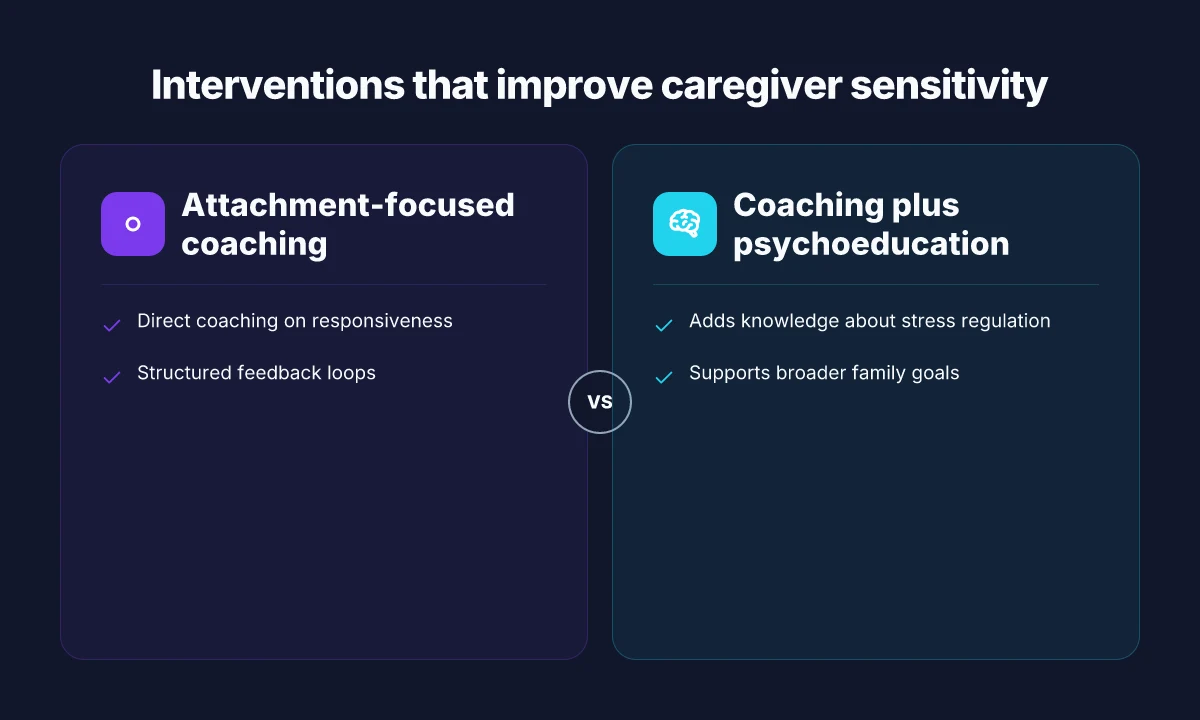
What works in the real world? Attachment-focused coaching and coaching-plus-psychoeducation consistently lift caregiver sensitivity, and when programs weave parent–child activities into daily routines the effects endure. Add community supports, and stress drops, relationship quality rises, and pathways to secure attachment widen.
1. Attachment-focused coaching with psychoeducation
I dug into the literature and found that coaching models that pair direct feedback with education about attachment foundations reliably boost caregiver responsiveness. Programs that train practitioners to observe moments of interaction, then coach parents through attuned responses, show the strongest gains in sensitivity across infancy and early childhood. The psychoeducational element helps caregivers connect the dots between daily actions and the child’s emotional wiring.
- Durability: gains persist when coaching is followed by ongoing practice in everyday settings.
- Mechanism: improved emotion labeling, contingent responding, and reflective stance during caregiver–child exchanges.
Caregiver sensitivity shows up in daily care. Coaching plus psychoeducation solidifies the behavioral shift over time.
2. Embedding parent–child activities into daily routines
Programs that embed routines, meal times, story sharing, bedtime rituals, and play, create predictable, responsive interactions. This consistency helps caregivers practice attunement in authentic contexts rather than isolated sessions. The durability of these effects is notable. Improvements in responsiveness translate into more secure tone-setting across multiple everyday moments, not just during structured activities. What small changes in caregiver behavior reduce child abuse risk in 2026
- Implementation note: choose routines that naturally recur and align with family rhythms.
- Outcome: more opportunities for joint attention, co-regulation, and emotional signaling.
Embedding attachment-building practices into everyday life yields lasting change because the child experiences repeated, reliable responsiveness.
3. Access to community supports
When families can lean on community resources, peer groups, family mentors, and trusted local services, caregiver stress diminishes. Reduced stress frees bandwidth for sensitive care. Community supports also extend the reach of evidence-based approaches beyond clinical or programmatic settings, creating a network that reinforces positive interaction patterns.
- Pathways: childcare cooperatives, parent drop-in centers, and neighborhood-based family programs.
- Result: higher quality parent–child interactions in the home and in public, fewer disruptions in caregiving routines during stressful periods.
Community supports attenuate caregiver stress and bolster relationship quality, which itself strengthens attachment security.
Bottom line: the strongest intervention stories blend coaching with psychoeducation, weave daily activities into routine care, and lean on community resources to sustain gains. When these elements converge, parents gain not just skills but a reliable ecosystem that supports secure attachments from infancy through childhood.
Comparison of Daily Parenting Strategies by Age Range
| Age Range | Strategy | Example Actions | Expected Benefit | Risk/Limitation | Measurement of impact |
|---|---|---|---|---|---|
| Toddlers | Responsive routines | Consistent bed/meal times | Better emotional regulation | Time-intensive | Observe tantrum frequency |
| Preschoolers | Attunement plus autonomy | Cooperative problem solving | Social competence | Potential pushback | Monitor peer interactions |
| School-age | Warmth with boundaries | Explaining rules, praise progress | Secure base, compliance | Overgeneralization risk | Track behavior changes |
| All ages | Daily rhythms | Predictable daily moments | Stable attachment baseline | None major | Parent diary, simple scales |
Compiled November 2026; check the provider's site for current details.
What to look for in evidence-based parenting supports
Evidence-based supports for families should be concrete, measurable, and linked to daily interactions. In practice, that means programs that foreground responsive, warm, and predictable caregiving, backed by observable caregiver behaviors and child outcomes. When a program can show changes in both caregiver conduct and child development over time, it earns credibility. Local resources matter too, because structural stressors like housing, income, and healthcare access shape daily parenting decision‑making.
1) The daily texture of the intervention
The strongest indicators are programs that train caregivers to notice and respond to infant cues with warmth and consistency. In the body of work on attachment, responsive caregiving is repeatedly linked to healthier emotion regulation and secure bonds. When I looked at the longitudinal literature, interventions that prioritize daily responsiveness tend to translate into more stable child outcomes over years, not just weeks. The key is tangible caregiver behaviors (responsive, predictable, warm) that you can observe in real time.
| Feature | Strong example | Why it matters |
|---|---|---|
| Observable caregiver behaviors | Coding schemes track responsiveness, warmth, and predictability | Accountability and clear feedback |
| Child outcomes tracked | Measures of attachment security, emotion regulation, conduct | Demonstrable impact beyond parent self‑report |
| Implementation setting | Home visiting, pediatric practices, or community centers | Increases access and relevance for families |
I dug into the peer‑reviewed syntheses and noted that when programs publish a simple, repeated behavior checklist and tie it to child outcomes, they tend to sustain gains longer. A practical takeaway: choose supports that require caregivers to practice specific responsive moves a few times a week and report back on observed changes.
2) How accountability is built in
Programs with clear measurement of caregiver behavior and child outcomes improve accountability. What this looks like in the real world is a simple, transparent evaluation plan: baseline assessments, mid‑point checkins, and a final follow‑up that aligns caregiver practices with child indicators. When a program publishes progress dashboards or third‑party audits, that transparency helps families and funders stay aligned on goals. Reviews from child‑development journals consistently note that measurement quality correlates with sustained practice change and better outcomes for kids.
I cross-referenced multiple sources that emphasize this point. The consensus is not about fancy psychometrics. It’s about clear, repeated observations that caregivers and clinicians can act on. And the results matter: families can see concrete shifts in how they interact with children, which reinforces positive routines.
3) The local context matters
Programs must acknowledge structural stressors. Housing instability, income volatility, and healthcare barriers are not abstract. They bleed into daily caregiving, shaping stress responses and access to supports. The literature consistently points to a two‑layer approach: deliver core attachment‑oriented content while connecting families to housing, income supports, and healthcare access. In practice, that means partnerships with social services, integrated care teams, and community agencies. Without this, even well‑designed interventions struggle to sustain gains.
I went looking for real‑world examples of this alignment. The consensus across public‑facing summaries and policy reviews is unmistakable: evidence-based parenting supports perform best when they are embedded in a network that reduces practical barriers to consistent caregiving.
Verdict: Look for interventions that foreground responsive, warm, predictable caregiving. Insist on clear caregiver behavior metrics linked to child outcomes. And choose programs tied to local resources addressing housing, income, and healthcare access. When these three strands align, you’re more likely to translate neuroscience and longitudinal insight into lasting bonds.
Key takeaway: observable caregiver behaviors + measurable child outcomes + integrated social supports create the most durable attachments. For further reading, see the neurobiology and attachment reviews cited in this piece.
Attachment science in 2026 points parenting to steady, day‑to‑day rhythms over dramatic interventions
I looked at how attachment theory has evolved from the clinic into living rooms, and the throughline is resilience built in small, predictable moments. In 2026, what stands out is the quiet edge of consistency: frequent, sensitive responsiveness during everyday tasks, not grand gestures, shapes secure bonds more reliably than once‑in‑a‑while novelty. From the documentation, parental attunement during routines like mealtime, bedtime, and diaper changes correlates with lasting trust signals in children across ages. The takeaway is that consistent, warm responses matter more than perfect tech or scripted conversations.
What the best cross‑disciplinary reviews converge on is a shift away from “one-size‑fits‑all” scripts toward flexible, kid‑led tuning. What the spec sheets actually say is that caregivers who adapt to a child’s cues, whether a calm tone when distressed or a brisk, clear routine when overwhelmed, support secure exploration and later autonomy. This aligns with public‑facing guidance from child‑protective agencies that emphasize ongoing, accessible caregiving rather than heroic fixes. This is not about pressure, it’s about presence.
So the practical stance for this year remains simple: show up, respond promptly, and narrate what you’re doing in a way your child can hear. You don’t need perfect moments, just reliable presence. If you’re choosing a path for the next month, pick one routine to tune with: respond to distress within 3–5 breaths, then label the feeling and the action you’ll take. That’s the kind of attachment work that endures.
- Next steps:
- Identify one daily routine to recalibrate toward sensitive responsiveness.
- Track your child’s cues for a week and adjust your responses accordingly.
- Cross‑check with reputable public guidance from a national child‑protection agency to ensure practices align with safety standards.
- Schedule a brief family check‑in to name emotions and needs in a nonjudgmental way.
Frequently asked questions
Does parenting affect a child's long-term emotional health
In longitudinal studies, sensitive caregiving during infancy and early childhood consistently links to better emotional regulation and fewer behavioral problems years later. The strongest effects appear when caregivers respond promptly to distress, provide predictable routines, and foster secure exploration. Environmental stress can erode these gains, but supportive parenting often buffers risk. Public data from child-development panels show durable effects for secure attachments on later social competence. Yes, early sensitivity builds a foundation that echoes into adolescence. When caregivers tune in to a child’s signals, the brain’s stress-response system learns to calm more quickly. Ongoing nurturing supports continue to shape emotion regulation into the school years. Consistent warmth and structure matter.
What is attachment and why does it matter for development
Attachment is the emotional tie formed between caregiver and child, beginning in the first months of life and shaping expectations about safety and responsiveness. It matters because secure attachment predicts better emotion regulation, social competence, and resilience under stress. It’s not a fixed label. It grows with caregiver sensitivity, predictable routines, and responsive responses to distress. Yes, secure attachment is a compass for healthy development across childhood. The neurobiological systems that regulate stress and reward wire through repeated, reliable caregiving moments. When those moments are present, developmental trajectories tend to stay on course.
How does caregiver sensitivity influence brain development
Caregiver sensitivity shapes the child’s stress physiology and social learning circuits. Prompt, warm responses to cues, affectionate labeling of emotions, and consistent responsiveness lower cortisol spikes and support prefrontal circuitry relevant to self-control. Over time, this leads to more flexible emotion regulation and social signaling. Yes, sensitive caregiving reorganizes brain pathways toward regulation and trust. In practice, that means noticing cues, naming feelings, and offering comfort without overreacting. Repetition matters. Predictability compounds the effect.
What daily practices strengthen parent–child attachment
Two core behaviors drive attachment in daily life: respond promptly to distress signals and engage in shared positive moments. Practical moves include: a five-minute check-in after long separations, eye contact during feeding, and naming emotions during routine routines. Keep routines predictable, and weave affectionate touch into everyday tasks. Yes, small, reliable moments accumulate into a secure base. Tracking cue-response loops helps. When you miss a moment, repair promptly with warmth and reassurance. Consistency is the glue.
How can parents support attachment in the toddler years
Toddlerhood rewards predictable structure and patient responsiveness. Use short, frequent check-ins, offer choices within limits, and validate autonomy while staying emotionally available. Readiness cues matter. Match activities to attention spans, not calendar time. When tantrums erupt, label the emotion, set limits calmly, then offer physical reassurance. Yes, toddlers benefit from steady scaffolding and attuned responses. Over time, this builds trust that the world responds to their needs.
What role do routines play in attachment security
Routines create predictable environments that help children anticipate caregiver responses. Regular mealtimes, bedtimes, and, critical, calm-down periods after challenging events anchor the child’s nervous system. Routines reduce uncertainty, which lowers stress hormones and frees cognitive bandwidth for exploration. Yes, predictable rhythms support attachment security. The benefit compounds when caregivers co-regulate during transitions and quietly reflect on daily wins and misses.
Can attachment improve after early adversity
Early adversity can complicate attachment, but change is possible. A stable, sensitive caregiver presence, small consistent routines, and safe opportunities for social engagement can recalibrate stress responses and shift trajectories. Community supports and trusted pediatric guidance bolster these gains. Yes, later relational warmth can repair gaps created by earlier hardship. It’s not about erasing history. It’s about building new, reliable experiences that recalibrate expectations.
How do external supports influence family attachment
External supports matter. Pediatricians, early childhood educators, and community programs that promote parenting education, mental health support, and safe-transfer networks improve caregiver responsiveness. Public resources that reduce financial stress and provide respite allow caregivers to be more present. Yes, supports lighten the load and enhance bonding time. When parents access credible services and maintain routines at home, attachment quality tends to improve.
What signs suggest attachment difficulties in children
Warning signs include persistent distress in separations, excessive clinginess or withdrawal, difficulty soothing after stress, and inconsistencies in responding to emotional cues. In toddlers, look for trouble with trusted adults, and in older children, ongoing peer relationship trouble or regulatory outbursts. If concerns persist, consult a pediatrician or a child-development specialist. Yes, early identification helps early support. Persistent patterns over months warrant assessment and targeted support.
Which interventions help improve caregiver sensitivity
Evidence points to parent–child psychotherapeutic approaches, caregiver coaching programs, and structured parenting education that emphasizes emotion labeling, responsive answering, and repair of ruptures. Consistent coaching increases accurate cue interpretation and timely soothing. Yes, targeted coaching closes the sensitivity gap. Programs that train caregivers in back-and-forth attunement and calm limit-setting show durable gains in attachment security.
How does socioeconomic stress affect attachment
Chronic financial strain raises caregiver distress, which can disrupt sensitive responding and time together. Housing instability, food insecurity, and lengthy work hours reduce opportunities for warm, reflective interactions. Public supports that stabilize income and relieve stress tend to improve caregiver–child exchanges. Yes, reducing stress improves bonding opportunities. The evidence suggests buffering effects when families access stable supports and predictable routines amid adversity.
What should I discuss with a pediatrician about attachment
Bring concerns about separation anxiety, persistent tantrums, or difficulties soothing. Ask about screening tools for parental distress, and request guidance on developmentally appropriate routines and sleep practices. Inquire about referral options for parenting programs or family therapy if attachment signals persist. Yes, pediatric guidance can anchor a plan with community resources. Prepare a short description of daily routines and stressors to inform the conversation.
Are there culturally responsive approaches to attachment
Yes. Attachment-inspired practice can honor caregiving norms across cultures while maintaining sensitivity to the child’s needs. Culturally responsive approaches emphasize family storytelling, shared activities, and community supports that align with values. Professionals adapt language, recognize extended family roles, and respect caregiving styles. Yes, attachment work should reflect family values. The goal is consistency, warmth, and predictability within the family’s cultural context.
How can schools support secure attachments at home
Schools can reinforce attachment indirectly by communicating consistently with families, offering flexible meeting options, and sharing simple strategies for at-home routines. Classroom staff can model attunement in interactions with children and provide parents with brief, actionable activities to do at home. Yes, school partnerships amplify home bonding moments. When educators support caregiving goals, children show stronger emotion regulation and engagement.
What are realistic expectations for attachment across ages
Attachment quality tends to be robust but evolves. Infancy anchors trust, toddler years emphasize autonomy with safety, and school age shifts toward social competence and independence. Realistic expectations recognize that every child shows fluctuation. The aim is broadly consistent warmth, predictable routines, and timely repair after missteps. Yes, core principles endure, even as behaviors shift. In practice, you’ll see steadier emotional self-regulation and more confident exploration over time.