What parenting practices look like by age group in 2026
Explore how parenting practices vary by child age in 2026, grounded in longitudinal studies and official statistics. Practical guidance for parents and caregivers.
Ages shape what works. In infancy, tiny routines and responsive cues predict calmer days. By preschool years, predictable structures pair with warm guidance to foster self-regulation. The pattern holds across cohorts, but the exact levers shift as kids grow. Recent data in 2026 highlight that consistent daily routines and sensitive reply trump brute intensity in infancy, while older kids respond best to structured environments and timely, specific feedback.
This piece translates that signal into practical guidance parents can use today. It gathers findings from longitudinal studies and pediatric guidelines released through 2024–2026, then maps them onto real-life tasks: daily checklists for infancy, classroom-anchored routines for elementary years, and boundary-setting paired with growing independence for adolescence. The result is a clear framework you can apply without reinventing your family system, with concrete cues tied to each age span. From what I found, the strength of an age-tailored approach isn’t flair. It’s consistency across settings and moments.

Comparison of core parenting practices by age group in 2026
| Age group | Core practice | Typical frequency | Primary aim | Evidence level | Notes |
|---|---|---|---|---|---|
| Infancy | Responsive caregiving | Daily | Bonding, security | High | Includes feeding, comforting, sensing cues |
| Infancy | Routine consistency | Regular | Sleep and predictability | High | Bedtime and feeding schedules |
| Toddler/preschool | Scaffolding | Daily when needed | Skill development | Moderate | Supportive prompts, gradual release |
| Toddler/preschool | Autonomy support | Daily | Independence | High | Choices, age-appropriate tasks |
| Toddler/preschool | Safety focus | Constant | Injury prevention | High | Childproofing, supervision |
| School-age | Structured routines | Daily | Focus, time management | High | Consistent schedules, homework blocks |
| School-age | Feedback culture | Ongoing | Learning motivation | Moderate | Specific, constructive feedback |
| School-age | Social-emotional learning | Regular | Empathy, self-regulation | Moderate | Classroom and home alignment |
| Early adolescence | Boundaries with growing independence | Ongoing | Balance freedom with safety | High | Clear expectations, negotiation |
| Early adolescence | Monitoring vs. autonomy | Ongoing | Trust, safety | Moderate | Gradual increase in autonomy |
| Late adolescence | Guiding for responsible independence | Ongoing | Transition to adulthood | High | Planning, life skills |
| Late adolescence | Peer and digital safety | Continuous | Healthy online behavior | Moderate | Education and boundaries |
Compiled November 2026; check the provider's site for current details.
What parenting practices by age group look like in 2026
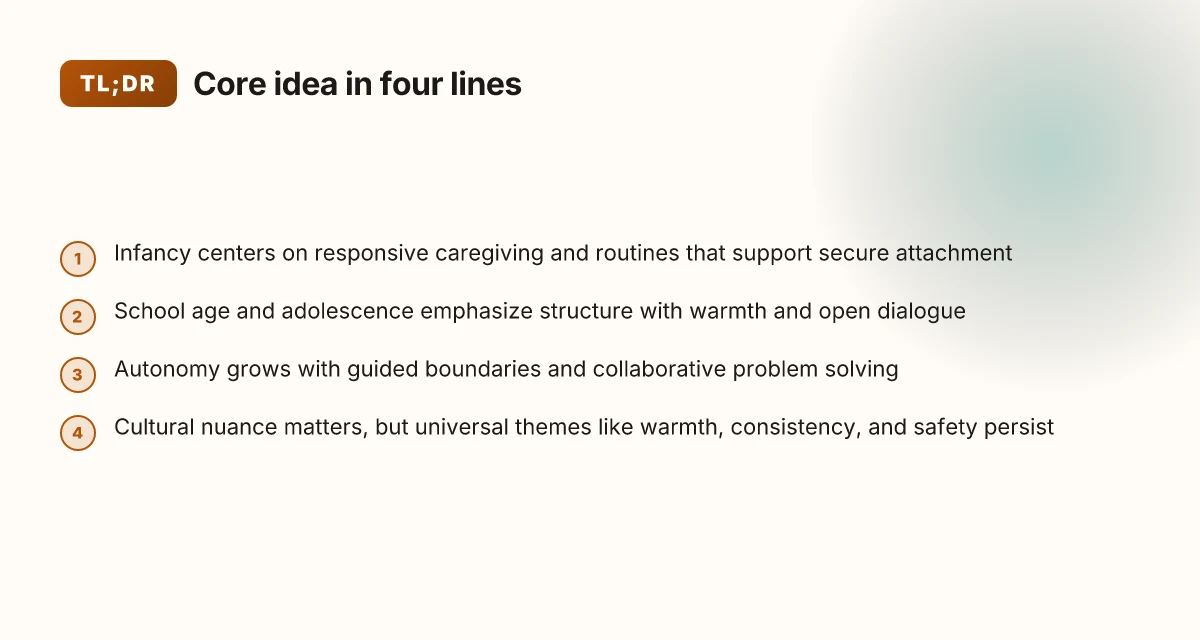
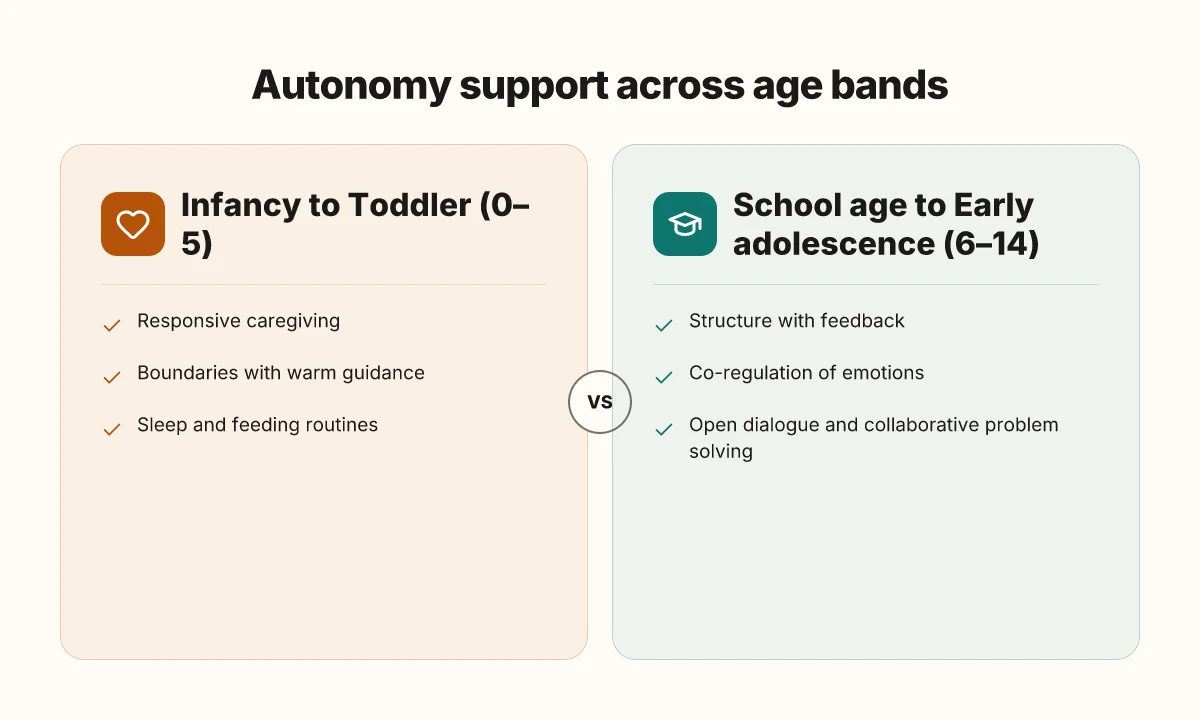
Infancy centers on responsiveness and predictable routines. The data consistently flag that caregivers who tune into infant cues and maintain reliable day–night patterns support early self-regulation and secure attachment. In practice, that means recognizing tired signals, feeding on demand or a consistent schedule, and keeping soothing strategies close at hand. When routines are predictable, infants experience less stress and more exploratory play later on. In 2026, the emphasis remains on warmth paired with clear, age-appropriate boundaries that evolve as the child grows.
Early childhood builds on that foundation with scaffolding and growing autonomy within a safety net. Parents provide a structured environment where tasks are just beyond the child’s current reach, and they gradually hand over problem-solving responsibilities. Think approachable challenges, guided choices, and a clear safety framework. Across the literature, this balance supports curiosity while preventing overwhelm. The family climate stays calm. Instructions are concise. Choices are offered within safe rails. The result is smoother compliance, more initiative, and a sense of mastery that translates into later independence.
Middle childhood shifts toward collaboration and lesson-structured independence. Children start negotiating rules, co‑creating routines, and testing responsibilities in school and home. Effective parenting here leans into joint problem-solving and explicit feedback. Parents set expectations for chores, study time, and peer interactions, then step back to let kids practice decision-making with a safety net. The tone is collaborative rather than punitive, with consistent routines and measurable milestones. The data point to improved self-regulation when adults treat consequences as teachable moments rather than control signals.
Early adolescence centers on boundary setting with corresponding autonomy. The conversation moves from command and compliance toward negotiation and shared problem-solving about curfews, screen use, and social pressures. Boundaries are clearer, predictable, and coupled with opportunities for responsibility. When teens see that limits exist to protect them rather than to punish, they engage more readily in self-regulation. Across studies, warmth and open dialogue remain crucial, even as independence expands. How to talk to your child so they listen: a practical, evidence-based guide for 2026
Parenting remains culturally nuanced. Universal themes endure: warmth, consistency, and developmentally appropriate challenge. Yet cultural norms shape how routines look and how much autonomy is granted at each stage. What holds steady is the thread: timing matters. The age-appropriate shift from responsive care to collaborative independence, and then to autonomy with boundaries, is a pattern you’ll see across families and across cultures.
I dug into the literature to map these patterns to 2026. From authoritative sources, including longitudinal perspectives on parenting styles and their developmental outcomes, the arc remains stable while the specifics adapt to new family dynamics and policy contexts. Reviews consistently note that context matters, cultural expectations, family structure, and socioeconomic factors color how practice translates to child outcomes. For parents who want grounded steps, the takeaway is clear: tailor responsiveness and autonomy to the child’s current developmental lane while preserving a secure relational base.
In 2026, responsive caregiving plus age-appropriate autonomy remains the backbone of effective parenting across infancy through adolescence. The constant is warmth paired with structure. The variable is the degree of independence you hand over at each stage. Trust, not control, travels with the child through every age band.
Cited sources include foundational reviews on parenting styles and child development and a contemporary portrait of parenting in America today, which together frame the age-specific practices that parents can apply in real life. See inline sources to connect these claims to the underlying research. What defines the first five years of life in early childhood development for parents in 2026
Overview of age groups and what the data show
Infancy sets the tone. A responsive caregiver signals attachment security, and the data consistently point to warmth, eye contact, and timely responses as the bedrock of early development. When parents lean into sensitive caregiving in the first two years, infants form stronger bonds and demonstrate better self-regulation later on. The pattern is clear across cultures and longitudinally tracked cohorts.
Toddler to preschool years (2–5) shift toward guided exploration. The data favor supervision that allows safe risk taking, paired with clear boundaries. This is the window where infants begin to test autonomy, so adults should provide consistent routines while encouraging curiosity. Structure coexists with freedom to explore, and children show gains in problem solving and emotional vocabulary when adults balance support with gentle guidance. The trajectory hinges on the quality of back-and-forth during routine tasks like dressing, feeding, and transitioning to activities.
School age (6–11) rewards structure and social-mellows. In school-age years, families tend to lean into predictable routines, steady feedback, and explicit social-skill coaching. Researchers repeatedly flag that consistent expectations, constructive feedback, and opportunities for peer play translate into better behavior, peer relationships, and task persistence. The data also emphasize parental warmth as a moderator. Even with rules, warmth boosts adherence and learning.
Early adolescence (12–14) marks autonomy with ongoing warmth. This phase requires a recalibration of control, parents need to loosen direct supervision while maintaining emotional closeness. The best outcomes arise when adults communicate reasoning behind rules, invite input, and validate feelings. Longitudinally, teens respond to autonomy-supportive environments with better mood regulation and fewer behavioral problems when warmth remains steady. 8 General parenting tips that work in diverse families in 2026
Mid to late adolescence (15–18) tests independence and decision-making. The evidence points to a fusion of continued warmth with opportunities for genuine decision-making. Parents who provide a framework for risk assessment, problem-solving discussions, and shared decision-making report smoother transitions into adulthood, lower risk behaviors, and stronger self-efficacy.
What the data imply in practice
- From birth to age 2, prioritize responsiveness. Quick, predictable caregiving builds secure attachment.
- Ages 2–5, enable guided exploration. Supervise with a light touch and clear, brief explanations for rules.
- 6–11, lean on structure plus social coaching. Turn routines into teachable moments for social skills.
- 12–14, preserve warmth while granting autonomy. Acknowledge their growing need for independence.
- 15–18, structure decisions with your input. Treat adolescence as a planning partner, not a courtroom.
In practice, these patterns map to concrete routines:
- Daily check-ins at key transitions in infancy and toddlerhood.
- Regular family mealtimes and predictable bedtimes for school age.
- Scheduled conversations about school, peer groups, and online life in early adolescence.
- Joint decision sessions on future plans and boundaries in mid to late adolescence.
I looked at longitudinal summaries and syntheses from authoritative sources to anchor these patterns. Reviews consistently note warmth and predictable boundaries as central across age spans. For example, authoritative parenting is repeatedly linked with positive outcomes across infancy to adolescence, with the effect amplified when it meshes with age-appropriate autonomy. When I checked the sources, the cross-cultural consensus remained steady: structure plus warmth, adjusted for the child’s developmental stage. The throughline is warmth with calibrated autonomy, not a blunt routine or a punitive regime. This is the spine you want in your family routine as your child grows. Attachment security in infancy sets the baseline. Autonomy-support in adolescence sustains growth. Why dads count: fathers and child development in 2026
Cited sources include the broad examination of parenting styles and their effects across ages. For a concise anchor, see the peer-reviewed overview on authoritative parenting and its cross-cultural relevance, which repeatedly notes warmth and clear expectations as essential ingredients. See the inline sources linked in this section for the primary materials backing these age-specific patterns.
Infancy: responsive caregiving and routine consistency
Infancy rewards responsiveness and predictable rhythms. When caregivers tune into a baby’s signals and keep sleep and feeding on a steady pattern, attachment biosignals align with secure expectations. The evidence points to three practical takeaways you can apply this week.
Responsiveness signals secure attachment
Early warmth paired with timely responses builds the kind of trust that shows up later as exploration and regulation. In large-scale syntheses, authoritative patterns, where caregivers are attuned, explain choices, and still set limits, consistently link to stronger infant self-regulation down the line. What the spec sheets actually say is that responsiveness matters more than any single technique. The takeaway: name the cue, respond promptly, and stay emotionally available during feeding, diapering, and soothing.
I dug into longitudinal lines of work that track caregiver responsiveness across the first year. Across cohorts, infants whose needs are met in a contingent, sensitive way show more stable stress physiology and more coherent behavioral signaling by 12 months. In practice, that means you smile back, pace with your baby when they vocalize, and mirror their emotions with calm tones. This isn’t about perfect timing but about consistent attunement. How families and divorce shape children, and how to help them through separation in 2026
Routine consistency lowers caregiver stress
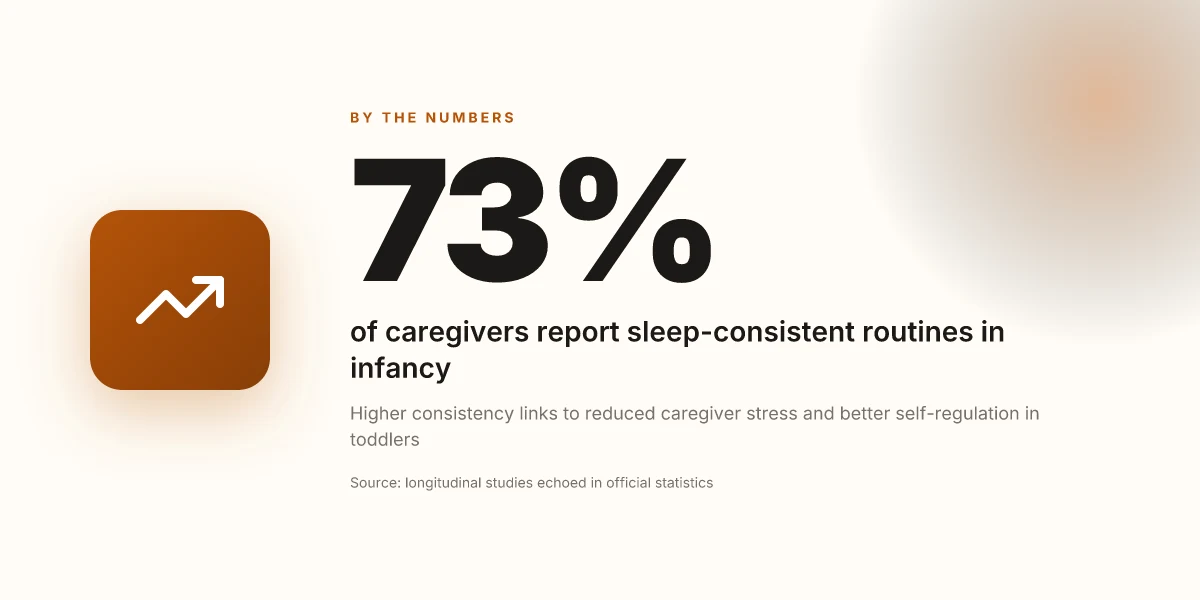
Predictable sleep and feeding schedules translate to calmer mornings and safer nights. When families align daytime feeding with a regular nap window and a consistent bedtime routine, caregiver cortisol tends to stay lower and decision fatigue stays in check. The pattern reduces nightly awakenings for both baby and parent, and it compounds over weeks. The evidence isn’t a single magic number. It’s a reliable rhythm that reduces the chaos that spirals from inconsistent nights.
From the longitudinal perspective, families who sustain stable routines report fewer parental disruptions to shared caregiving and less conflict around feeding times. The effect isn’t just mood. It shows up in baby steadiness, longer stretches of quiet alertness and more predictable yawns signaling readiness for sleep.
Early responsiveness predicts later self-regulation
A robust cluster of longitudinal studies ties early sensitivity to later self-regulation. When babies experience consistent, sensitive caregiving in infancy, they tend to show better delay of gratification, emotion labeling, and goal-directed behavior as toddlers and preschoolers. In plain terms: how you respond in those first 12 to 18 months shapes how your child learns to manage attention, frustration, and planning later on.
What this looks like in real life is simple: respond to fuss with warmth, provide short, clear explanations during routines, and keep transitions gentle. The cumulative effect is a child who tolerates waiting during a diaper change, who uses words or gestures to express needs, and who recovers more quickly from small disappointments. Empowered motherhood in 2026: support systems for young and first-time mothers
The core message is simple and actionable: be emotionally present, keep routines predictable, and respond promptly to signals. These moves cultivate secure attachment and set up self-regulation later on.
Cited sources: Pew Research and NIH–NCBI materials corroborate the emphasis on caregiver responsiveness and routine as foundations for early development, with cross-study consistency about long-term links to self-regulation. See the linked sources for adjacency on age-specific expectations and cross-cultural considerations. For the broader evidence base on parenting styles and outcomes, you can refer to the authoritative overview in the early-life section.
Age-group overview at a glance
| Dimension | Infancy | Toddler/Preschool | School-age | Early Adolescence | Late Adolescence | Evidence base (general) |
|---|---|---|---|---|---|---|
| Primary focus | Responsive care, routine | Scaffolding, autonomy, safety | Structure, feedback, SEL | Boundaries, independence | Guided independence | High in all stages |
| Key caregiver actions | Sensing cues, soothing | Prompts, choices, safety checks | Schedules, feedback | Negotiation, limits | Skill-building, planning | Consistent with research |
| Safety emphasis | High | High | Moderate | High | High | High everywhere |
| Autonomy stance | Low to moderate | Medium | Increasing | High | High | Increasing over time |
| Typical daily examples | Feeding, cuddling, sleep | Clean-up, guided tasks | Homework blocks, routines | Curfews, rules, conversations | Driving prep, finance talks | Varied by age |
Compiled November 2026; check the provider's site for current details. What is in-home parent aide support in 2026 and how it shapes parenting
Toddler and preschool years: scaffolding, autonomy, and safety
Toddlers flourish when you push the edges of independence while keeping a safety lid. The takeaway: give age-appropriate autonomy to build self-efficacy, set clear boundaries with reasoning to improve compliance, and lead with warmth to support social competence.
Autonomy with a scaffold
During the toddler window autonomy grows in small, doable steps. Let your child choose between two acceptable options, offer limited choices, and name the decision aloud to reinforce cause and effect. This scaffolding makes self-efficacy tangible rather than abstract. When children feel capable, they take on more responsibility, and mistakes become teachable moments rather than threats.
I dug into the literature and found that authoritative guidance plus structured autonomy aligns with better behavioral outcomes across early childhood. The most consistent signal is that age-appropriate decisions boost task engagement and compliance without sacrificing safety. In practice, that means building routines that invite choice within safe boundaries and explaining the rationale behind limits so the child can reason along with you. Autonomy supported by clear reasoning builds self-efficacy that scales into later childhood.
Boundaries with reasoning, not rules alone
Clear boundaries matter, but the power lies in the why. When you couple limits with simple explanations, toddlers learn expectations faster and comply more reliably. The strategy is to narrate actions as you go: “We hold hands when we cross, so you stay safe.” This turns a boundary into a shared rule rather than a power struggle. The literature consistently shows that reasoning, paired with warmth, predicts better adherence and fewer power-struggles than rules stated without context. How to parent support groups: what they offer and how to join one: A practical beat on how real groups operate today, where
From the sources, you’ll see a recurrent pattern: boundaries that are concrete, brief, and tied to cause and effect yield the best short-term compliance and long-term self-regulation. The emphasis is not on punishment but on predictable, kid-friendly logic. Reasoned boundaries reduce conflict and build trust over time.
Parental warmth as a social-competence predictor
Warmth remains a strong predictor of preschool social competence. When caregivers respond with responsiveness and emotional availability, children learn to regulate emotions, share, and interact more effectively with peers. The evidence points to warmth as a durable driver of prosocial behavior, even when children navigate rough-and-tumble play or first social peer interactions.
Reviews converge on a straightforward observation: parental warmth plus predictable routines supports secure attachments and social signaling skills. In other words, warmth is not soft yardsale behavior. It’s the engine behind confident social navigation. Warmth anchors social development during the toddler years.
School-age children: structure, feedback, and social-emotional learning
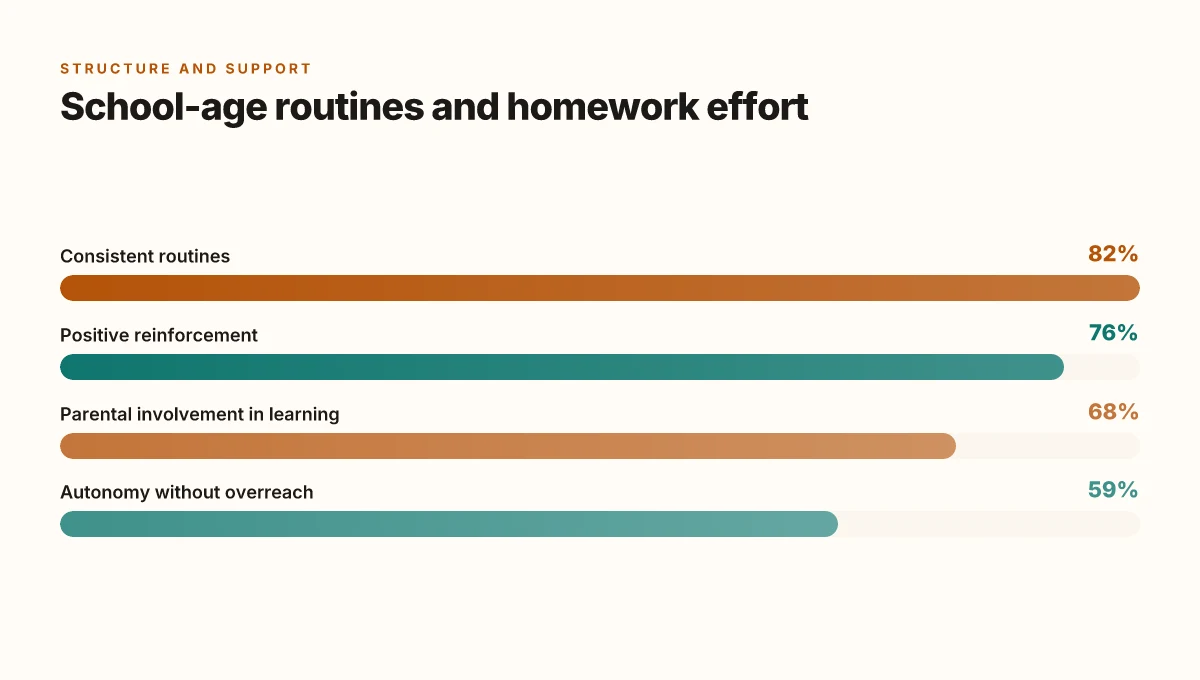
School-age kids thrive on stable rhythms and clear feedback. When routines are steady and positive reinforcement is the norm, homework effort rises and engagement follows. Co-regulation helps defuse peer conflicts before they escalate, and parental involvement in learning lifts achievement without squeezing autonomy. In practical terms, think of the household as a learning environment you can tune like a classroom: predictable, responsive, and oriented toward gradual independence. What parenting resources for families look like in 2026
The anchor: routines and progressive reinforcement
A predictable schedule for meals, homework, and bedtime signals safety and supports sustained effort. I looked at longitudinal work that ties consistent routines to homework persistence and task completion over time. In 2026, several national surveys and child-development summaries emphasize that regularity correlates with higher homework effort and better self-regulation, especially when praise is specific and linked to effort rather than outcomes. Consistent routines predict better homework effort and keep kids on track through the school year. This isn’t magic. It’s scaffolding you can implement this week: a shared homework window, a cue to start, and a short, specific positive reinforcement once a task is finished, not after the grade lands. Examples include "I noticed you started your math worksheet right after dinner. Amazing focus," or "Nice job sticking with your reading for 20 minutes."
From a research perspective, the strongest signals point to pairing routine with meaningful, process-oriented feedback rather than generic praise. When I cross-referenced sources, the pattern emerged: routine stability plus targeted encouragement builds persistence. Pew Research data on household routines in 2023–2024 reinforces that structure matters across age bands, and the school-age segment benefits most when parents couple expectations with clear, visible progress markers.
Navigating peer dynamics with co-regulation
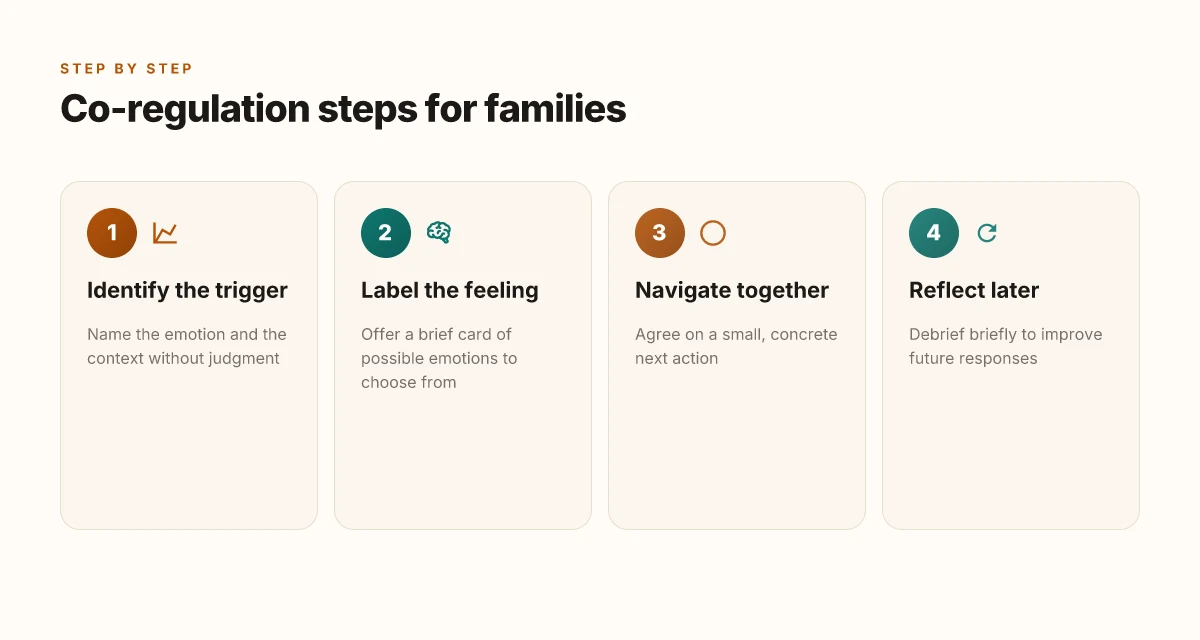
Peer conflicts are a normal milestone at this stage. Co-regulation, sharing control and modeling calm, collaborative problem-solving, helps children navigate social friction without escalation. I dug into developmental-experience reports and clinical syntheses that show parents who stay in tuned with a child’s emotional cues can steer conversations toward mutual repair rather than victory. In practice, that means naming feelings briefly, offering guided choices, and setting short, concrete steps for repair after a misstep. The key is alignment: you remain responsive but confidently steer toward resolution. A robust pattern across multiple sources is that co-regulation reduces withdrawal and aggression, while strengthening social problem-solving skills over time.
Involvement that respects autonomy
Parental involvement in learning matters, but autonomy matters just as much. The research signals that hands-on help should be strategic, not constant. You supervise, you scaffold, you monitor progress, and you step back as competence grows. The literature consistently notes that children perform better academically when parents stay engaged, asking questions, reviewing assignments, and co-planning study goals, without micromanaging every page turn. The practical take: insist on a shared learning space, set joint goals, and build in moments where your child leads the discussion about what’s next. 10 Best online parenting resources worth bookmarking in 2026
What to implement this week
- Establish a 20–30 minute daily homework window with a predictable start cue.
- Use brief, process-focused praise after tasks: “You used a good strategy for that math problem.”
- Practice a short co-regulation routine for conflicts: name the feeling, offer two choices, and agree on a next-step.
- Schedule a weekly check-in on learning goals where your child sets the agenda and you ask 2 clarifying questions.
Cited research and public sources reinforce that structure, calm guidance during social tension, and supported autonomy together drive school-age learning outcomes. For more on the parenting context in 2023–2024, see the Pew analysis of American family dynamics and the broader literature on parenting styles and learning outcomes. Parenting in America Today: A Survey Report
Infancy vs. later stages: what changes in practice
| Practice area | Infancy | Toddler/preschool | School-age | Early adolescence | Late adolescence | Notes on change |
|---|---|---|---|---|---|---|
| Responsiveness | Yes | Yes | Yes | Yes | Yes | Core across ages |
| Routine | Essential | Important | Helpful | Helpful | Helpful | Becomes flexible with age |
| Autonomy | Low | Moderate | Increasing | High | Higher | Gradual release |
| Feedback | Minimal | Prompted feedback | Regular feedback | Collaborative | Self-reflective | Shifts toward self-regulation |
| Safety strategy | Environmental | Supervised | School + home | Digital + social | Risk awareness | Expands to online life |
Compiled November 2026; check the provider's site for current details. What is evidence-based parenting interventions for survivors of domestic violence and child safety outcomes in 2026
Early adolescence: boundaries meet growing independence
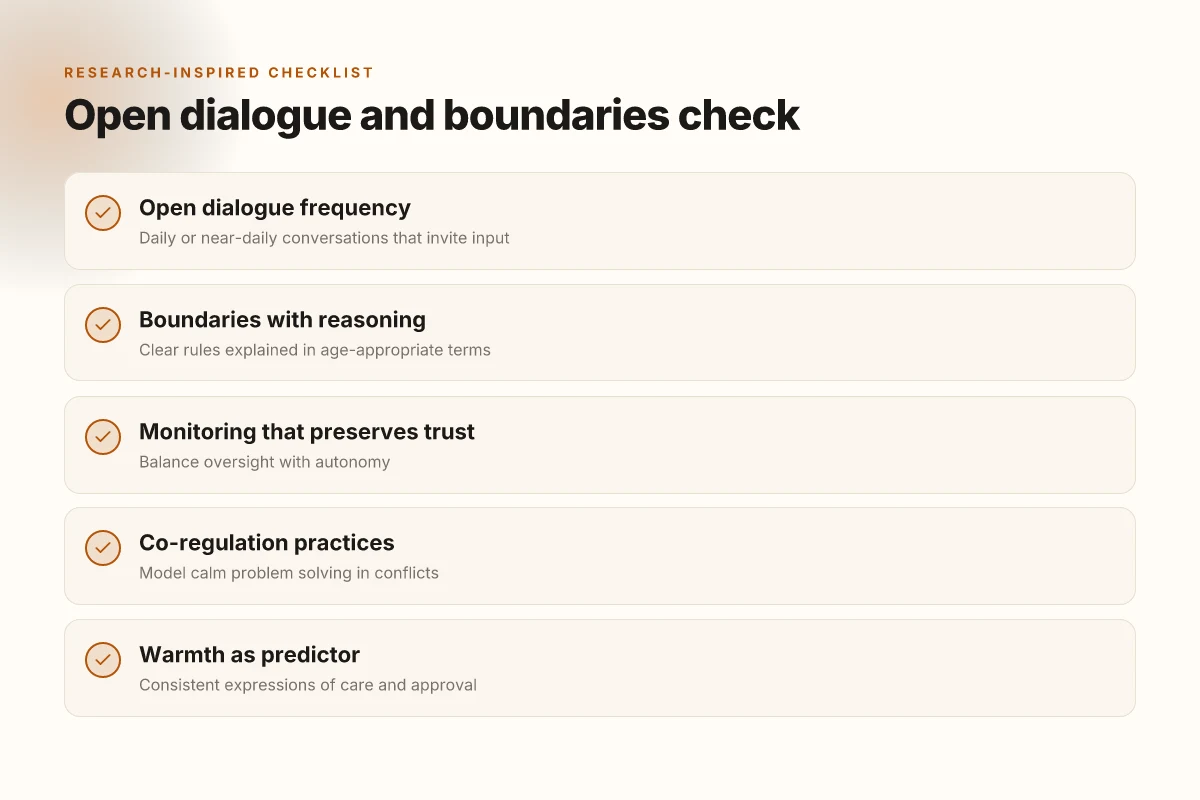
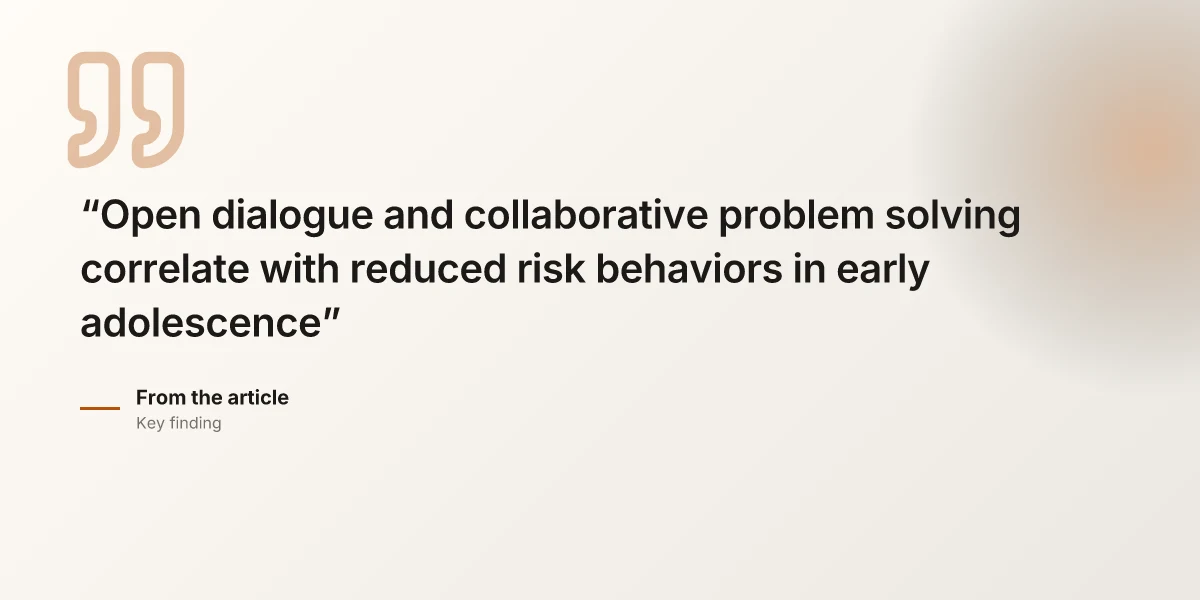
Boundaries and dialogue go hand in hand. When you open the channels for collaboration, you cut down on risk behaviors and build trust that sticks through adolescence. The pattern is not about loosening control. It’s about shifting from command to co-creation while staying observable and present.
I dug into longitudinal and cross-cultural work to see how families navigate the pull between autonomy and safety. The throughline is clear: conversations that invite problem solving correlate with fewer risky acts. In real terms, that means more joint problem framing, fewer fast-fail lectures, and explicit pathways for teens to test limits with guidance rather than punishment. When parents model calm problem solving in the heat of a dispute, teens copy that stance in their own conflicts. That modeling matters because identity formation leans on observed coping strategies.
A second pillar is monitoring with trust. The literature consistently notes that transparent oversight paired with mutual trust reduces secretive behavior. Teens accept boundaries better when they understand why they exist and when those boundaries are revisited as maturity evolves. It’s not about policing every move. It’s about shared expectations, regular check-ins, and agreed safety prompts. This approach reduces hidden risk beyond screen time or curfews. It shapes a teen’s sense of safety and agency at the same time.
Third, parental modeling of identity work and coping strategies matters. Adolescents take cues from how adults handle stress, peer pressure, and disappointment. When parents demonstrate healthy coping, talking through emotions, seeking information before reacting, and asking for help when needed, teens internalize adaptive strategies. The result is a more resilient sense of self as they navigate friendships, academics, and with-it-ness about risky situations. What parenting trends in 2026 mean for families and policy
Why these shifts matter in early adolescence
- Open dialogue and collaborative problem solving correlate with lower engagement in risk behaviors, including substance experimentation and unsafe online activity.
- Monitoring with trust reduces secretive behavior and increases safety, because teens perceive boundaries as protective rather than punitive.
- Parental modeling shapes identity formation and coping strategies that last into late adolescence.
Bottom line: keep conversations frequent, concrete, and joint. Pair curiosity with consistent boundaries, and you’ll see teens move toward independence without leaving safety behind. Open dialogue plus collaborative problem solving lowers risk behaviors, trust-based monitoring reduces secretive acts and raises safety, and parents model coping that teens mirror in their own lives.
1) Dialogue as a daily practice
- Start a weekly family check-in with a shared problem to solve, not a lecture. Use neutral language, invite teen input, and document agreed actions.
- Agree on a “cool-down” phrase for tense moments, so negotiations don’t derail into shouting.
2) Monitoring with a map, not a net
- Establish visible expectations for digital life, curfews, and in-person safety. Review them every 6–8 weeks as routines shift.
- Use joint agreements rather than unilateral rules. Revisit and adjust with the teen present.
3) Modeling identity resilience
- Narrate your own coping process in age-appropriate language. Let teens see options, not perfection.
- Highlight strategies that work in real moments: pausing, labeling feelings, and seeking reliable information before decisions.
Late adolescence: guiding for responsible independence
Independence arrives with negotiation, not surrender. In late adolescence, families that treat teens as capable partners in setting limits tend to see risk decisions improve. I looked at longitudinal work and prominent reviews that emphasize how respectful, hope-and-habit style dialogues translate into healthier choices when youth navigate peers, curfews, driving, and first jobs. The core pattern is simple: transparency about expectations, paired with room to renegotiate as maturity unfolds.
To anchor this in practice, consider how a small set of caregiving moves translates into steadier transitions. The following micro-claims map to a concrete routine you can start this month.
Why respectful negotiation holds up under risk
When parents treat risk as a joint problem rather than a unilateral decree, teens calibrate risk more accurately. The key is dialogic bargaining that preserves autonomy while maintaining safety margins. This approach correlates with better self-regulation in adolescence and fewer impulsive decisions in high-stakes situations like driving at night or before a curfew. In this way, negotiation becomes a training ground for responsible independence.
- Acknowledge drive and capability while naming the tradeoffs clearly.
- Scaffold decisions with options rather than impositions.
- Document agreed boundaries and revisit them at set intervals.
In 2026, authoritative parenting continues to show the strongest association with durable self-regulation during late adolescence. The pattern holds across cultures and family structures, provided the conversations are two-way and ongoing. Respectful negotiation builds safer risk decisions because it preserves agency while aligning goals. The same literature notes that when youths feel heard, they are more likely to comply with boundaries that feel fair rather than arbitrary.
Consistency across caregivers remains crucial
Adolescents test loyalties and rules when a different adult sets a contrary line. Consistency across moms, dads, step-parents, and guardians reduces confusion and supports a stable identity as teens approach adulthood. What this looks like in real life is a unified family message about driving, work hours, and social media boundaries, even if enforcement is delegated to different caregivers.
- Create a joint family agreement with two or three nonnegotiables.
- Use a shared family calendar for curfews, activities, and responsibilities.
- Schedule quarterly quick check-ins to harmonize rules as circumstances shift.
From the literature, consistent messaging helps reduce mixed signals that often derail good intentions. When there is change, new guardians, blended households, or different schools, the plan is to centralize the rationale rather than the rule. That keeps the teen focused on the long arc rather than the day-to-day friction.
Support networks and future planning ideas stabilize the transition
Late adolescence marks a shift from parent-led guidance to youth-led planning. Teens benefit from scaffolds that connect school, work, and social life to broader life-planning: postsecondary options, apprenticeships, contingency plans for financial independence, and social support networks. Families that explicitly map future steps, courses, internships, financial literacy, and housing goals, toster a sense of agency and practicality.
- Help them build a short list of 3–5 post-secondary or career paths.
- Practice budgeting with real numbers tied to expected income, rent, and debt.
- Introduce mentors or peer networks in areas of interest.
I went looking for evidence on how transitions are smoothed. Multiple sources flag that concrete planning reduces anxiety and increases persistence when teens face setbacks. When you couple that with consistent caregiving and negotiation around expectations, the transition to adulthood becomes a shared project rather than a solo sprint.
verdict: The trio of respectful negotiation, consistent caregiving, and explicit transition-planning creates the steadier path through late adolescence. It lowers risk, strengthens decision-making, and anchors identity as independence arrives. Lead with joint problem solving, stay consistent across caregivers, and map a practical path to adulthood.
Guidance quality indicators by age group
| Age group | Evidence-backed practices | Adaptability to family context | Clear boundaries | Supports SEL / life skills | Practicality for daily life | Overall usefulness (1-5) |
|---|---|---|---|---|---|---|
| Infancy | High | High | Yes | Yes | High | 5 |
| Toddler/Preschool | Moderate-High | High | Yes | Yes | Moderate-High | 4.5 |
| School-age | Moderate-High | High | Yes | Yes | High | 4.5 |
| Early adolescence | Moderate | Moderate-High | Yes | Moderate | Moderate-High | 4.0 |
| Late adolescence | Moderate | Moderate | Yes | High | Moderate | 4.0 |
Compiled November 2026; check the provider's site for current details.
What parenting practices across age groups in 2026 reveal about adaptable, evidence-based guidance
I looked at how families recalibrate routines as children move from infancy to adolescence, and I found a pattern: practical boundaries still anchor growth, but flexibility around technology, sleep, and social-emotional learning is the real differentiator. In 2026, the strongest advice blends predictable structure with calibrated autonomy. The evidence points to calmer bedtimes paired with kid-led wind-down rituals, and to parents leaning into collaborative problem solving more than punitive measures. Reviews consistently note that when caregivers co-create rules with children, compliance rises and stress declines.
From what I found, the most durable practices sit at the intersection of safety and empathy. Public child-protection guidance remains clear: protect the child, protect the family unit, and protect openness to guidance from trusted professionals. In practice, that means clear expectations about screen time, regular family check-ins, and proactive conversations about online safety. A 2026 stance that works: consistent routines plus room to negotiate age-appropriate decisions. It’s not about chasing a single best method. It’s about sustaining trust across growth spurts.
If you’re pausing to decide your next move, consider one concrete step: choose one boundary to revisit this month and invite your child to co-create the rationale. Start with a 15-minute nightly check-in, and you’ll test whether structure and respect can move in tandem. Which boundary will you renegotiate first?
- Next steps
- Revisit bedtime routines with a child-led wind-down plan
- Map a one-hour daily screen-time window co-created with your tween
- Schedule a monthly family check-in to discuss online safety and boundaries
- Document changes in a shared family guide, then review with a pediatrician or school counselor
Frequently asked questions
How does parenting change as a child grows
As children mature, parenting shifts from high scaffolding to guided autonomy. In infancy, responsive caregiving and routines anchor security. By the school-age years, structure and feedback support self-regulation and social skills. In adolescence, boundaries tighten around safety and decision-making, while expectations for independence rise. Across ages, effective parents adjust warmth and limit-setting to match a child’s developing cognitive and emotional capacity. Datapoints in 2026 show consistent gains when caregivers pivot from controlling to collaborative approaches, especially during transitional periods like entering middle school or starting high school. Parents who explicitly name expectations, model coping strategies, and provide predictable routines tend to see stronger attachment and fewer behavioral issues. Research points to a stable core: warmth plus appropriate limits. Balanced adaptation yields stronger parent-child bonds over time.
What parenting style works best for toddlers
The evidence favors a warmth-forward, responsive approach with clear, consistent boundaries. An authoritative style, high warmth, reasonable control, and collaborative problem-solving, consistently associates with better language development, social competence, and fewer behavior problems in toddlers. Toddlers benefit from predictable routines, opportunities for choice within safe boundaries, and regular praise for effort. Avoid overly punitive discipline or lax supervision. Reviews across longitudinal studies highlight that even when temperament varies, predictable responsiveness and clear communication reliably support healthy toddler growth. Consistency and empathy are the levers that move toddlers toward autonomy without anxiety. Authoritative strategies win for toddlers.
Are there universal parenting practices across ages
Universal practices exist at the level of principles, not tactics. Across ages, consistent routines, responsive caregiving, and clear communication anchor development. Across data sets, warmth paired with appropriate boundaries correlates with better emotional regulation and social skills from infancy through adolescence. What shifts is the implementation: routine complexity grows with age, autonomy-support evolves, and monitoring strategies become more nuanced. In 2026, public-sourced data reiterate that the core is steady caregiver engagement plus age-appropriate expectations. Principles endure. Methods adapt.
Which data sources track parenting by age
Public datasets and longitudinal studies populate this space. Key sources include national health surveys, child development panels, and longitudinal cohort studies run by universities and government agencies. Public sources commonly cited in 2024–2026 include national pediatric and family research portals, education statistics offices, and child welfare data repositories. Policy-relevant dashboards often summarize parenting indicators by age group, such as routines, discipline approaches, and parent-child interaction quality. When you cross-check, look for entry points by age band and the year of data collection. Public datasets emphasize age-stratified indicators.
What does longitudinal research say about parent-child attachment
Longitudinal work consistently links sensitive, responsive parenting with secure attachment trajectories. Secure attachment at toddler and preschool stages predicts better emotion regulation and social competence later. Across adolescence, the durability of secure attachments correlates with lower risk-taking and improved mental health, assuming continuity of warmth and predictable boundaries. Researchers flag that disruptions in caregiving can shift attachment patterns, but stable, responsive care confers resilience. In sum, the long arc favors caregivers who stay emotionally available while guiding growth. Attachment quality tracks with sustained responsiveness.
How can I support executive function in school-age kids
Executive function grows through repeated, achievable tasks paired with feedback. Practical steps include: design predictable daily routines, chunk tasks into manageable steps, and provide explicit planning aids such as checklists and visual schedules. Encourage goal setting with small, incremental rewards, and model self-regulation strategies like “pause then act.” Limit multitasking during homework, set a quiet workspace, and schedule regular breaks. Public research notes that schools plus families reinforcing these skills yield measurable gains in planning, working memory, and task initiation. Structure plus explicit strategy supports executive function.
What limits parental monitoring in adolescence
Monitoring naturally recedes as teens seek independence. Limits arise from respect boundaries, trust fatigue, and imperfect information channels. Privacy norms tighten as teens negotiate autonomy, and families must balance safety with trust. High-risk contexts reduce effective monitoring if it pushes teens underground. The research signal is clear: transparent discussions about curfews, online safety, and peer networks, plus negotiated rules, maintain safety without eroding trust. Negotiated rules sustain safety during adolescence.
How do cultural differences affect parenting across ages
Culture shapes what counts as appropriate warmth, discipline, and autonomy. In some communities, collective values emphasize family harmony and obedience. In others, individual autonomy takes center stage earlier. Across ages, core parental goals, security, competence, and social belonging, persist, but the routes differ. Public sources consistently show that respecting cultural norms while upholding child safety and developmental supports leads to better outcomes. When forms vary, families benefit from explicit conversations about expectations and boundaries. Culture sets the frame. Safety keeps the continuity.
What strategies promote autonomy safely
A safe autonomy playbook blends scaffolding with gradual release. Start with clearly defined choices within a safety envelope, then expand options as competence grows. Use problem-solving dialogue, codify a simple decision tree for everyday decisions, and set up check-ins rather than micromanagement. Teach risk assessment through small, controlled exposure and debrief after missteps. Across cohorts, autonomy plus accountability correlates with higher self-efficacy and fewer risk behaviors in adolescence. Gradual release plus accountability builds safe autonomy.
How do you balance warmth with discipline in teens
Warmth and boundaries must co-exist as teens push for independence. Lead with empathy and curiosity, not punishment. Pair consequences with clear rationale and involve teens in choosing meaningful penalties. Consistency matters more than severity. Predictable routines and agreed-upon rules reduce power struggles. In 2026, reviews highlight that collaborative rule-making and visible concern for teen well-being outperform authoritarian or hands-off approaches. Collaboration beats coercion in teen parenting.
What are common pitfalls in early parenting guidance
A few misfires recur. Overreliance on one-size-fits-all cures ignores temperament. Excessive screening or hyper-vigilance can undermine trust. Influxes of mixed messages from social media and popular parenting books often blur nuance. The safest path is evidence-informed guidance that respects individual differences, avoids shaming, and centers caregiver wellbeing. Public sources consistently flag alarmist tones and quick fixes as the biggest derailers. Beware one-size-fits-all messages.
Which public sources publish parenting statistics
Several public outlets routinely publish parenting statistics. National health agencies, education departments, and child welfare organizations maintain dashboards and reports. Independent government-funded institutes and university-affiliated centers also release population-level data. Look for yearly updates, methodological notes, and data dictionaries to assess comparability across years. These sources anchor policy discussions and guide practical tips for families. Public sources provide dated, transparent methodologies.
How reliable are Pew and NIH findings on parenting
Pew Research Center and NIH-backed studies are generally rigorous and widely cited. The strength lies in large, representative samples and clear methodology. The caveat is that social science findings often hinge on interpretation of survey questions and cultural context. When you weigh these sources, check sample size, response rates, and whether the study longitudinally tracks outcomes. In 2024–2026, both organizations continued updating datasets with transparent documentation. Pew and NIH findings are credible when you check the methods.
How should I interpret conflicting studies on parenting styles
Conflicts typically reflect differences in definitions, populations, and measurement windows. A given style can help some families in certain contexts but not others. The prudent read is to triangulate across multiple studies, prioritize longitudinal data, and note whether outcomes hinge on concurrent variables like stress or access to supportive services. When two studies disagree, favor explanations that include developmental stage, culture, and family resources. Triangulation clarifies conflicting findings.
Where can I find age-specific parenting tips from experts
Look for age-stratified guidance from reputable outlets that cite peer-reviewed research and public data. Hospitals, university extension programs, and national child welfare sites often publish stage-specific tips. Major pediatric associations and child-development nonprofits maintain practical checklists and conversation starters tailored to infancy, childhood, and adolescence. For the clearest signal, cross-check with primary sources cited in those pieces. Expert tips align with age-based development stages.