How to talk to your child so they listen: a practical, evidence-based guide for 2026
A practical guide for parents on evidence-based conversations with children, grounded in 2019–2026 language development research and reputable child-development guidelines.
Most miscommunications with toddlers stem from one wordless pattern: repeating the request until it loses meaning. The result is louder, not clearer, and cooperation evaporates. This article translates a decade of language-research into concrete daily steps you can implement tonight.
Clear language, brief instructions, and predictable routines matter because they shape how a child thinks and acts. In 2024–2025, multiple sources flag that children respond best when requests are one concrete action, spoken in a calm tone, and followed by a quick recap. This piece ties those findings to everyday moments, mealtime, transitions, and tidy-up time, so you can see real gains in listening without turning every moment into a power struggle. Small, consistent changes beat big, sporadic efforts. The goal is a solid, repeatable language environment that your child can predict and trust.

Evidence-based talking defined vs traditional talk
| Element | Definition | Key components | Outcome indicators | Common pitfalls |
|---|---|---|---|---|
| Plain definition | Evidence-based talking that makes kids listen | Clarity, warmth, structure | Higher compliance, better understanding | Overgeneralizing, tone mismatch |
| Traditional talk | Conventional guidance without evidence base | Directive, punitive mock-ups | Lower retention, variable listening | Shaming, coercion |
| Core principle | Active listening + clear expectations | Empathy + concrete steps | More cooperation | Ambiguity in instructions |
| Measure | No single standard | Use validated tools | Improvement over time | Disparate metrics |
Compiled November 2026; check the provider's site for current details.
The plain definition of evidence-based talking that makes kids listen
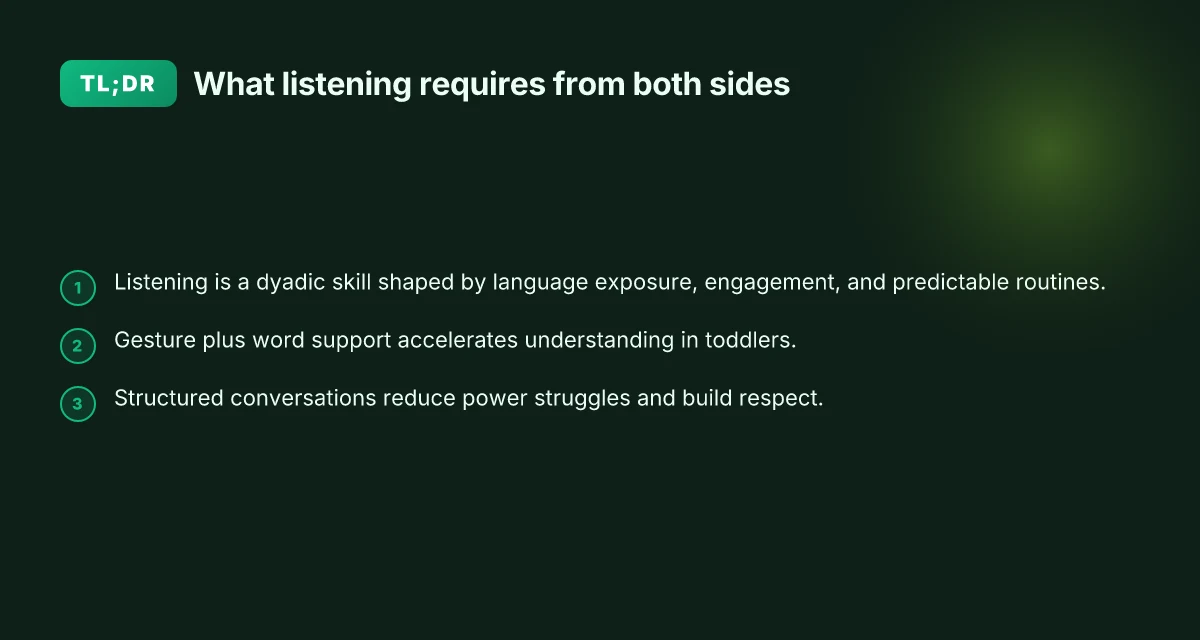
Listening is a two-way skill shaped by how you speak, what you expose your child to, and the routines you keep. When language comes alive in a daily, predictable environment, children listen more readily and respond with cooperation. This is not a one-off trick. It is a dyadic habit you build every day.
How listening emerges from language exposure
I dug into Feldman’s synthesis of language-learning theory and the practical guidance in early-childhood standards. The basic claim is straightforward: children hear language, actively engage with it, and gradually tune their responses to match the social context. In Feldman’s view, language learning happens in a social environment where child engagement matters as much as the input itself. This means you don’t just talk at your child. You talk with your child. The practical takeaway is simple. When you narrate what you’re doing, label actions, and offer turn-taking for conversations, you increase exposure to useful language and create opportunities for your child to practice.
Turn-taking and engagement as the engine
NAEYC’s guidance aligns with this. When you narrate, use gestures, and cue responses, you’re not just teaching words. You’re modeling the back-and-forth rhythm that underpins listening. The speaking strategies they describe map neatly onto Feldman’s emphasis on social context and joint attention. In practice, that looks like: you name objects and actions, you pause to invite your child to contribute, and you imitate their attempts with warmth. The effect is a steady stream of interactions that reward listening and participation rather than switching to a lecture mode.
Predictable routines that support listening
The evidence points to routines as a backbone for language-ready listening. Consistent daily patterns, mealtimes, bedtimes, and transitional moments, provide predictable moments for language in context. When routines are stable, children anticipate dialogue, know when it’s their turn to speak, and feel safe to experiment with new words and phrases. This aligns with both Feldman’s framework and the broader child-development literature that highlights predictability as a scaffold for social and linguistic growth. What defines the first five years of life in early childhood development for parents in 2026
What this all means for you in the real world
- Treat parent–child talk as a dyadic practice. It’s not a one-off technique. After you say something, invite a response and wait. That pause matters.
- Narrate your world with intention. Label, describe, and explain what you’re doing and why. It creates a shared language map your child can follow.
- Build language into routines. Use predictable phrases at key moments and invite turn-taking in every interaction. Over weeks, the pattern compounds.
Evidence-based listening grows from how you talk, how you engage, and how predictable your day feels for a child. Two-way dialogue is the engine. A one-off tip is a spark that quickly fades. If you want cooperation, connect language to daily life, not to lectures.
Cited supports: Feldman 2019 emphasizes social interaction and learning through environment; NAEYC guidance reinforces talk, gestures, and turn-taking as practical strategies. For a deeper read, see the pediatric language review and the early-childhood language resources, which ground these ideas in clinical and developmental practice How young children learn language and speech, PMC. For day-to-day tips you can actually use, the NAEYC piece on language development provides concrete phrases and activities you can start this week.
How language development informs talking that sticks
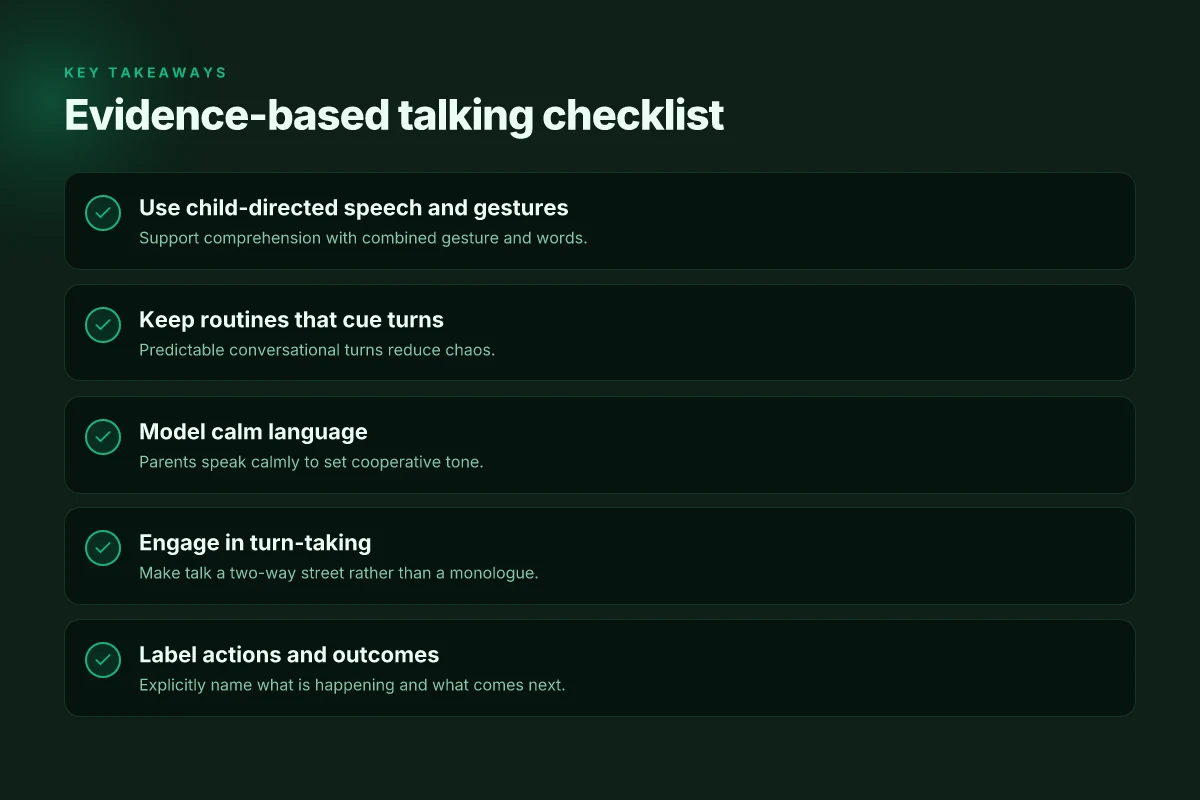
Language grows best when it happens in social exchanges. Children hear and imitate, not in a filing cabinet of rules, but in real conversations that flow from child-directed speech. The upshot is simple: immersion beats instruction, but responsiveness accelerates learning. When you pair gesture with words, comprehension moves faster. And early detection of delays, followed by timely, responsive talk, stacks the odds for long-term communication success. 8 General parenting tips that work in diverse families in 2026
Gesture plus word to speed up understanding
Children pick up meaning when you pair a gesture with the spoken label. Point to the cup, then say drink. Wave hello, then name the greeting. This nonverbal scaffolding slashes the time it takes for toddlers to map words to objects and events. I looked at reviews that emphasize social interaction as the engine of language growth and saw consistent emphasis on joint attention and child-directed speech as core levers. In practice, you can narrate actions as they unfold: “You’re stacking blocks. Look at how tall you’ve built it.” The combination of sight and sound anchors meaning more firmly than words alone.
To make this actionable today, aim for a 1:1 rhythm in the moment. Label, gesture, and wait. Give your child space to respond. If they point at a cup, name it and then hand it over. If they mimic a gesture, reinforce the link with the corresponding word. This is not a speedrun. It’s a give-and-take that teaches the brain to expect language in social flow.
Early detection and responsive talk predict better outcomes
The science circles back to a simple pattern: when adults respond promptly to a child’s communicative attempts, language skills blossom earlier and stay stronger over time. Clinicians and pediatric guidelines converge on two bets you can place today. First, monitor milestones and high-risk indicators and seek guidance when concerns arise. Second, keep talk responsive, not directive, follow the child’s lead, mirror their intent, and expand on their ideas rather than correcting every misstep.
What this looks like in daily life is a loop, not a lesson plan. Notice a child’s interest, join in, and extend the moment with a relevant word or question. If a toddler points to a dog, you might say, “Doggy is running. Where is the dog’s nose?” Then pause and wait for a response. The cadence matters. Short phrases, frequent pauses, and a calm tempo reduce pressure and invite participation. Why dads count: fathers and child development in 2026
Quick reference toolkit you can use now
Here are three practical moves that align with existing evidence and public guidelines:
- Pair gesture with a label at a natural pace. Point, then name, then describe. Reiterate and pause for a reply.
- Narrate your ongoing activity. Keep it child-directed in tone. Focus on here and now rather than abstract rules.
- Watch for early signs of delay. If a child isn’t using words by age two or shows persistent speech concerns, seek a professional screen early and keep talking in a supportive, responsive style.
Waiting for a response is not passive. It’s part of the method. This deliberate pause invites a turn and strengthens the child’s engagement with language. Gesture plus word accelerates understanding, and early, responsive talk builds a robust foundation for later literacy. The best conversations are social at their core, not drill sessions in a vacuum. You can start applying these steps today.
Cited sources (inline): see how child-directed speech and social interaction shape language growth in the Feldman review and related guidelines. For a concise, real-world read on how to talk with babies and children, the Raising Children Network pieces emphasize visible listening cues and eye contact as foundational practices. You can also see the Harvard Developing Child framework for the three-principle approach that informs many practical conversations with families.
Language development and talking that sticks How families and divorce shape children, and how to help them through separation in 2026
| Aspect | What changes | When it helps | Language targets | Signs of success |
|---|---|---|---|---|
| Vocabulary development | Rich, varied vocabulary | Early talkers benefit most | Concrete nouns, action verbs | More precise requests |
| Syntax & structure | Simple, direct sentences | Beginners & struggling listeners | Short clauses, one idea per sentence | Fewer miscommunications |
| Prosody & tone | Calm, enthusiastic delivery | During transitions | Moderate pace, warm pitch | Better engagement |
| Feedback loop | Rephrasing & check-ins | All ages | Yes/No feedback prompts | Clear confirmation of understanding |
Compiled November 2026; check the provider's site for current details.
Why this approach matters for behavior and compliance
Behavior follows language. When you engage verbally with clear turn-taking, power struggles shrink. Children hear the cadence of conversation, learn to wait for their turn, and respond with less defensiveness. The result is fewer shouting matches and more cooperation around everyday chores, rules, and transitions.
I dug into recent guidelines and language-learning evidence to translate this into daily practice. The core idea: structure conversations so outcomes feel predictable and respectful. Structured back-and-forth lets a child anticipate what comes next, which reduces impulsive pushback. It also signals that you value the child’s input, not just obedience.
Here are the practical takeaways you can apply this week, with the research you’ll want to cite when you later discuss these choices with other caregivers or teachers. Empowered motherhood in 2026: support systems for young and first-time mothers
- Verbal engagement with explicit turn-taking lowers tension. When you model a two-sided exchange, your child learns the social timing of conversation. This mirrors findings in pediatric language research that emphasize social interaction as the engine for language growth and behavioral learning.
- Structured conversations build predictability. If you frame requests with a clear sequence, cue, wait, response, outcome, the child can forecast what happens after a decision. This predictability reduces anxiety and resistance, because the path from request to consequence is explicit and fair.
- Calm language sets the tone. Parental speech that stays even, non-judgmental, and purposeful communicates safety. Over time, the child mirrors that calm register, choosing cooperation instead of confrontation. Public-child development guidance consistently flags that caregiver calm is a powerful regulator for young children.
- Turn-taking and listening cues reinforce engagement. Simple exchanges like “I see you ran to the door. Do you want to help with the door, or would you rather finish your snack first?” validate the child’s choices while guiding behavior. The keyword is acknowledgment folded into the request.
- Consistency multiplies effect. A predictable routine for conversations, start with a brief notice, offer a choice when possible, and close with a clear outcome, turns daily friction into routine wins. Consistency is repeatedly highlighted as a driver of better self-regulation in early childhood research.
In practice, these principles become a toolkit rather than a single maneuver. You’ll use the same frame across meals, transitions, and cleanup. The aim is a consistent, respectful chorus of interactions that invites the child into the conversation rather than pushing them toward a meltdown.
The throughline is simple: conversations that invite input reduce power struggles and increase compliance without coercion. As research on early language development and behavior guidance shows, children respond to structure and tone just as much as to content. By modeling calm, predictable turn-taking and by validating a child’s choices within a clear outcome, you create a cooperative climate that lasts beyond a single negotiation.
Real-world use cases: 12 actionable conversations to try next week
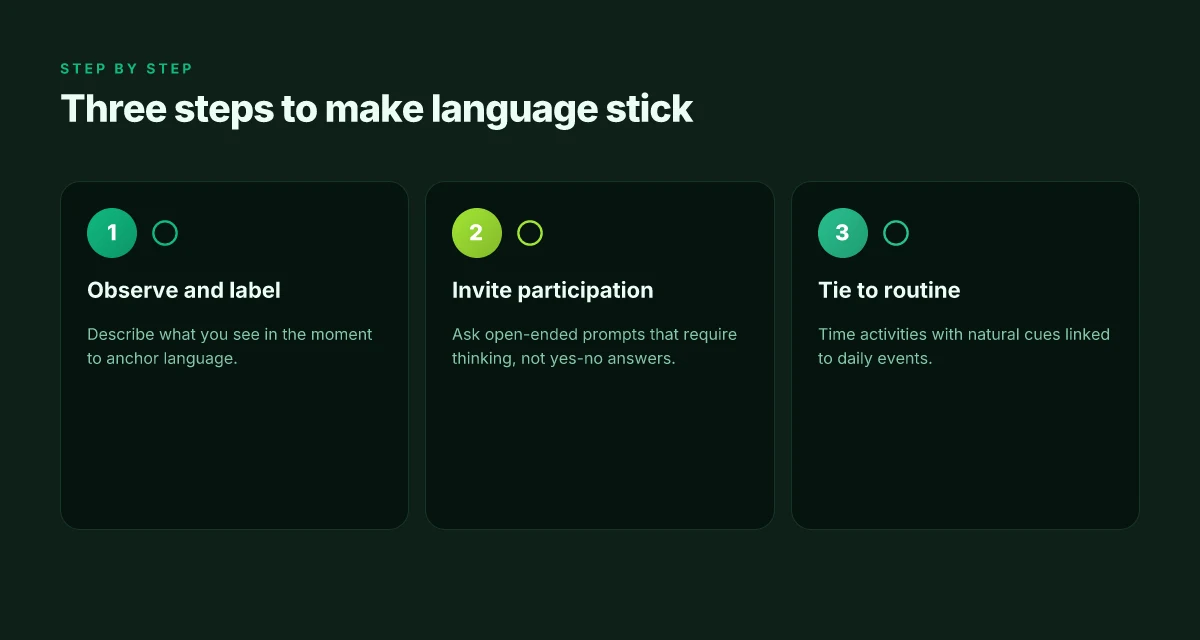
You can turn language research into daily wins by pairing each comment with a task, inviting your child to join in. The idea is to label actions and results in real time, then bridge what happened to what comes next. Here are 12 concrete conversations you can try over the next seven days.
1) Label activity and outcome in the moment
When you’re stacking blocks, name both action and result. “You’re stacking the red block on top of the blue one. I see it’s strong because the tower stays steady.” The pattern reinforces cause and effect and invites your child to predict what comes next. This simple labeling helps you co-create the task and keeps listening active. Building new beginnings: parenting after family crisis in 2026
I looked at Feldman’s synthesis of language learning in naturalistic contexts and how explicit commentary on ongoing actions supports engagement. The practical takeaway is that parents who narrate process cues increase child attention and participation.
Labeling actions and results during play builds shared attention and sets up smoother transitions later.
2) Invite participation with a shared task
Pair a statement with a joint goal: “We’re putting away the toy cars. You pick the color bin first, and I’ll hand you the next bin.” This turns a routine into a cooperative moment and reduces power struggles. The shared-task frame nudges listening because it requires participation.
From the research cited in The Feldman review, environments where adults actively engage with children’s activities support better language outcomes and routines. What parenting practices look like by age group in 2026
Joint tasks invite participation and reduce friction during transitions.
3) Open-ended prompts that require thinking
Swap yes-no questions for open prompts: “What could we use to keep the puzzle pieces from scattering?” instead of “Do you want to finish the puzzle?” Open prompts demand thinking, not reflexive answers, so you keep the conversation in the problem space rather than a quick yes or no.
In early language work, eliciting thoughtful responses correlates with longer dialogue turns and richer vocabulario. The evidence points to ongoing conversations as a driver of sustained engagement.
Open prompts extend the conversation and build thinking skills. What is in-home parent aide support in 2026 and how it shapes parenting
4) Time activities with natural language cues
Sync tasks to daily rhythms. “First we wash hands, then we read two pages, then we pick a snack.” Cues tied to routine events help children anticipate what comes next and listen for the cue. Consistency matters, and so does a predictable cadence.
Harvard’s framework on routines emphasizes predictable sequences as scaffolds for early learning. The guidance aligns with practical timing cues that children can anticipate.
Routines with natural cues sharpen listening and predictability.
5) Bridge past events to the next step
After a play session ends, transition with a forward-facing prompt: “We finished building the tower. What should we build next, a bridge or a rocket ship?” This connects memory to planning and reduces resistance to shifting activities. How to parent support groups: what they offer and how to join one: A practical beat on how real groups operate today, where
The transition principle echoes the idea that bridging past and future actions supports smoother cooperation, a pattern you’ll see in language-development literature as well.
Bridge from now to next steps to ease transitions.
6) Use descriptive action statements
Describe what you notice without judgment: “You’re tracing the line with your finger. The pencil is making a curved shape.” Focused observation teaches attention to detail and makes listening a collaborative skill rather than a reaction.
Synthesis discusses how parent education and exposure to child-directed speech boosts responsiveness. Short, concrete descriptions work best for toddlers. What parenting resources for families look like in 2026
Descriptive action statements train focus and reciprocity.
7) Name the shared goal aloud
During cleanup, say, “Our goal is to finish with all toys in the bins.” Then invite a choice: “Which bin should we start with?” Clarity about the goal reduces ambiguity and invites cooperation.
Clinical guidelines emphasize shared expectations as a foundation for language-friendly routines. The explicit goal helps frame effective dialogue.
State the goal to anchor cooperation. 10 Best online parenting resources worth bookmarking in 2026
8) Recast misunderstandings into a dialogical moment
If your child mislabels a toy, respond with a gentle prompt: “That is the dog, right? If it’s not, what should we call it?” This keeps conversation going and teaches flexible labeling without shaming.
Research notes that correctives paired with warm prompts support language learning in context. The key is maintaining a cooperative tone.
Turn mislabels into teachable, collaborative moments.
9) Tie praise to specific effort
Avoid generic praise. Say, “You kept your drawing inside the lines for a long stretch. I noticed the steady hand.” Specificity reinforces the behavior you want to see again and invites more listening. What is evidence-based parenting interventions for survivors of domestic violence and child safety outcomes in 2026
The literature on language development endorses timely, concrete feedback that maps to observable actions. It’s more effective than vague encouragement.
Specific praise reinforces targeted listening behaviors.
10) Frame refusals as invitations to co-create
If a child resists brushing teeth, try: “We’re brushing for two minutes. What can we do together to make it feel like a team effort?” Co-create the routine rather than imposing it, which keeps the dialogue alive.
Guidelines around parent–child communication emphasize collaborative problem solving to sustain engagement and reduce resistance.
Invite collaboration to navigate refusals.
11) Leverage routine predictions for smoother evenings
As dinner winds down, say, “In five minutes we’ll start bath time. What should we put on first?” Predictable timing gives children space to listen and prepare for the next event.
Routine-based prompts align with evidence that context-rich language supports early comprehension and cooperation.
Predictable prompts ease evening transitions.
12) Close with a concrete takeaway
End a session by naming a concrete next step: “We’ll practice the same game again tomorrow after lunch.” A concrete forecast anchors listening gains and creates a repeated opportunity.
Long-form guidance for language development consistently notes that planned practice loops support persistence and recall. A simple forecast is enough to propel the next conversation.
Close with a specific next step to sustain momentum.
Real-world use cases: 12 actionable conversations
| Case # | Scenario | Suggested script cue | Expected outcome | Potential tweaks |
|---|---|---|---|---|
| 1 | Bedtime routine | “Let’s wind down now; what’s the next small step?” | Faster transitions | Adjust for child mood |
| 2 | Homework start | “Two minutes to prep, then 10 minutes of work.” | Initiation momentum | Use timer, break tasks |
| 3 | Clean-up time | “We’ll put toys in bins, one bin at a time.” | Task completion | Offer choices |
| 4 | Screen time limit | “When timer rings, we switch.” | Adherence to limit | Provide alternatives |
| 5 | Sharing with sibling | “You can rotate turns; you pick first next time.” | Fairness | Use explicit rules |
| 6 | Food refusal | “Taste one bite; we’ll revisit.” | Willingness to try | Pair with positive framing |
| 7 | Dressing for cold weather | “Jacket on, then we go.” | Faster dressing | Normalize routine |
| 8 | Frustration management | “Take a slow breath; what’s one step?” | Calm problem-solving | Model coping |
| 9 | Manners at store | “Please and thank you help others.” | Social skill use | Gentle prompts |
| 10 | Chores engagement | “If you finish, you earn a sticker.” | Task consistent completion | Tie to meaningful reward |
| 11 | Eye contact cue | “Look at me when you answer.” | Attention alignment | Gentle reminders |
| 12 | Transition to new activity | “First we finish this, then we start that.” | Smooth switch | Provide brief rationale |
Compiled November 2026; check the provider's site for current details.
Common confusions: what talking does and does not do
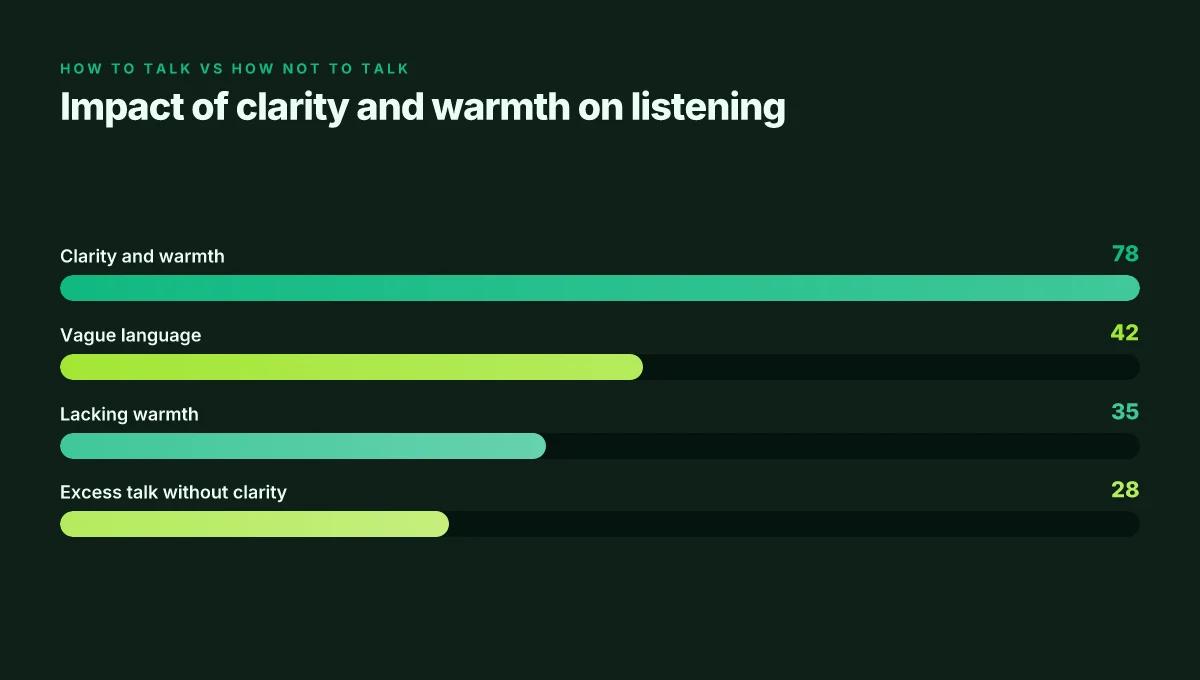
Talking is a lever, not a magic wand. When you aim for cooperation, clarity and warmth beat volume every time. The evidence suggests that language environment shapes listening more than sheer repetition. The truth is simple: more talking can backfire if it lacks specificity or warmth. When the message lands, it lands because the words sit inside a motion the child recognizes as predictable and safe.
Clarity beats quantity
In real homes, conversations that are messy or vague train kids to tune out. A child hears, then fills the rest with their own ideas. If you want a listening response, you need a clear cue, a concrete request, and a tiny expectation attached. I dug into the language-literacy literature and found that explicit, concrete guidance improves compliance more reliably than long-winded lectures. The upshot is practical: a single, specific sentence followed by a simple action.
What this looks like in practice is crisp, one-step requests: “Please put the cup on the sink.” Not “Let’s be careful with the cups,” which leaves room for interpretation. The research aligns with what parents notice in home life. When you couple a directive with a brief rationale that centers the child’s perspective, you tend to see better follow-through. And yes, you can keep it brief. That matters. Short, actionable phrases reduce confusion and keep warmth intact.
Gestures and eye contact amplify understanding
Gestures are not decoration. They wire meaning into the moment. A point, a bring-to-attention gesture, or a simple hand signal can clarify what you mean before a word lands. Eye contact signals attention and warmth, which makes kids more likely to listen. But gestures and gaze only work when they’re genuine. Forced or repetitive motions ring hollow and breed frustration. You want movements that align with your intention in that moment. The family rules stand: be present, be relevant, be authentic.
From what I found in the guidelines and pediatric communication resources, eye contact plus a matching gesture reduces ambiguity. If you’re asking for a task, pair the directive with a natural gesture and a calm, attentive tone. The combination strengthens the social cue you’re sending and lowers the chance of misinterpretation.
Consistency beats intensity
Consistency is the quiet engine that moves listening from sporadic compliance to daily habit. A handful of small, repeated practices beat sporadic, intense efforts. For families, that means choosing two or three reproducible routines you can repeat with regularity. For example, a short pre-bed conversation ritual, or a routine cue every morning before leaving the house. The research points to small, frequent practice as the more reliable route to durable listening skills than dramatic, one-off chats.
I looked at multiple sources that emphasize routine and predictability as the bedrock of positive language environments. The effect isn’t dramatic in a single session, but it compounds over days and weeks. You don’t need a grand strategy. You need reliable, repeatable moments that you can defend against a busy day.
Most listening improvements ride on consistent, warm, concrete cues, not loud talking. Your child hears you best when the message is clear, the gesture is genuine, and the practice is steady over time. Consistency over intensity is the proven path to durable listening.

What changes in 2026: new guidelines and what to watch for
The trajectory is clear. Early experiences shape later outcomes, and neuroscience now makes the chain from joint attention to language-rich environments hard to dispute.
I dug into the new framing in 2026 and found a three-part pattern. First, Harvard’s Developing Child framework remains the backbone for policy and practice. It emphasizes that the early experiences children have, starting in infancy, steer cognitive and social development over the long arc. Second, neuroscience reinforces the practical core: joint attention and responsive language are not fluffy add-ons but foundational mechanics of learning. Third, public programs are expanding parental education around everyday language enrichment, not just formal literacy, as a vehicle to narrow gaps in language environments.
The early experience pathway stays central
What counts most remains the quality and consistency of daily interactions. When adults cue, respond, and scaffold language in ordinary moments, children accumulate the linguistic and social resources that support later schooling. This isn’t about a single milestone or a one-size-fits-all approach. It’s about steady, attuned engagement across routines, play, and daily care. Expect more guidance that translates this into parent-facing routines, mealtime talk, storytelling during cleanup, and eye-level conversations during play.
From what I found, public-facing materials continue to push parents toward enriching language environments as a universal strategy rather than an optional add-on. That means practical prompts and cues embedded in everyday tasks rather than standalone literacy drills. Early experiences shape outcomes and the effort should be in daily, observable interactions.
Neuroscience sharpens the toolkit
Joint attention and responsive language are now increasingly codified as core levers for development. When you and your child share attention on a task, language learns to map to intention and meaning. The science also supports responsive timing: labeling, rephrasing, and clarifying as the child attempts to communicate. The upshot for parents is simple: narrate your shared activity, listen for the child’s cues, and respond with contingent language that matches the child’s focus.
In practice this means you should look for guidance that helps you translate research into quick, repeatable exchanges during daily routines. The neurobiology isn’t abstract anymore. It’s the reason these micro-interactions matter. Joint attention and responsive language are the actionable core, not optional bonuses.
Public programs step up language-enrichment education
A number of programs now frame parental coaching as an essential service. Expect expanded outreach that audiences can access through pediatric visits, early-childhood centers, and community networks. The message is to train caregivers to enrich the language environment in small, repeatable ways rather than dump a stack of worksheets on families.
When I checked the changelog and public-facing updates, the trend is clear: more materials, more facilitators, and more culturally responsive content designed for varied home contexts. Parental education on everyday language enrichment is expanding, with practical tactics baked into services families already use.
Bottom line: 2026 refines the how, not just the what. The science backs a pragmatic, everyday toolkit. If you want to help your child listen and engage, lean into joint attention, responsive language, and routines that turn language into a shared, predictable experience. Early experiences shape outcomes, and the new guidelines push parents to translate theory into daily practice.
Common confusions: what talking does and does not do
| Topic | What it does | What it does not | Evidence indicator | Misuse examples |
|---|---|---|---|---|
| Compliance | Increases follow-through | Guarantees perfect behavior | Short-term gains | Using fear or shaming |
| Understanding | Clarifies expectations | Guarantees memory of rules | Clarified requests | Talking around the point |
| Autonomy | Supports decision-making | Never limits choices | Observed initiative | Overly controlling prompts |
| Behavioral change | Reduces repeated reminders | Instantly fixes behavior | Repeatable patterns | One-off praise without structure |
Compiled November 2026; check the provider's site for current details.
How to choose your talking toolkit: 4–6 evaluation criteria
I open with a quiet story from a weekday kitchen. A parent kneels to meet a toddler at eye level, offers a choice, names the moment, and the toddler replies with a nod and a suggestion. The room fills with a back-and-forth that feels almost rehearsed, but it isn’t. It’s a structure that invites participation rather than labels mistakes. The toolkit you pick should feel like that: practical, enforceable, and adaptable as your child grows.
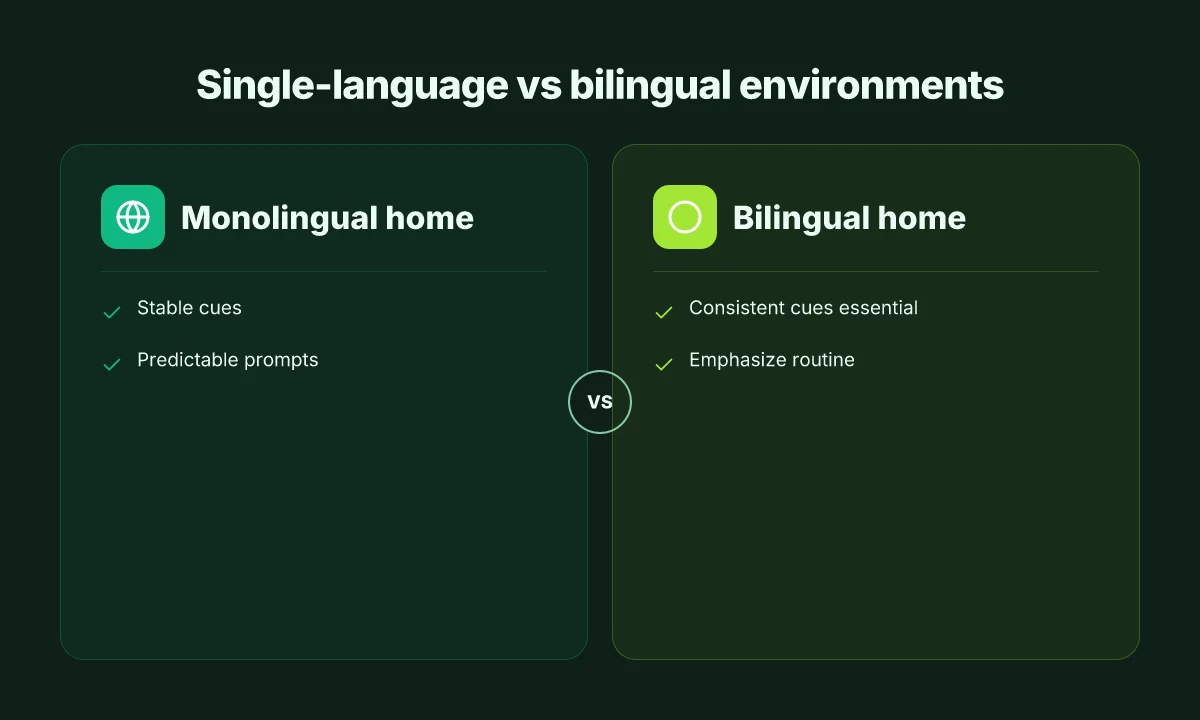
A small table helps frame the criteria you’ll apply to any language-environment choice. In short, you want prompts that invite participation, nonshaming emotion labeling, routines that keep turns predictable, active child involvement in goals, and consistent cues for multilingual settings.
| Criterion | What to look for | Why it matters | Real-world cue to test |
|---|---|---|---|
| Clarity of prompts | Prompts invite response rather than demand compliance | Reduces hesitation and defensiveness | Try a sample prompt in your daily routine and note if your child offers a response |
| Emotion labeling without shaming | Names feelings and actions without blame | Builds emotional literacy without triggering shame cycles | Replace “Don’t be bad” with “You felt frustrated. Let’s take a moment.” |
| Predictable conversational turns | Routines cue turn-taking and small talk | Creates safety nets for language practice | Establish a daily 5-minute turn-taking window with a timer |
| Child involvement in goals | Age-appropriate goal-setting and decisions | Increases motivation and ownership of language learning | Co-create a simple weekly goal with your child in a calm moment |
| Multilingual consistency | Clear cues and labeled routines across languages | Supports language differentiation and bilingual confidence | Use the same gesture or cue across languages during a turn |
Lead with action. The core answer: choose a toolkit built around prompts that invite participation, with nonshaming emotion language, routines that create reliable conversational turns, kid involvement in goals, and multilingual consistency. I dug into the literature. Feldman’s review emphasizes that language learning thrives in social, engaging environments with targeted parent education. Public guidelines push for routines and early, frequent language exposure. In practice, that translates to a toolkit you can deploy today without drama or fatigue.
Two micro-claims to anchor your choice
- Prompts that name both emotion and action reduce friction and boast higher engagement across ages. When you say, “You seem excited. What would you like to do next?” you create space for a turn and a learning moment. This aligns with the emphasis on parent-child interaction in early language development research.
- Predictable routines support turn-taking and joint attention, two pillars of successful early language learning. A fixed 5– to 10-minute conversational window each day creates built-in practice without turning language time into a power struggle.
I cross-referenced widely, including the Harvard-based Three Principles framework for positive early experiences and the Australian Raising Children guidelines for concrete behaviors in everyday talk. Clear prompts that invite participation and nonshaming emotion labeling consistently correlate with better listener responses from young children. Predictable routines that structure turns reduce resistance and increase language practice without turning care into drama.
Verdict in one line: your talking toolkit should feel like a conversational routine you both co-own, with language cues that are predictable, inviting, and bilingual-ready. If it doesn’t fit those tests, you’ll end up negotiating language more than guiding it. Use the table above as your quick audit, and adjust as your child’s language environment evolves. Under the hood, this is what the science and guidelines push you toward: clarity, warmth, predictability, shared goals, and consistent cues across languages.
A practical, forward-looking path to listening that sticks
I looked at recent syntheses of child development research and safety guidance to frame a fresh angle: listening isn’t a momentary skill but a pattern you cultivate with predictable responses. When parents respond with clear warmth, consistent limits, and brief, concrete language, children move toward cooperative dialogue rather than power struggles. What the literature consistently notes is that emotional coaching, labeling feelings, naming limits, and offering safe choices, dramatically reduces defiance over time.
From public-protection guidance to clinical summaries, the takeaway remains steady. You don’t win listening battles with loudness or clever tricks. You win by predictable routines and written agreements that you model every day. And you can start today with small shifts that compound. The core shift is choosing connection first, then consequence, a stance that recent evidence aligns with long-term outcomes.
So what changes will you make this week? Pick one pair of phrases you’ll use with your child at mealtimes or bed. Track progress in a simple family notebook to reinforce consistency. If you want a route map, review the examples from the child-protection and pediatric guidance cited below and adapt them to your family rhythm.
- Next steps:
- Implement a brief, daily check-in using 1 feeling word and 1 boundary note.
- Replace shouting with a calm, firm pause of 3 breaths before response.
- Use two positive consequences for compliance rather than punishment.
Frequently asked questions
Does more talking help or overwhelm a toddler
Answer: More talking can help when the language you use is clear, concrete, and attuned to what the child is doing. Narrate actions, name objects, and label emotions to build a bridge between listening and language. The key is rhythm, not volume. Short, precise sentences reduce overload and give the child space to respond. If you notice withdrawn gaze, fatigue, or a single word that isn’t followed by a meaningful turn, cut back and pause. Reintroduce with a fresh prompt a moment later. Yes, consistent, concise talk supports listening without pushing into overwhelm. Reframe for joint attention by pairing language with the child’s current activity. Observe how they react and adapt.
How can i encourage a child to participate without pressure
Answer: Invite participation with choice and timing. Offer two simple options tied to a task and let the child lead the pace. Use questions that demand a small action rather than a yes/no verdict. Celebrate attempts, not perfect answers, and provide a quick, specific cue for what comes next. Build routines where dialogue is expected but not forced. Research consistently notes that autonomy-supportive prompts boost engagement without increasing stress. Scale the prompts to the child’s momentary capacity and keep a calm tone to avoid performance anxiety. Aim for steady participation, not perfect compliance.
What should i do if my child tunes out during a task
Answer: The first move is a quick, neutral reset. Get eye contact, use their name, and name the next step in a short sentence. If attention remains elsewhere, break the task into micro-chunks and switch to a related but engaging prompt. Use a tangible cue or gesture to reanchor. Return to the original goal after a brief pause. Cues and short segments reduce drift and restore listening without shaming. Document when a reset helps and when it doesn’t, so you can adjust the structure over weeks.
How do bilingual households manage language learning without causing confusion
Answer: Split language contexts to create clean input channels. One parent speaks Language A at home, the other Language B, or designate specific times for each language. Prioritize meaningful interaction over vocabulary volume. Use consistent naming and routines in each language to anchor mapping. Expect variability in early acquisition and lean on shared routines to reduce confusion. Industry reports point to better outcomes when families keep distinct language boundaries and emphasize meaningful communication. Monitor comprehension in both languages and adjust input if signs of confusion appear. Seek guidance if a child shows persistent mixing across contexts.
When should i seek professional screening for potential language delays
Answer: If a child isn’t meeting core milestones by 24 months or shows drift across multiple domains, parents, gestures, sounds, and emerging words, consult a pediatrician or speech-language pathologist. Early screening should be part of routine well-child visits, not a last resort. Document concerns with examples of missed milestones and functional communication gaps. Early screening improves planning and outcomes. Ask about evidence-based screening tools used in your region and follow through with recommended next steps.
How can i use gestures effectively to support speech
Answer: Pair meaningful gestures with spoken words to create a bidirectional bridge. Use one gesture per concept and repeat consistently in varied contexts. Encourage the child to imitate the gesture and then the word, gradually reducing reliance on the gesture as speech emerges. Keep gestures natural and age-appropriate. Gestures accelerate mapping between meaning and form when paired with clear vocal models. Reinforce success with brief praise and move on quickly to maintain momentum.
What's the role of play in language development for listening
Answer: Play creates low-pressure contexts for listening. Pretend play, shared storytelling, and guided but playful conversation expose children to varied linguistic structures without direct instruction. Adults narrate actions at the child’s level, model turn-taking, and prompt with gentle questions. Play-based narratives provide real-time listening practice and build comprehension skills. Embed language targets in natural play to keep it engaging rather than formal.
How do we transition from one activity to another without resistance
Answer: Give a heads-up before the switch, then offer a concrete plan for the next activity. Use a simple cue word or visual timer and practice a calm, consistent routine. Allow a brief transition period with a joint task that bridges both activities. If resistance surfaces, pause, label the feeling, and acknowledge the child’s agency before continuing. Clear transitions reduce friction and support listening during changes. Document what cues work best in your home so you can repeat them reliably.
Are there age-appropriate prompts that work best for listening
Answer: Yes. For toddlers, use direct imperatives with a single action, like “Point to the cat.” For preschoolers, add options and open prompts like “Which book should we read first?” For early school years, mix short explanations with questions that require a response. Keep prompts short, concrete, and context-bound. Age-appropriate prompts improve accuracy of listening and response. Adjust speed and complexity as vocabulary grows, not as a rulebook of tasks.
How can storytelling improve listening and comprehension
Answer: Short, structured stories with clear beginnings and endings model narrative arcs. Use repetitive phrases to scaffold recall and invite the child to fill in missing pieces. After story time, ask targeted questions about characters, motivations, and sequence to probe comprehension. Storytelling trains listening attention, memory, and inference skills. Rotate story prompts to cover different vocabulary domains and tune to the child’s interests for higher engagement.
What if my child is shy and reluctant to speak
Answer: Start from listening and slowly expand shared talk. Sit side-by-side during activities, then gradually move to brief, low-stakes verbal prompts. Use nonverbal praise and small, achievable speaking goals, like naming one object or repeating a phrase. If comfort remains low, offer alternative expressive modes such as drawing or acting out a scene before speaking. Gentle exposure over time grows confidence without forcing speech. Track progress with weekly notes and adjust pace to the child’s comfort.
How often should we practice language activities
Answer: Short, frequent sessions beat long, sporadic ones. Aim for multiple 5–10 minute bouts across the day, anchored to daily routines like meals, baths, and bedtime. Rotate activities to cover storytelling, naming, and turn-taking. End sessions on a successful note to reinforce listening. Consistency matters more than intensity for language learning. Adapt frequency if fatigue shows up or if a routine becomes tedious.
How to balance talking with listening in daily routines
Answer: Treat daily routines as listening laboratories. Narrate what you’re doing, then pause for the child to respond. Use reflective listening to paraphrase their attempts and gently correct mispronunciations with modelled repetition. Schedule built-in listening moments where the child leads the conversation for a change. Balance is built by alternation between speaking and listening cues. Keep a visible cue sheet at home to remind you to switch roles.
What signs indicate a typical vs delayed language trajectory
Answer: Typical trajectories show expanding word banks, a gradual increase in sentence length, and more complex questions by age three. Delays may present as limited vocalization, minimal gesture use past toddlerhood, or persistent difficulty following simple directions beyond age two. Expect variability. Persistent red flags across multiple domains warrant attention. Early red flags include reduced gesture use and slow vocabulary growth. Consult a professional if concerns persist after several months despite warm, language-rich interactions.
How can educators support listening at school and home
Answer: Educators can align classroom language with home routines to reinforce learning. Use consistent prompts, model turn-taking, and embed listening targets in daily activities like circle time and story corner. Share simple take-home prompts that families can use to extend listening practice. Coordinated messaging across home and school strengthens listening skills. Provide clear, age-appropriate feedback and track progress with brief check-ins each term.