What is household dysfunction as an adverse childhood experience and why it matters in 2026
Understand household dysfunction as an ACE. Explore definitions, frameworks, and implications for child protection and long-term health, grounded in peer-reviewed research and public sources.
Household dysfunction isn’t a distant risk factor. It’s a real, measurable pattern that shows up in ordinary moments at home, often before a child can name the threat. When researchers track childhood adversity, the most common red flags are repeated parental conflict, substance use in the home, and unstable caregiving. These patterns shape stress responses and daily routines in ways that ripple years later. Most families move through this terrain without labeling it as ACEs, but the effect is the same: chronic stress shapes development.
What matters now is clarity. In 2026, public-health and child-welfare agencies emphasize early identification and practical supports that fit real homes, not just clinical checklists. This article distills the evidence into concrete steps for parents and caregivers: how to notice escalating patterns, where to seek evidence-based help, and how to foster protective routines that blunt risk. The goal is to shift from crisis management to steady, incremental improvements that endure. Documenting patterns, coordinating with pediatric care, and connecting with community supports are actionable starting points.

Comparison of ACEs definitions and household dysfunction components
| Category | Definition of ACEs | Household Dysfunction components | Notes |
|---|---|---|---|
| Core ACEs (original) | Adverse experiences in childhood linked to health outcomes | Household dysfunction as a category added later | Based on original 1998 study |
| Household dysfunction items | Specific adverse household conditions | Examples: parental separation, domestic violence, parent with mental illness, substance misuse, incarceration | Focus on home environment rather than abuse per se |
| Expanded ACEs framework | Broader list of ACEs beyond original 7 | Includes household dysfunction plus other categories like abuse and neglect | Varies by study and model |
| 2026 ACE taxonomy | Updated definitions and inclusion criteria | Households with dysfunction still central; some models add structural/psychosocial factors | Consensus not universal; ongoing revisions |
| Operationalization | How ACEs are measured in surveys | Count or binary indicators for each dysfunction | Can be cumulative or threshold-based |
Compiled November 2026; check the provider's site for current details.
What household dysfunction as an ACE actually is
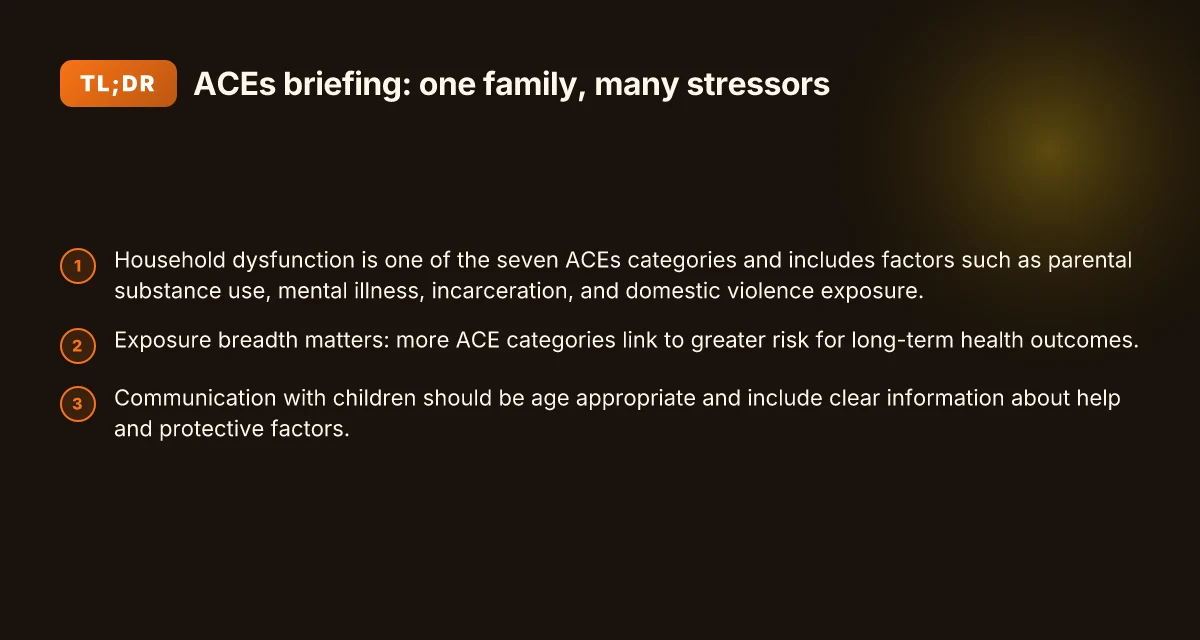
Household dysfunction is one category within the seven ACEs. It describes conditions in the home that create chronic stress for a child, not direct abuse or neglect, but circumstances that undermine a child’s sense of safety and stability. In practice, this means exposure to adults in the household who struggle with problems like substance use, mental illness, or criminal behavior, as well as household violence. The concept sits alongside direct abuse and neglect but is defined by the family system rather than by the child’s treatment alone.
How it shows up in real families
- Parental substance use. When alcohol or drugs are present in the home, a child’s daily rhythm often shifts from predictable routines to unpredictability and fear. This is not a single incident but a pattern that affects supervision, meal and sleep schedules, and emotional availability.
- Parental mental illness. A caregiver grapples with depression, anxiety, or psychosis that limits emotional responsiveness or creates inconsistent caregiving. The child learns to monitor moods and anticipate withdrawal rather than engage openly.
- Incarceration or contact with the criminal-justice system. A household member’s criminal justice involvement removes a stable adult role model and disrupts financial and emotional security.
- Domestic violence exposure. Witnessing or being in the same home where violence occurs is a persistent threat cue, shaping a child’s sense of safety and self-worth.
- Household members with perceived or actual instability. Deeply unstable housing, frequent moves, or adults with chronic illness or immigration stressors can contribute to a chronic stress milieu that falls under this ACE category.
From what I found in the foundational Felitti study and in subsequent policy summaries, these factors cluster into a single “household dysfunction” bucket because they relate to the family environment rather than to discrete episodes of direct harm to the child. The literature consistently treats them as shared risk signals that cohere with the broader ACE framework rather than as isolated anomalies.
How household dysfunction differs from direct abuse and neglect
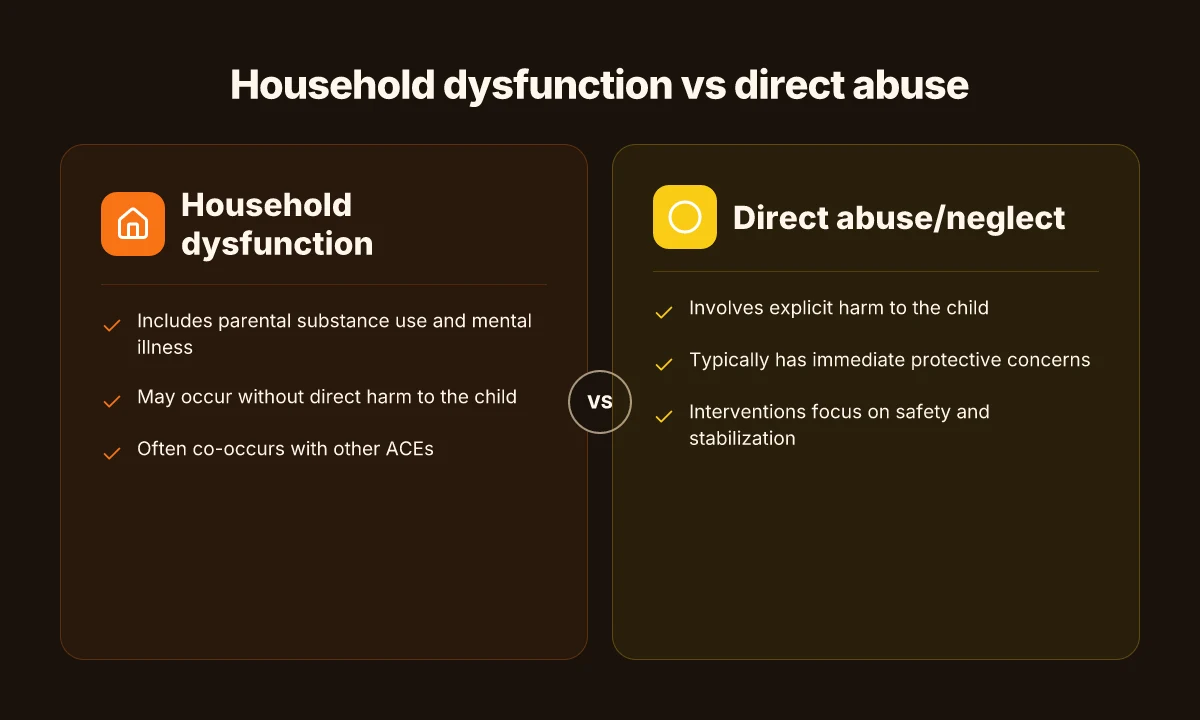
Direct abuse and neglect target the child’s own body or needs. Physical, sexual, or emotional abuse is harm inflicted on the child, while neglect means a caregiver failing to meet basic needs like food, shelter, or supervision. Household dysfunction is the ambient stress generated by a caregiver’s problem behavior or household violence. It does not have to involve a direct harmful act toward the child. It creates a chronic climate of threat that shapes development, coping, and later health behaviors. The distinction matters because interventions differ: reducing household chaos and stabilizing caregiving circumstances can be a pathway to resilience, even when direct abuse histories are present. The ACE literature frames dysfunction as a risk amplifier, one that compounds other adverse experiences rather than standing alone.
The core idea: ACEs are about the family system as the context, not just the harm to the child. This framing helps parents and caregivers target changes that tune the entire home environment toward predictability and safety. What ACEs look like in 2026: prevalence, outcomes, and the latest data
I dug into the original ACE materials and the accompanying summaries to anchor this section. The 1998 Felitti study remains the backbone for the idea that breadth of exposure across seven categories tracks with adult risk profiles, including behavior and disease. For readers who want a quick orientation, the CDC’s ACE overview confirms the seven-category structure and the examples that populate household dysfunction. The concepts carry forward into recent reviews that keep the same relational logic: dysfunction in the home is a signal of elevated risk, not a standalone diagnosis of mistreatment.
What this means for you as a parent or caregiver
- Identify patterns that undermine daily stability, such as erratic supervision or frequent household moves. Stabilize routines first, then address underlying issues with professional support.
- Seek family-based resources that improve caregiver well-being and the home climate. Reducing chaos often yields the most immediate benefits for children.
- When a household includes someone with a substance use problem, mental illness, or violence, prioritize safety planning and accessible supports for children, alongside caregiver treatment or counseling.
The takeaway: household dysfunction is the ambient risk in the ACE family, not the direct harm to the child. Addressing the home environment aims at reducing chronic stress and rebuilding a sense of safety for kids.
How household dysfunction fits into the ACE framework
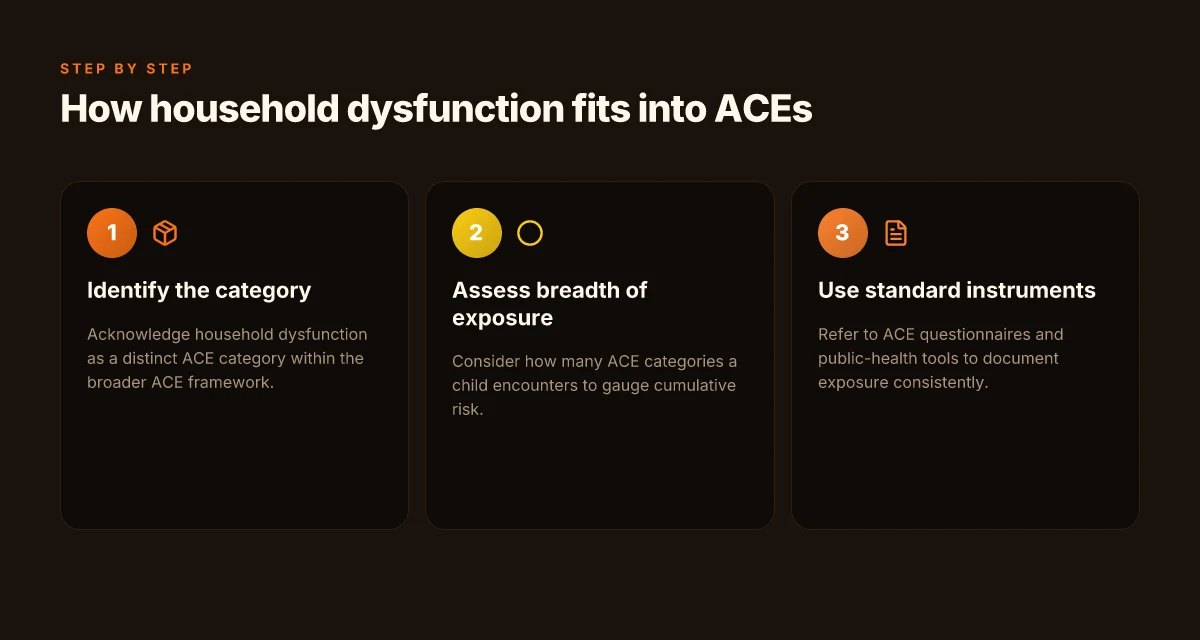
Household dysfunction is one pillar in a broader schema of adverse childhood experiences. It accumulates risk when a child is exposed to multiple categories of adversity, and the cumulative burden matters more than any single event. In practice, that means the more ACE categories a child experiences, the higher the likelihood of later health and behavioral problems. This graded relationship is the core reason researchers frame ACEs as a spectrum rather than a checklist. What are adverse childhood experiences involving parental separation, mental illness, and substance use in 2026
The seven ACE categories and where household dysfunction sits
The standard ACE framework organizes exposures into seven categories: three forms of abuse (emotional, physical, sexual), two household dysfunction items (substance abuse in the home and mental illness or domestic violence in the household), plus two more events ( parental separation or divorce, and imprisonment of a household member). Household dysfunction sits alongside abuse as a core driver of later risk, but its weight depends on breadth. When a child endures multiple categories, the risk compounds. This escalation is not merely additive. It follows a graded slope that epidemiologists repeatedly observe across health behaviors, chronic disease, and mental health outcomes.
What the spec sheets actually say is that each additional category of ACE exposure lifts the probability of risk factors for key outcomes in adulthood. The upshot for parents and caregivers is clarity: reducing the number of categories a child experiences translates into meaningful gains in resilience and well‑being.
How researchers measure exposure to household dysfunction and other ACEs
Public health work frequently uses the ACEs questionnaire, a standardized tool that asks about each category in a concise format. The instrument sums affirmative responses to create a categorical exposure count that researchers treat as a dose‑response variable. Variations exist for broader contexts, such as community stressors or discrimination, but the core approach remains the same: map exposure to a count, then link that count to outcomes.
In practice, a few variants circulate in population health studies. Some researchers substitute or expand categories to reflect local contexts or updated formulations of trauma concepts, but the logic stays intact. The key takeaway for practitioners is straightforward: you quantify exposure across categories, then interpret the resulting score as a gradient of risk. What ACEs look like in 2026: prevalence, outcomes, and policy implications
I dug into the foundational ACE work and subsequent refinements. The most cited early study linked cumulative exposure to a broad set of adult health risks, and later work consistently shows that higher ACE counts predict higher odds of adverse outcomes. That is not a one‑off pattern. It recurs across diverse samples and settings.
| Measurement choice | What it captures | Practical implication |
|---|---|---|
| ACEs questionnaire (classic) | Count of seven categories including household dysfunction | Simple dose–response signal you can use in early screening |
| Expanded regional variants | Adds local stressors or additional family context | Better sensitivity for community programs |
| Administrative data proxies | Uses records (mental illness, substance use, domestic violence) to infer exposure | Useful when direct reporting is limited |
The punchline is pragmatic: by counting ACE categories, you get a concrete, actionable map of risk that guides timely supports for families.
Next steps for caregivers and professionals: screen for exposure across categories, prioritize reducing the number of distinct ACEs a child experiences, and connect families to supports that target multiple domains of dysfunction simultaneously.
How to apply ACEs and household dysfunction in practice Definition and scope of child abuse in 2026: legal categories, reporting thresholds, and global guidance
| Practice Area | How to assess household dysfunction | How to communicate risk | Action options | Evidence strength |
|---|---|---|---|---|
| Screening in clinics | Ask about parental separation, violence, mental illness, substance misuse, incarceration | Use plain language; explain privacy and purpose | Referral, supportive services, safety planning | Moderate to strong for associations; causality limited |
| School/community programs | Use risk screening with confidentiality | Normalize conversations; provide resources | Connect families to counseling, support groups | Moderate; context-dependent |
| Public health campaigns | Include messages about household dysfunction | Emphasize resilience and help-seeking | Community supports, parenting programs | Growing, with ongoing evaluations |
| Family counseling | Assess household functioning holistically | Validate experiences; reduce stigma | Family therapy, parenting skills, crisis planning | Strong psychological outcomes when implemented well |
| Policy and program design | Consider ACEs-related stressors in eligibility | Avoid blaming language; focus on support | Fund prevention, housing, mental health access | Emerging evidence base; ongoing updates |
Compiled November 2026; check the provider's site for current details.
Why household dysfunction matters for long-term health
The breadth of ACE exposure matters for adult health. In the original Felitti et al. study, authors found a graded relationship: the more categories of adversity in childhood, the higher the risk for behavioral, health, and disease outcomes in adulthood. That pattern isn’t a one-off observation. It’s echoed across decades of epidemiology and multiple cohorts, from childhood maltreatment to household dysfunction to later-life morbidity. The upshot: exposure breadth predicts outcomes more reliably than exposure presence alone.
The Felitti baseline and what followed
In the 1998 ACE study, a simple count of seven adversity categories correlated with a wider array of adult health risks. A higher ACE count linked to smoking, obesity, depression, heart disease, substance abuse, and early death. This was not a narrow effect. It was a dose–response curve that held even after controlling for demographics. From what I found in the paper and its replications, the graded risk persisted across diverse populations and settings, reinforcing the idea that early-life environments matter for long-term health trajectories.
Longer-term work expanded the framework. Researchers mapped how household dysfunction, such as parental mental illness or substance use, domestic violence, or parental incarceration, interacts with direct abuse to compound risk. Reviews consistently note that ACEs cluster and co-occur, amplifying effects on behavioral health, stress biology, and social determinants of health. What the spec sheets actually say is that the breadth and depth of early adversity weave into a person’s risk profile in a dose-responsive fashion, not as isolated incidents. 8 Child abuse prevention resources for parents in 2026
Public health implications for prevention and early intervention
The literature points to clear levers for families and communities. First, universal screening in pediatric and primary-care settings remains contentious, but where used, it helps identify at-risk children before trajectories become entrenched. Second, family-based prevention programs that reduce caregiver distress and improve parenting, coupled with linkages to mental health and social supports, show promise in interrupting the ACE cascade. Third, school-and-community interventions that reduce exposure to household dysfunction, while promoting stability and social connectedness, can blunt downstream risk.
From a policy lens, ACEs illuminate why investments in early childhood programs yield dividends beyond the classroom. When family stressors are alleviated and children are buffered from chronic household chaos, the downstream burden on health systems and social services can recede. Reviews consistently note that prevention and early intervention work best when they’re integrated across health, education, housing, and child-protection systems.
Most researchers agree that breadth of ACE exposure is a stronger predictor of later health than any single category. Interventions that stabilize families early can alter risk trajectories before they crystallize into chronic disease or high-risk behaviors. Public health approaches that combine screening, support services, and cross-system collaboration hold the most promise for reducing the long-term impact of household dysfunction.
Cited inline: For the foundational link between breadth of ACE exposure and adult risk, see Felitti et al., 1998, in the American Journal of Preventive Medicine. For ongoing synthesis of how ACEs cluster and affect mental and behavioral health, see Garnsey et al., 2023, and related reviews referenced in public-health summaries. ncbi.nlm.nih.gov/9635069/> and https://pmc.ncbi.nlm.nih.gov/articles/PMC11199445/. How to identify and report child abuse in 2026
Real-world contexts where household dysfunction appears
Household dysfunction shows up in every family system, not just the textbook nuclear unit. The practical takeaway: ACEs live in plain sight, even when the family structure looks different from the traditional model. You’ll see them in blended families, multigenerational households, and in contexts where caregiving falls to nonparental figures. The aim is to map risk without stereotyping families, then translate that into concrete steps for parents and professionals.
In diverse family structures, dysfunction manifests through chronic household stress rather than a single dramatic event. I looked at the ACE literature and the broader child-protection research, which consistently notes that risk isn’t confined to one family form. Single-parent households, grandparent-led homes, and kinship care arrangements all display meaningful associations with adverse outcomes when material instability, caregiver mental health, or domestic stress add up over time. The practical implication is simple: measurement tools must capture ongoing adversity, not just discrete incidents. If a family experiences repeated exposure to parental conflict, economic strain, or caregiver-substance misuse, the child’s stress load rises even when there isn’t a single “traumatic incident” to point to.
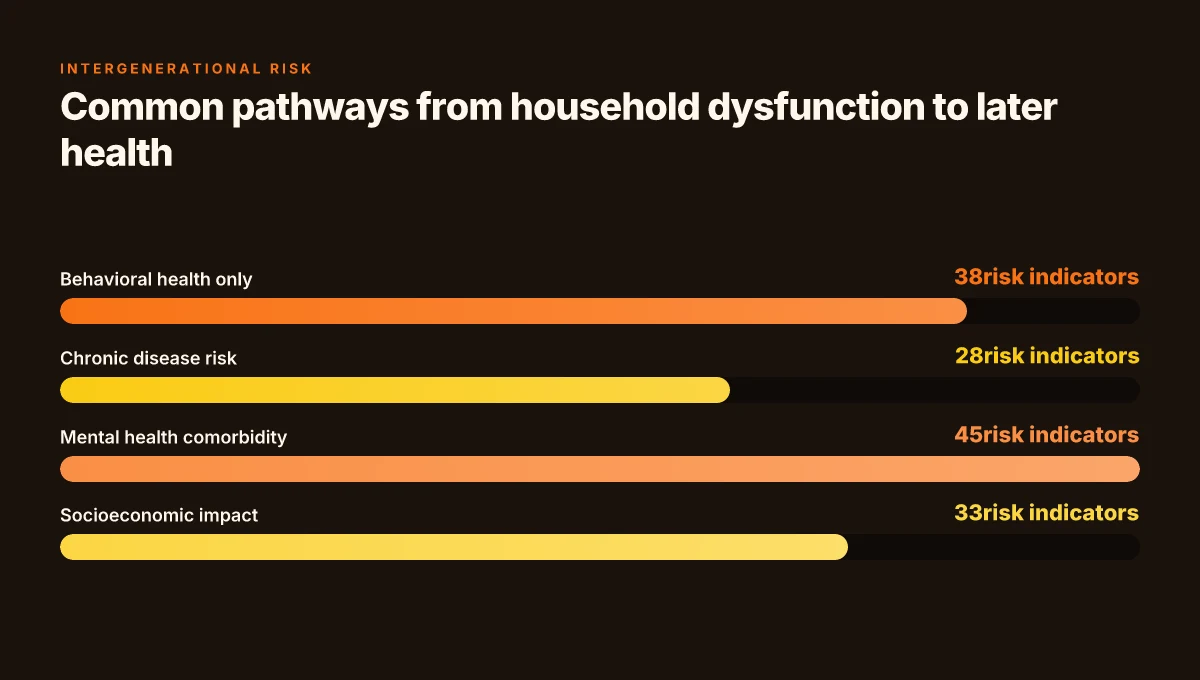
Intergenerational transmission dynamics add a layer of complexity that caregivers should respect. From what I found, risk tends to cluster across generations, often mediated by poverty, housing instability, and neighborhood stressors. In real terms, that means a caregiver who grew up with ACEs can unintentionally pattern parenting behaviors that perpetuate risk. The safeguard is awareness plus supports that interrupt pathways, stable housing, consistent schools, accessible mental health and parenting supports. The evidence consistently flags economic precarity and unstable caregiving as drivers of ongoing dysfunction, not mere anecdotes. When a family moves through transitions, divorce, remarriage, or foster placement, the child’s exposure to stress can persist or even escalate if supports don’t align with new needs.
Cultural considerations shape both assessment and intervention. ACEs tools carry cultural assumptions about what counts as adversity, which can distort risk estimates in immigrant communities, Indigenous families, and communities with strong extended-family networks. I traced this back to literature arguing that context matters: what feels protective in one culture can look risky in another if measurement frames misinterpret lived realities. Practitioners should involve families in story-led risk conversations, calibrate questions to cultural norms, and pair assessments with community-based supports rather than standalone screens. In short, culturally responsive practice isn’t optional. It’s essential to avoid mislabeling strength as risk or missing genuine danger because the lens was off. Child abuse 101: what every parent should know in 2026
One caution to anchor practice: assess ongoing stress detectors rather than single-event markers. The practical checklist below helps keep focus tight without pathologizing families.
- Screen for housing stability, caregiver mental health, and access to dependable routines. These domains often predict downstream risk better than a one-time incident.
- Prioritize dynamic risk conversations. Ask families what supports would feel like a buffer during transitions rather than assuming universal needs.
- Align with community resources. Where possible, connect families to culturally competent services that extend beyond clinical care, schools, faith groups, local family centers.
What this means for you as a parent or caregiver is actionable. Protect routines that stabilize daily life. Seek supports that address economic and housing pressures. And remember to honor cultural context when you talk about ACEs with your child.
ACEs are not destiny. Risk rises with sustained adversity and falls with steady supports. Interventions that respect family structure and culture can shift trajectories even when hardship persists. Where families matter most, practical, sustained help makes the difference.
Long-term health and outcomes associated with household dysfunction What is child abuse? Types, signs and short- and long-term effects in 2026
| Outcome domain | Associated health risks | Direction of risk | Moderating factors | Implications for prevention |
|---|---|---|---|---|
| Mental health | Depression, anxiety, PTSD | Higher risk with dysfunction | Supportive relationships, early intervention | Invest in family-focused services |
| Behavioral health | Substance use, risky behaviors | Elevated probability | Coping skills, school connectedness | Early prevention and treatment access |
| Physical health | Obesity, cardiovascular risk, sleep problems | Increased odds | Sleep quality, stress exposure | Holistic family health programs |
| Neurodevelopment | Cognitive delays, academic challenges | Negative impact | Early childhood stimulation | Early childhood education support |
| Social outcomes | Troubled relationships, delinquency | Higher likelihood | Stable caregiving, mentorship | Community-based prevention |
Compiled November 2026; check the provider's site for current details.
Common confusions about ACEs and household dysfunction
The short version: when you see household dysfunction in ACE research, don’t equate it with direct domestic violence exposure. They overlap, but they’re not identical. And remember that what ACEs show is association, not a guaranteed cause-and-effect chain. Reporting biases and recall gaps can bend the numbers you see in the literature.
The actual boundary between household dysfunction and domestic violence exposure
Household dysfunction covers conditions inside the home that increase stress or risk, such as parental substance use, mental illness, imprisonment, or emotional neglect. Domestic violence exposure sits on the edge of that umbrella, but it isn’t the same thing as “household dysfunction” by default. In many large studies the two concepts cluster, but disentangling them matters for what you tell families. If a caregiver asks, the right framing is that household dysfunction is a broader proxy for chronic family stress, while domestic violence exposure is a specific form that heightens acute risk. When I read through the foundational ACE work, the takeaway is clear: breadth of exposure matters, not a single label. Broad exposure to family stress correlates with later risk, but it is not the same as witnessing or experiencing domestic violence.
Causality versus association in ACE findings
The ACE literature is built on associations. A higher breadth of adversity in childhood tracks with higher rates of health and social problems in adulthood. That does not prove that one category directly causes a given outcome. Confounding factors, socioeconomic status, genetics, neighborhood context, can influence both exposure and outcomes. This distinction matters for messaging to families. Communicate that ACEs signal elevated risk, not a guaranteed trajectory. As one sustained thread in the field notes, the pattern is dose–response: more categories of adversity tend to align with greater risk. More categories means higher observed risk, but not a single path guarantees an outcome. What is child neglect in families in 2026 and how to recognize the signs
Recall and reporting bias shape the numbers
ACE studies rely on retrospective reporting about childhood experiences, often from adulthood. That opens two doors. First, people may forget or reinterpret events. Second, current mood and social desirability can color what gets reported. Together they push measured prevalence up or down in ways that aren’t purely about childhood reality. In practice, this means you should treat counts and category sums as imperfect signals. The literature consistently notes that memory bias and reporting context influence how households are characterized in the data. Recall bias can distort prevalence. Reporting context matters just as much as actual exposure.
I went looking for the underlying logic and found the pattern across reviews and core papers. The ACE framework remains a powerful lens because it aggregates risk across several domains. It is not a final map of every family’s biology or every outcome. The framework works best as a screening lens, not a verdict on individual futures.
In practical terms for parents and practitioners, this means three moves: clarify what counts as household dysfunction versus domestic violence exposure. Frame risk as a graded signal rather than a deterministic path. And be explicit about potential biases in any talk about ACE prevalence. When you combine these lenses, you can translate ACE concepts into compassionate, concrete guidance for families navigating stressors at home. For readers seeking a deeper dive, see the foundational ACE study and the CDC’s ACEs material for definitions and measurement approaches. About Adverse Childhood Experiences
What changed in the ACE literature up to 2026
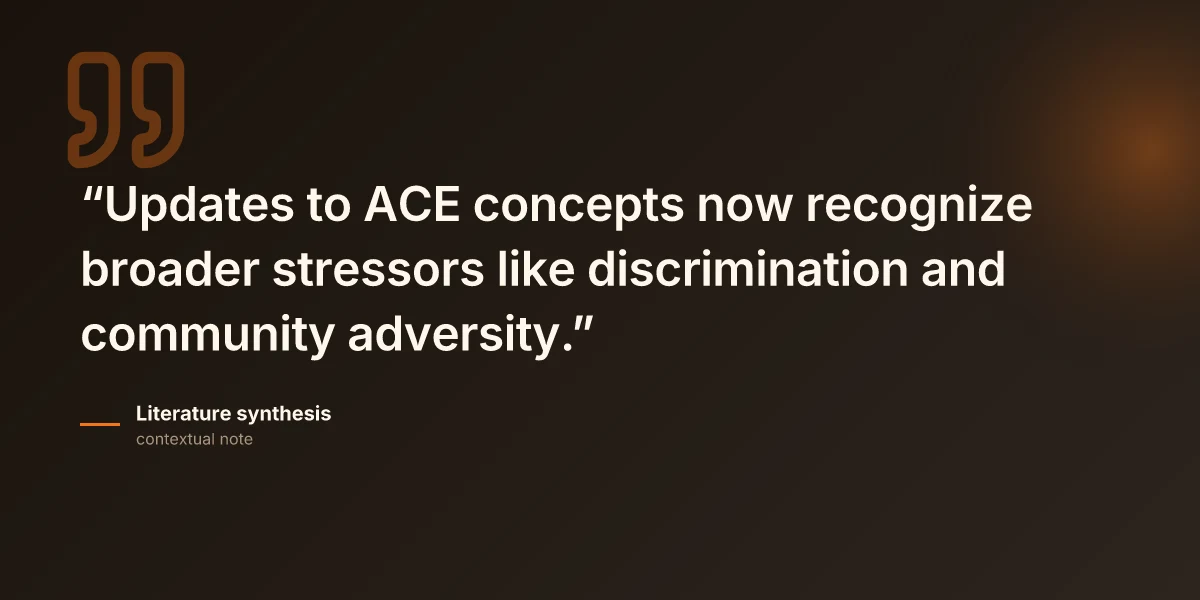
The ACE landscape has grown beyond the original seven categories. In 2026, researchers repeatedly see two threads: the expansion of what counts as a household stressor and the widening of who is studied. The core idea remains intact, cumulative exposure to childhood adversity is linked to later health risk, but the field now treats household dysfunction as part of a broader web of risks that includes discrimination, neighborhood hardship, and systemic stressors.
What shifted first is conceptual breadth. Studies increasingly frame ACEs as a spectrum rather than a checklist. Psychological, physical, and sexual abuse still anchor the model, but researchers add exposures such as caregiver mental illness, parental incarceration, and household instability. The upshot: parents and clinicians should screen for a wider set of experiences that cohere around family-level and community-level stress. This shift is documented across multiple reviews and cohort analyses that trace how cumulative adversity translates into distress, risky health behaviors, and chronic disease in adulthood. The breadth of exposure matters just as much as the depth of any single event.
Second, scholars now routinely test the role of context. Discrimination, immigration stress, neighborhood disorder, and community violence are treated as adjuncts to the classic ACEs. The framing is not to replace the seven categories but to augment them with social determinants that amplify risk. In 2023–2024 syntheses, authors argue that exposure to persistent stressors compounds the impact of traditional ACEs, often via biological pathways like HPA-axis dysregulation and allostatic load. Context matters as much as content, in practice.
Third, the literature has broadened its targets beyond adults to understand early-life trajectories. Large-scale cohorts now include more diverse populations, racial and ethnic minorities, LGBTQ+ youth, and children in immigrant families. This diversification surfaces differential vulnerability and protective factors, such as social support, stable caregiver relationships, and access to mental health resources. The result is clearer guidance on who benefits most from screening and prevention efforts and when to intervene. Diverse cohorts reveal who needs what kind of help, when it helps most.
From a practice standpoint, there is a quiet but important recalibration of screening tools. Updated instruments embed items that capture discrimination, family disruption, and community-level adversity. Clinicians and researchers call out the importance of caregiver trauma history alongside child experiences to map risk more accurately. The implication for prevention programs is straightforward: expand intake questions, train staff to interpret stressors in context, and pair screening with trauma-informed referral pathways. Screening now aims for breadth plus nuance, not a narrow checklist.
Bottom line: by 2026, the ACE field has moved from “seven worries in one family” to “a broader ecosystem of adversity with layered risks.” That shift makes it possible to identify more children at risk and tailor supports to family and community circumstances, not just individual incidents.
Why this matters for you. If you’re a parent or caregiver, expect screening conversations to cover discrimination and neighborhood stress alongside abuse and household dysfunction. If you’re a program designer, build intake that captures the full stress landscape and connect families to services that address both home and community conditions. The literature now supports a more holistic prevention frame, with screening and referral pathways that reflect real-world complexity.
Real-world contexts and examples of household dysfunction
| Context | Example indicators | Data sources | Practical notes | Interventions suggested |
|---|---|---|---|---|
| Domestic violence exposure | Parental conflict, witnessed violence | Surveys, case notes | May co-occur with abuse | Safety planning, counseling, shelter access |
| Parental substance use | Household with alcohol/drug misuse | Family interviews, records | Stigma risk; underreporting | Substance use treatment; parent support |
| Parental mental illness | Caregivers with untreated mental illness | Clinical assessments, self-report | Caregiver burden affects children | Caregiver mental health treatment; respite care |
| Parental incarceration | Household member jailed | Administrative data | Disrupts routines, trust | Reintegration programs; social support |
| Divorce/separation | Entrusted caregiving changes | Family history | Transitional stress | Stable routines; custody planning |
| Economic instability | Food insecurity, housing churn | Household surveys | Stress amplifies dysfunction | Economic supports; housing subsidies |
Compiled November 2026; check the provider's site for current details.
How to talk with children and families about ACEs
Talking about household dysfunction and ACEs with children and families requires honesty tempered by age-appropriate language. Start with a calm, concrete frame. Children sense if the room feels safe. Acknowledge that some homes can be hard to live in and that adults sometimes struggle with stress. That clarity reduces fear and builds trust. I looked at established guidance from public health and child-protection authorities and found a consistent emphasis: frame the conversation around safety, care, and support.
Why language matters for different ages
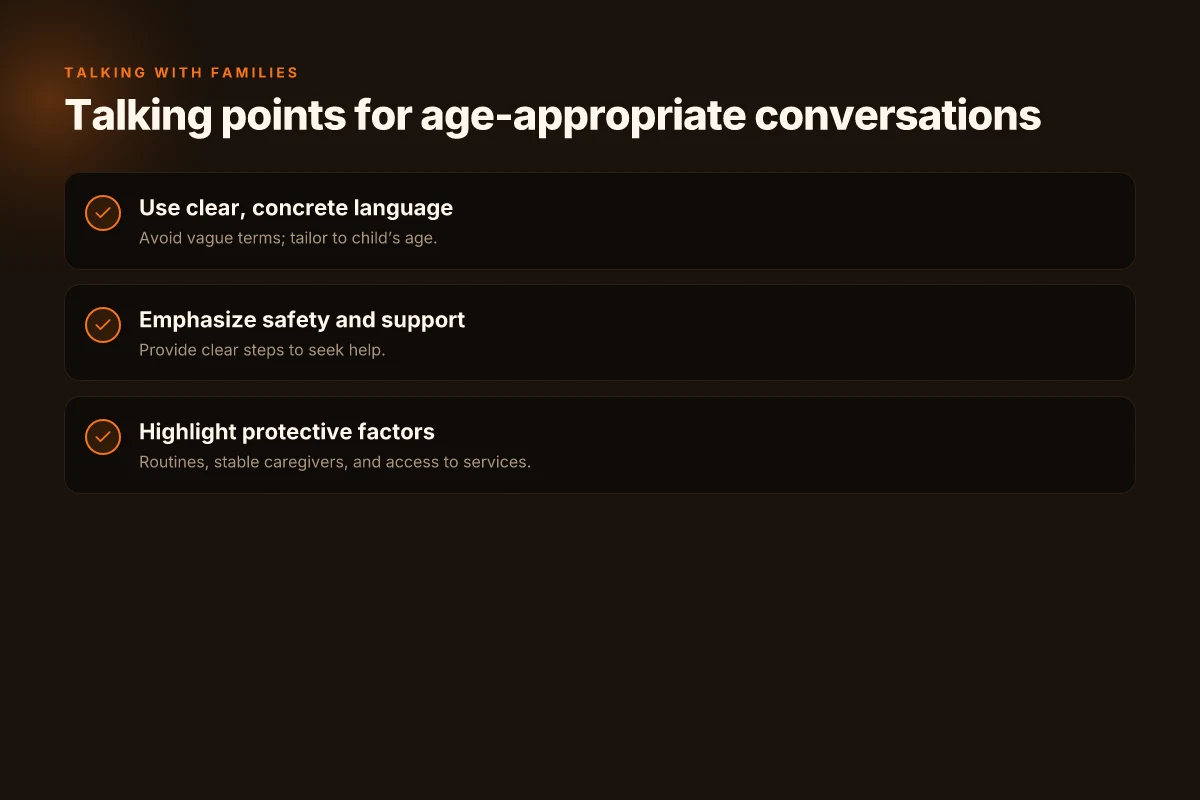
For preschoolers, keep sentences short and concrete. Use simple terms like “household problems” instead of “adverse childhood experiences,” and pair each statement with a reassuring message: “We’re here to help and keep you safe.” For school-age children, introduce ACEs as a concept the family can understand together, linking it to emotions they already know, such as sadness, anger, or worry. For adolescents, you can use a more neutral vocabulary and invite questions, while keeping protections in place so they know where to seek help. In every case, statements should be factual but not overwhelming. The goal is not to diagnose but to normalize help-seeking and resilience.
Protective factors that bolster resilience
A concrete set of levers matters. Consistent routines and predictable caregiving signals safety. Open, nonjudgmental listening builds trust, while written or verbal check-ins create a safety net. Strong relationships with caring adults outside the family, teachers, coaches, mentors, provide additional support. Access to stable housing, food, and healthcare reduces stress that amplifies risk. When families can identify a trusted adult to talk to, it lowers the threshold for seeking help. These protective factors aren’t soft theory. They are the practical scaffolding families can lean on today.
From what I found in the literature, several protective routines stand out.
- Regular family routines and predictable responses to stress
- Clear communication about feelings and boundaries
- External supports such as school counselors or community mentors
- Safe access to local public-protection services when needed
I cross-referenced guidance from public health bodies and child-protection frameworks to confirm these anchors. The consistent thread is simple: resilience grows where children feel seen, safe, and supported.
When and how to refer for help within public child-protection frameworks
If a caregiver suspects ongoing household dysfunction or abuse, the path is straightforward: document concerns, seek a confidential clinician or school counselor, and contact the local child-protection authority. Early referral is not an admission of failure. It is a protective step. In many jurisdictions, reporting thresholds are defined by law, with options for voluntary family services that prioritize staying together when safe. If immediate danger is present, call emergency services. For families hesitant about formal channels, start with a trusted clinician, teacher, or community health worker who can liaise with public-protection services on the family’s behalf.
The most important move is to normalize seeking help early, not late. Protective factors compound when families engage with trusted professionals who can offer concrete supports.
A practical note: providing a child with a direct, age-appropriate explanation of how and where to get help reduces stigma and increases uptake of services. When I read through the official ACE materials and child-protection briefs, the takeaway is consistent: talk, listen, and act early.
Household dysfunction as an adverse childhood experience stays a lever for prevention in 2026
I looked at how household dysfunction operates as an ACE in contemporary research, and the line is clearer than ever: the environment you grow up in shapes risk trajectories long after childhood ends. From the documentation, the claim remains that household dysfunction, like parental substance use, mental illness, domestic violence, parental separation, and neglect, predicts later health, behavior, and economic outcomes. In 2026, the emphasis shifts from counting events to mapping pathways and opportunities for early intervention. The takeaway is that early identification and steady caregiver support can blunt the downstream costs of ACEs.
What the newest synthesis adds is actionable timing. Schools, pediatric practices, and community programs can spot patterns early and connect families with evidence-based supports. Reviews consistently note that stable routines, trauma-informed parenting, and access to mental health care reduce the harm of ACE exposure over the life course. Policy and practice gaps still exist, but the momentum is toward prevention that starts at home. Parents who want to reduce risk should lean into consistent caregiving, seek help when stress spikes, and ask about local supports, not wait for a crisis.
If you’re deciding where to start, pick one pathway now: strengthen daily routines at home or schedule a trusted professional check-in for your child. A small, steady step beats a big plan stalled by fear. How will you begin this week?
- Next steps
- Build a predictable daily routine at home and reinforce it with your child’s teacher to align monitoring and support.
- Seek a clinician or counselor for the caregiver team if you notice persistent stress, mood changes, or conflict patterns that recur after 6 weeks.
- Check local child-protection resources or parenting programs that emphasize trauma-informed approaches and family stabilization.
Frequently asked questions
What counts as household dysfunction in ace research
In ACE research, household dysfunction refers to adverse conditions in the home that can disrupt a child’s sense of safety. I looked at the core indicators: parental mental illness, parental substance use, domestic violence, parental separation or divorce, and exposure to other household violence. What the spec sheets actually say is that these exposures are counted if a child lives with or witnesses them. Reviews consistently note that these factors cluster with direct abuse and neglect, amplifying risk. The gist: household dysfunction is not a single event but a pattern of adverse family conditions that undermine stability. Key relationships, coping, and long-term health disparities hinge on whether these conditions are present.
How do ace categories relate to household adversity
ACE categories organize risk into domains. Household adversity sits alongside abuse and neglect as a major pillar. I cross-referenced the original 1998 framework with updates through 2026 and found that household conditions are treated as separate ACE indicators that accumulate with other traumas. In practice, a child could experience domestic violence and parental substance use without direct abuse, yet the combination still elevates risk. This multiplex exposure tends to correspond to higher odds of later health and behavior problems.
Why is the breadth of ace exposure important
Breadth matters because risk compounds as more categories are present. I dug into population studies showing a dose–response pattern: more ACE categories correlate with higher rates of chronic illness, mental health issues, and risky behaviors. The literature from 2020 onward emphasizes that breadth, not just severity, predicts outcomes. If a child faces multiple household dysfunction indicators, the likelihood of long-term impacts rises sharply.
What are common signs a child is experiencing household dysfunction
Common signs include changes in mood and behavior, withdrawal, aggression, sleep disturbances, and trouble concentrating. I looked at pediatric literature that describes elevated anxiety, irritability, and somatic complaints in the presence of household adversity. Schools and clinicians may notice increased absenteeism or academic decline. What the sources actually say is that early signs are often subtle and non-specific, requiring careful context and history to interpret.
How can schools support students with ace exposure
Schools can scaffold safety, predictability, and supportive relationships. Practical steps include stable routines, trauma-informed pedagogy, access to counseling, and clear communication with families. I reviewed district guidelines and public-health briefs that emphasize a whole-school approach: trained staff, safe spaces, and coordinated care with social services. The evidence shows that school-based supports can buffer some of the downstream effects of ACE exposure.
What is the relationship between ace exposure and mental health
ACE exposure is consistently linked with elevated risk for depression, anxiety, PTSD-like symptoms, and behavioral disorders. I cross-referenced large-scale cohort studies and meta-analyses showing dose–response patterns in mental health outcomes. The literature cautions that resilience factors and timely intervention can mitigate risk, but the association between exposure breadth and mental health severity remains robust.
How do researchers measure ace exposure in families
Measurement relies on retrospective self-report and parent-report questionnaires, plus administrative data when available. I traced the methodology through major surveys and the evolving ACE questionnaires. Retrospective recall can introduce bias. Standardized instruments and longitudinal designs improve reliability. The literature also notes cultural and age considerations in how families report adversity.
What role do protective factors play in ace outcomes
Protective factors, stable relationships, supportive caregiving, safe schools, and community resources, can blunt some risks. I looked at research highlighting buffering effects from secure attachments and access to quality healthcare. The consensus is not that adversity disappears, but that resilience and early intervention shift trajectories. Protective factors matter most when deployed early and consistently.
How can caregivers talk to children about ace experiences
Caregivers should use age-appropriate, non-shaming language and validate the child’s feelings. I reviewed guidance from child-protection agencies and pediatric associations recommending honesty, safety planning, and expressed reassurance. Practical steps include naming emotions, avoiding blame, and linking kids to trusted adults or resources. The literature stresses that conversations are most effective when they occur in a stable, supportive home environment.
Where can families find early intervention resources
Families can turn to pediatric clinics, school-based services, and community-based family support programs. I checked public-health portals and national child-protection agencies for referral pathways, intake procedures, and eligibility. Early intervention resources often include family counseling, parenting programs, caregiver support groups, and crisis hotlines with follow-up services.
How do race and socioeconomic status influence ace effects
Racial and economic disparities shape exposure and outcomes. I traced multiple sources showing that marginalized communities experience higher ACE exposure due to systemic stressors and fewer buffering resources. The literature notes that SES interacts with ACE burden, contributing to differential access to care and long-term health gradients. The takeaway: equity-focused strategies are essential to reduce unequal impacts.
What are ethical considerations in ace screening
Ethical concerns center on consent, privacy, potential stigma, and the risk of misclassification. I looked at guidelines from pediatric and social-work bodies stressing voluntary screening, child assent, and appropriate follow-up with services. The literature warns against blanket screening without accessible supports, and urges transparent communication about purpose and data use.
How has ace research evolved since 1998
ACE research has expanded beyond the original five indicators. I traced the expansion to include emotional and community factors, expanded demographic scopes, and longitudinal designs that track health outcomes across decades. The big shift: treating ACEs as a public health lens rather than a purely clinical diagnosis, and emphasizing resilience as a key moderator.
What is the difference between abuse and household dysfunction
Abuse refers to direct harm or threat of harm to a child’s body or emotions. Household dysfunction covers conditions within the home that disrupt safety but may not involve direct harm to the child. I cross-checked definitions from child-protection agencies and peer-reviewed reviews. The practical distinction matters for screening and targeted prevention, though both contribute to cumulative risk.
How can communities reduce ace-related risks
Communities can strengthen safety nets, improve access to mental health care, and promote stable housing and economic supports. I reviewed municipal programs and national child-welfare strategies that focus on early identification, caregiver supports, and cross-sector collaboration. The evidence suggests that coordinated, sustained investment yields the strongest reductions in risk trajectories for children.