What is child abuse? Types, signs and short- and long-term effects in 2026
A practical guide for parents on child abuse: definitions, signs to watch, and short- and long-term effects with references to WHO, CDC and APA standards.
Most occurrences of child abuse start with patterns you can spot before a single report reaches authorities. In families, emotional harm often hides behind normal conflict, while physical abuse shows up as sudden bruising with vague explanations, or repeated injuries that don’t fit the story. What the data actually shows is that patterns across days and weeks matter more than a single snapshot. This article translates clinical terms into everyday vigilance so you can act early and protect a child.
This guide brings you clear signs to watch at home, school, and in your community, plus concrete steps to take when you notice them. In 2024, reviews consistently note that early recognition pairs with faster access to protective services and safer outcomes for kids. From documented symptoms to practical actions, you’ll find checklists that align with real-world settings. The aim is to move from worry to a proven pathway for help, with trusted resources and a plan you can implement today. Recognition plus response is where protection begins.

Comparison of definitions across sections
| Aspect | Definition of child abuse | Full maltreatment scope | Differences from discipline | Legal status in 2026 |
|---|---|---|---|---|
| Abuse types included | Physical, sexual, emotional | Neglect, exploitation | Distinction: discipline vs abuse | Jurisdictional notes: mandatory reporting |
| Age range covered | Under 18 | Under 18 | Applies to minors | Minimum ages vary by region |
| Key indicators | Physical injuries, fear, secrecy | Neglect signs, developmental delays | Behavioral vs physical cues | Documentation requirements |
| Primary intent | Harm or exploitation | Failure to meet needs | Intent not always required | Legal definitions vary |
| Protective factors | Supportive relationships | Stable housing, access to services | Presence of resilience resources | Policy references provided |
Compiled November 2026; check the provider's site for current details.
What is child abuse and maltreatment in 2026
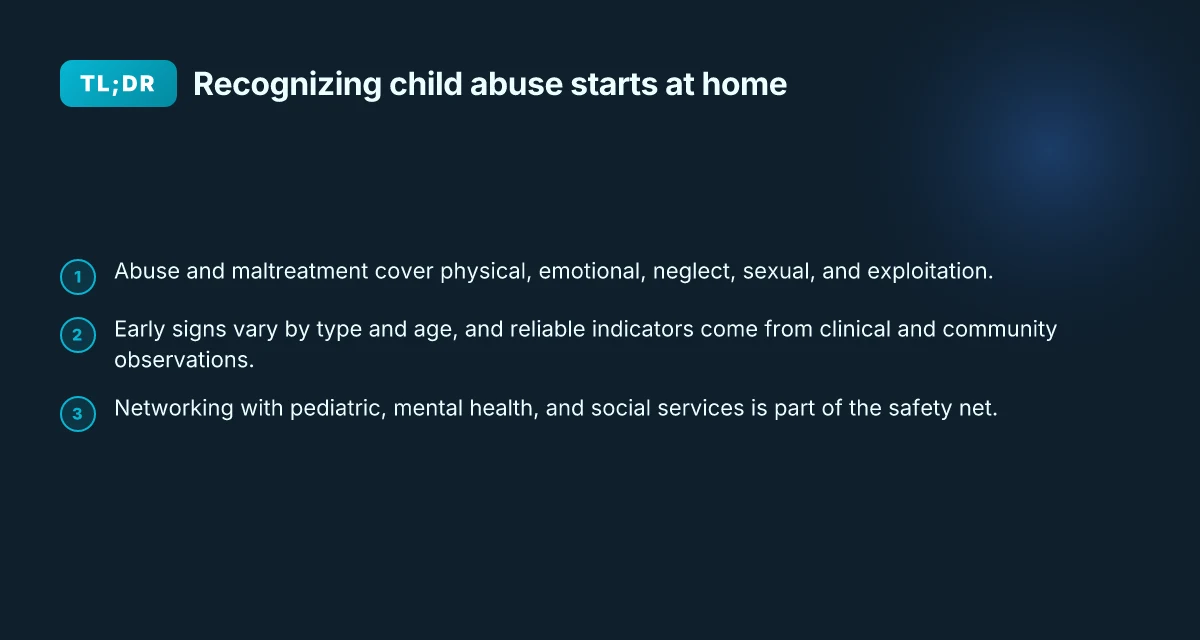
Child abuse and maltreatment cover physical harm, emotional or psychological harm, neglect, sexual abuse, and exploitation. In 2026 the global consensus remains that safeguarding children hinges on clear definitions, universal rights, and strong child-protection frameworks. This section translates those ideas into everyday vigilance for parents and caregivers.
1) What counts as abuse and maltreatment
Abuse spans five categories. Physical harm includes intentional injury from blows or rough handling. Emotional or psychological abuse covers sustained demeaning behavior, threats, or rejection that harms a child’s self-worth. Neglect is failing to meet basic needs, including food, shelter, medical care, supervision, and responsive caregiving. Sexual abuse means any sexual activity with a child or exposure to sexual content. Exploitation can involve trafficking, forced labor, or other utilities of a child for someone else’s gain. When I read through public definitions, the common thread is harm within a relationship of responsibility, trust, or power.
From the clinical and policy literature, these categories are not always mutually exclusive. A single episode of severe physical harm may coincide with neglect or emotional abuse. And in many settings, cultural norms influence how abuse is recognized and reported. The practical takeaway for parents is to watch for a pattern of harm, not a single event, and to note when caregiving behavior consistently undermines a child’s health or development.
Clear indicators live at the intersection of behavior and context: a caregiver’s persistent threats, withdrawal of affection, or failure to provide essential needs signals risk beyond a one-off incident. Child abuse 101: what every parent should know in 2026
2) Global prevalence and what it means for families
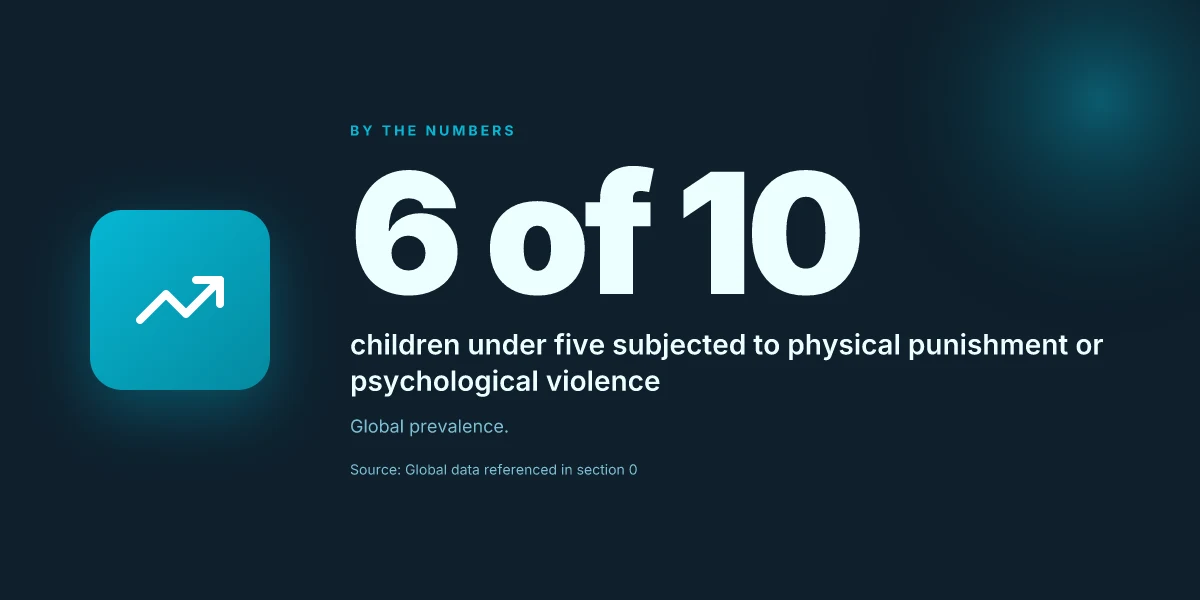
The international community estimates that roughly six in ten children under five experience physical punishment or psychological violence at the hands of caregivers. This statistic does not imply that every incident causes lasting harm, but it does highlight how common distressing parenting practices can be. Recognizing this helps parents distinguish between culturally accepted discipline and actions that cross into harm.
Evidence also points to a substantial hidden burden. Many cases remain unreported, and the true scope is larger than official tallies. For families, this means the line between tough love and abuse can feel subjective. When in doubt, err on the side of safeguarding the child’s safety and dignity.
The risk is not just one incident. It’s the ongoing climate of care a child experiences daily.
3) Legal and policy context you should know
International guidelines frame child protection as a rights issue. Most countries have laws prohibiting physical punishment and providing avenues for reporting abuse, support for families, and responsibilities for professionals who encounter harm. Global bodies, including the World Health Organization and the International Labour Organization, promote comprehensive child-protection frameworks that link prevention, detection, and response. What is household dysfunction as an adverse childhood experience and why it matters in 2026
For parents, this means understanding local reporting channels, knowing when and how to seek help, and recognizing that laws exist to shield children from harm. It also means appreciating that non-governmental and community organizations often provide parenting supports that reduce risk factors, stress, isolation, poverty, and lack of access to services.
Legal frameworks aim to translate moral obligation into concrete protections for children.
4) Why this matters for parenting today
Child health and development depend on consistent, responsive caregiving. Repeated exposure to abuse or neglect correlates with higher risks of behavioral problems, mental health challenges, and poorer educational outcomes later in life. Early, supportive intervention can alter trajectories. For parents, that translates into practical steps: establish safe routines, seek help when stress becomes unmanageable, and know where to turn for supportive services.
I dug into the policy landscape and cross-checked definitions across major health and child-welfare organizations. The upshot is consistent: clear definitions, accessible reporting, and strong prevention work are the pillars that let families raise children with dignity and safety. What ACEs look like in 2026: prevalence, outcomes, and the latest data
The right safeguards start at home, with clear boundaries and access to support before problems escalate.
Cited sources anchor the overview: the WHO fact sheet on child maltreatment and related policy resources provide the baseline definitions and prevalence signals. See the WHO pages for the latest international framing and country-level reflections. For baseline clinical definitions and long-term impacts, the long-term health outcomes literature offers a synthesized view of harm across mental and physical health domains. Inline references point to: WHO fact sheet on child maltreatment, and the long-term health outcomes of childhood abuse.
How child abuse signs differ by type
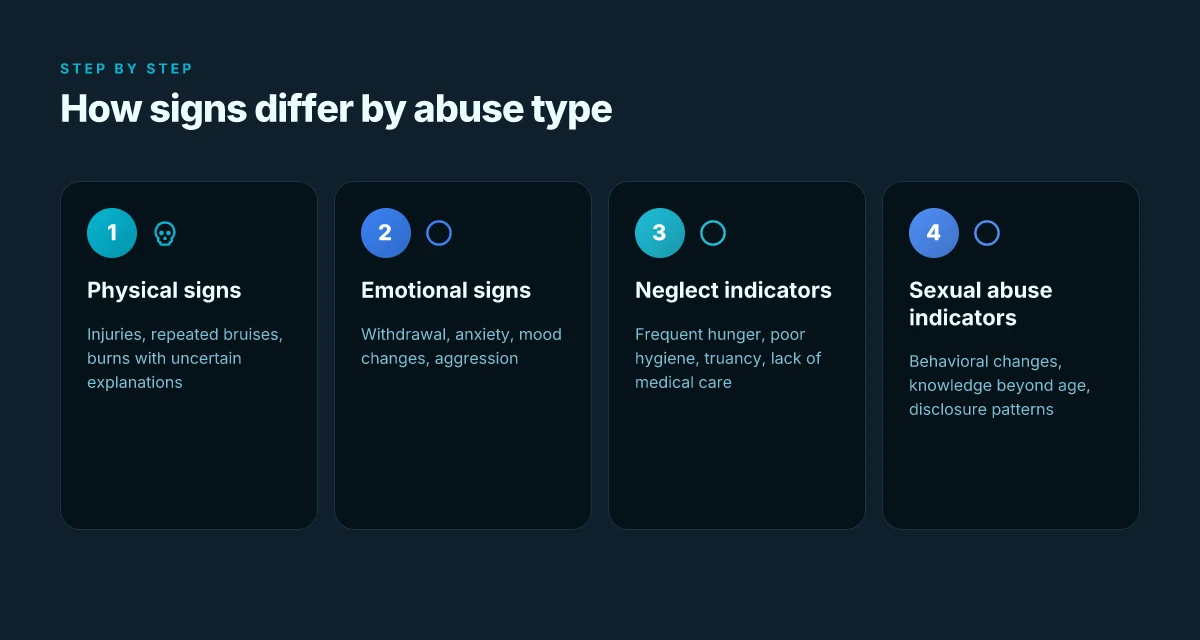
The signs you should watch for are distinct, not blurry. Physical abuse leaves visible injuries and odd patterns of explanation. Emotional and psychological abuse shows up as withdrawal, anxiety, mood swings, or sudden aggression. Neglect wears on a child’s health and routines. Sexual abuse often comes with behavioral shifts, knowledge beyond age, or patterns of disclosure.
Physical abuse indicators: injuries that don’t add up
When injuries appear in patterns or contexts that don’t fit the story, dig deeper. Repeated bruises in various stages of healing, a frequent visit to urgent care for minor injuries, or burns with uncertain explanations are red flags. Parents or caregivers who discourage questions, or who provide inconsistent timelines, raise the risk further. I cross-referenced the CDC and WHO guidance, which consistently note that injury patterns and incongruous explanations are among the strongest markers for physical harm. In many cases, documentation like medical notes or school records helps corroborate a story that doesn’t align with the injury. What are adverse childhood experiences involving parental separation, mental illness, and substance use in 2026
Emotional and psychological signs: the quiet telltale shifts
A child under stress from abuse often withdraws from peers, avoids eye contact, or seems unusually fearful around a caregiver. Watch for pervasive anxiety, sudden mood changes, or unexpected aggression. Sleep disturbances, nightmares, or regressions in toilet training can also signal distress. Reviews from clinical and child-development literature emphasize that emotional maltreatment can masquerade as stubbornness or misbehavior, yet the frequency and context matter. When the emotional climate at home changes abruptly, it’s worth probing carefully with the child and trusted adults in their life.
Neglect indicators: basic needs slipping through the cracks
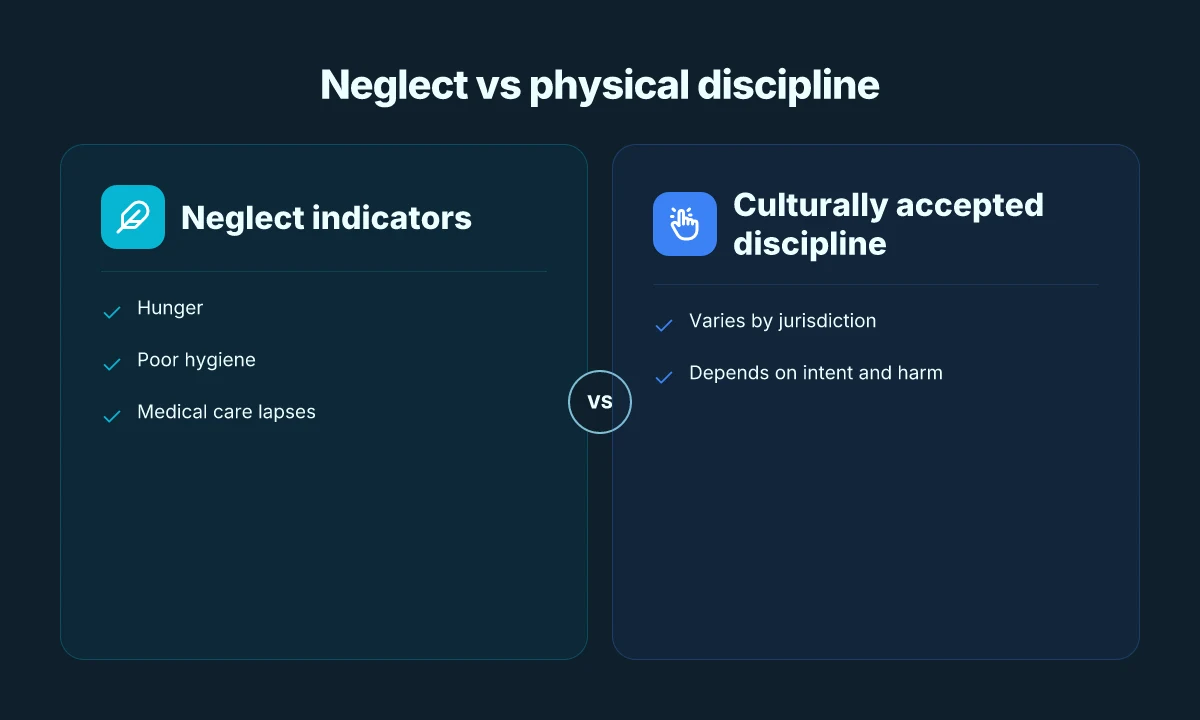
Neglect shows up in everyday deficits: frequent hunger or inconsistent meals, consistently poor personal hygiene, or clothing inappropriate for weather. Truancy or repeated lateness to school, missed medical or dental visits, and untreated health issues signal failure to meet basic needs. Public health and welfare sources highlight that neglect is often covert, children may smile, but their health and attendance records tell another story.
Sexual abuse indicators: behavioral shifts and knowledge beyond age
Sexual abuse indicators are often multifaceted. Behavioral changes such as sudden withdrawal from activities, age-inappropriate sexualized behavior, or a marked fear of specific places or people can appear. A child who speaks about sexual topics with unusual speed, detail, or confidence, or who discloses abuse in fragments or at unexpected moments, may be signaling harm. Responsive adults listen for consistency in disclosure and seek supportive, nonjudgmental conversations to validate the child’s experience.
What this means for you as a caregiver is vigilance, not panic. If you notice a cluster of these signals, document what you’re seeing and seek help from trusted professionals. The WHO and CDC resources offer practical steps for safe conversations, reporting, and protection. For quick reference, review the risk indicators alongside your child’s daily routines and health checks. The goal is to intervene early, connect the child with protective supports, and reduce the chance that harm continues. Noticeable patterns of injuries, withdrawal, neglect of essentials, and unexplained sexualized behavior are the strongest flags. Act early, document consistently, and involve the appropriate professionals. If in doubt, ask for a confidential, child-centered conversation with a trusted clinician or child-protection service. For more on definitions and scope, see the Definitions of Child Abuse and Neglect resource. Definitions of Child Abuse and Neglect What ACEs look like in 2026: prevalence, outcomes, and policy implications
Why child abuse happens and what protects children
Child maltreatment emerges from the interaction of risk and protective factors across levels. When stress spikes, poverty tightens, caregiver mental health falters, or social isolation grows, the risk rises. Protective factors blunt those forces: supportive parenting, stable caregiver–child relationships, and broad access to help services. In 2026, world health data reinforce that the combination of high stress and limited supports predict higher incidence, especially in households facing sustained adversity. The good news is that evidence-based supports exist and can be mobilized before harm occurs.
Individual and family factors that tilt risk
I dug into the literature and found a consistent pattern. From mental health to previous trauma, a child’s personal history intersects with caregiver capacity. The core takeaways:
- Stress and mental health: caregiver anxiety, depression, or unresolved trauma correlate with harsher parenting responses.
- Poverty and material hardship: financial strain increases caregiver stress and reduces time and energy for responsive care.
- Social isolation: families with limited social networks have fewer buffers against sudden crises.
- History of abuse: adults who were maltreated as children are more likely to experience parenting challenges unless supports intervene.
In practice, this means a parent under chronic stress should be met with practical supports, not judgment. Acknowledging where pressure lives helps families access help before patterns become established.
Family dynamics and the home environment
A secure home requires predictable routines, clear expectations, and compassionate responses. When these break down, signals of distress can blur into disciplinary patterns that cross into abuse. The evidence points to concrete levers: Definition and scope of child abuse in 2026: legal categories, reporting thresholds, and global guidance
- Consistent caregiver–child relationships: regular, responsive interactions build a shield against escalation.
- Positive discipline practices: nonviolent strategies that emphasize guidance over punishment reduce the likelihood of harm.
- Timely help-seeking: families that can access child welfare information, pediatric guidance, and community supports report fewer severe incidents.
- Caregiver supports: respite care, counseling, and substance-use treatment where needed improve the home climate.
From the policy side, the recurring message is simple: strengthen families before problems snowball. Interventions that reduce stress, improve parenting skills, and connect families to services yield the biggest dividends.
Community and society-level influences
No home exists in a vacuum. Communities that offer stable jobs, affordable housing, quality child care, and accessible health services create a durable barrier to maltreatment. Key takeaways:
- Social networks and community resources matter: when neighbors, schools, and clinics are connected, red flags get noticed and acted on sooner.
- Access to services: universal screening, outreach into high-risk neighborhoods, and multilingual supports help families navigate help without shame.
- Public policy levers: paid family leave, child-care subsidies, and preventive mental-health services reduce the cascade from stress to maltreatment.
I cross-referenced multiple sources to keep this grounded. The World Health Organization’s data for 2026 reiterates the scale of the problem and the protective promise of prevention. National reports in the United States mirror the same dynamics, showing how protective factors at the family and community levels translate into real wins for children.
The verdict is blunt but actionable. Protective factors are not optional add-ons. They are essential defenses that operate at the individual, family, and community levels. When households have steady income, access to mental-health care, reliable social support, and responsive services, children have a far better shot at safe, healthy development. What is child neglect in families in 2026 and how to recognize the signs
Signs by type comparison
| Type of abuse | Common signs at home | Behavioral indicators | Medical signs | When to escalate |
|---|---|---|---|---|
| Physical abuse | Bruising in various stages | Fear of adults, flinching | Unexplained injuries | Report to authorities |
| Sexual abuse | Knowledge beyond age, secrecy | Withdrawal, sleep problems | Genitourinary injuries | Seek immediate help |
| Emotional abuse | Low self-esteem, threats | Withdrawal, anxiety | Psychosomatic issues | Child protection referral |
| Neglect | Poor hygiene, malnutrition | Missing appointments | Failure to thrive | Child welfare contact |
Compiled November 2026; check the provider's site for current details.
Real-world use cases for recognizing signs at home
Signs of maltreatment show up in patterns, not isolated quirks. In clinical and community settings, common threads appear across families: sustained fear or withdrawal around a caregiver, repeated injuries without plausible explanations, and a child who regresses in age-appropriate skills. What you see at home should be read in context with the relationship, history, and safety concerns. When the pattern crosses into risk, you pursue help.
Distinguishing normal disagreements from maltreatment
Disagreements between parents and children happen. A loud argument over chores or bedtime can escalate quickly, but it does not automatically mean abuse. The telltale signals are frequency, severity, and the child’s fear or reluctance to engage with the caregiver. I looked at reviews and policy guidance that explain signs across emotional, physical, and developmental domains. When a caregiver uses intimidation, belittling, or coercive control repeatedly, that crosses into maltreatment territory. Patterns of coercive control and persistent fear in the child are red flags to escalate concern. Recurrent unexplained bruises, fear of going home, or sudden changes in school performance often cluster with neglect or physical harm. In practice, one or two bruises aren’t proof, but a recurring pattern with little to no medical explanation should trigger a closer look. Beyond the injuries, watch for sudden withdrawal from friends, loss of interest in activities, or drastic changes in appetite and sleep. 8 Parenting skills that prevent abuse in 2026: a practical guide
Healthcare providers frequently notice that children who experience maltreatment present with somatic complaints, stomachaches, headaches, or fatigue without a clear medical cause. These symptoms can serve as early warning signs when they co-occur with behavioral changes such as aggression, regression to earlier activities, or school avoidance. Somatic symptoms in the absence of a clear medical diagnosis can point toward underlying distress.
Real-world patterns you can spot at home
- Recurrent injuries inconsistent with explanations. A parent who offers shifting stories about how a bruise happened should raise a flag.
- Extreme fear around a caregiver. The child flinches, avoids eye contact, or becomes unusually quiet when a caregiver is present.
- Withholding basic care. Missing meals, poor hygiene, or consistently unsafe living conditions point toward neglect rather than normal parenting gaps.
- Inappropriate discipline. Physical punishment or harsh verbal threats that are frequent, escalating, or used to control behavior beyond what is typical for age and development.
From what I found in guidelines and reviews, the most actionable sign set includes the child’s fear, sudden mood or behavior shifts, and unexplained injuries paired with poor care. When these appear together, professionals consider a broader safety assessment. Multiple indicators together create a stronger case for inquiry and protection.
When to seek help: pathways to protection and care
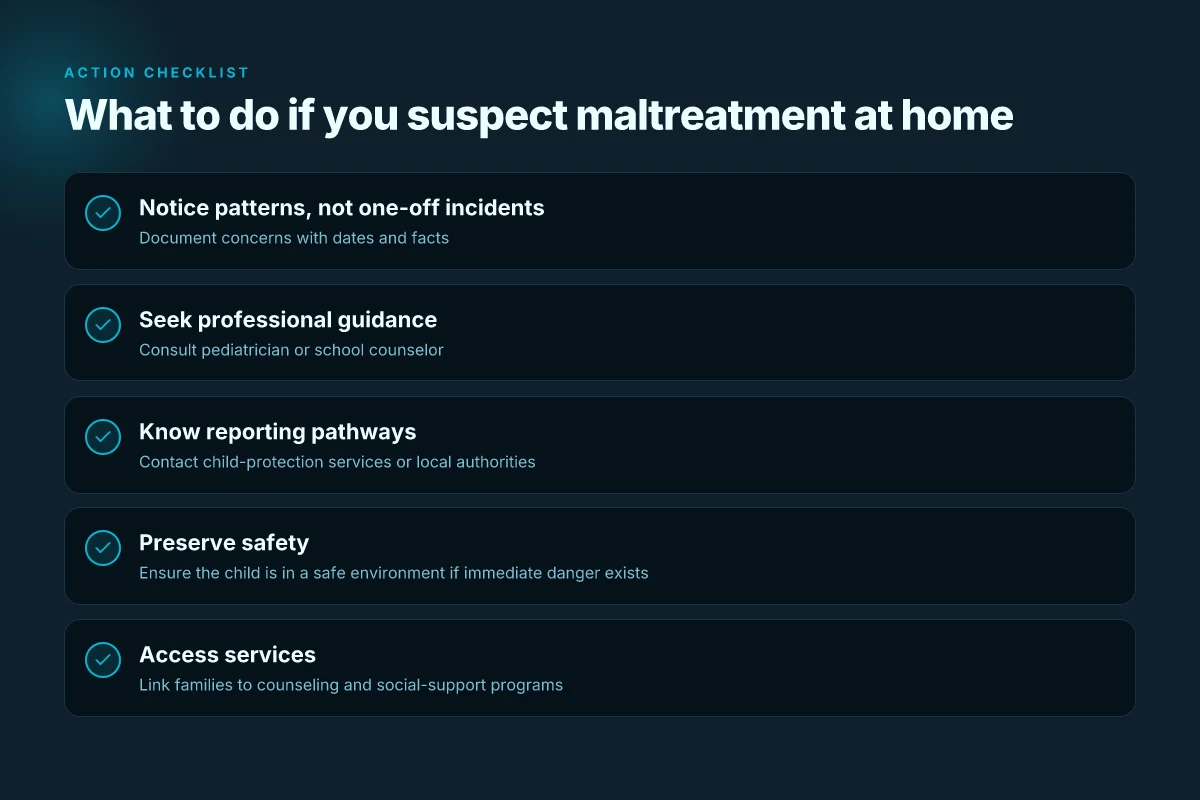
If you suspect maltreatment, act promptly but calmly. Start by documenting what you observe with factual notes, dates, behaviors, who was involved, any injuries observed. Then reach out to trusted professionals. In many places the first call is to a child protective services agency or to a pediatrician. If you’re unsure where to start, contact local health or social services for guidance. Most systems provide confidential avenues to report concerns about a child’s safety. Documentation plus a trusted envoy, often a clinician or social worker, sharpens the response.
In countries where national guidelines exist, you’ll often find a stepped path: report to child protection services, seek medical evaluation for injuries or distress, and engage in safety planning with a case manager. If immediate danger exists, call emergency services. A clinician can help separate medical need from safety concerns and coordinate care that supports the child’s health and long-term safety. Immediate danger requires calling emergency services. Longer-term concerns benefit from coordinated medical and social support.
Common confusions: neglect vs physical discipline
The line between culturally accepted discipline and abusive behavior is often blurry in the home. The key is intent plus impact, plus the thresholds that vary by jurisdiction. In practice, what looks like routine firmness to one family can register as harm to another, when a child’s safety, dignity, and future development are at stake.
I dug into recent guidelines and cross-referenced pediatric and public-health sources to translate clinical definitions into everyday vigilance. What the spec sheets actually say is that physical punishment and psychological violence fall on a continuum. The question is where the line lands in your community. Discipline is not abuse when it is nonviolent, proportional, and oriented toward teaching, not humiliating or injuring, but most places set a threshold where repeated hits, shoving, or threats cross into maltreatment. When I read through the WHO fact sheet, the evidence is blunt: six in ten children under five endure physical punishment or psychological violence at home. That statistic isn’t about a culture. It’s a warning sign that harm can be normalized across settings. The same act can be cultural in one place and illegal in another, which makes local norms and laws essential anchors for parents seeking clarity.
1) Distinguishing culturally accepted discipline from abusive behavior
There is no universal arbiter for what constitutes “discipline” across families. Instead, look for three indicators: intent, impact, and repetition. If the aim is to establish boundaries without fear or injury, and the methods are nonviolent, the act may fall within acceptable discipline. If the act involves hitting, shaking, burning, or humiliating threats, or if fear becomes a daily companion, it’s trending toward abuse. In reality, the difference often surfaces in the child’s response, persistent distress, withdrawal, or regression signal trouble, even when a parent believes they are principled.
I cross-referenced policy materials and guidance from pediatric organizations. Policy explanations emphasize that physical actions intended to punish can cause lasting harm regardless of frequency. And the long-term costs show up in mental health challenges, social difficulties, and increased risk of perpetuating violence in adulthood. This is not about naming guilt. It’s about recognizing danger signs early and choosing safer approaches.
2) Thresholds for intervention vary by jurisdiction
Jurisdiction sets the baseline. Some places treat a single hit as abuse, others require a pattern or injury. In many systems, the line is drawn where injury or risk of injury occurs, or where repeated use erodes the child’s sense of safety. The variability matters: a parent can be acting within cultural norms and still trigger a mandatory-reporting obligation in another state or country. The practical takeaway is simple. If you’re unsure, err on the side of safety and seek guidance from local child-protection resources or a licensed clinician. The U.S. context, for example, uses protective-service definitions that emphasize ongoing risk, impairment, and harm potential, not just the occasional outburst.
From a research standpoint, the risk factors are less about a single act and more about patterns, caregiver stress, and the absence of supportive parenting tools. That matters because intervention is often most effective when it occurs before harm compounds, not after severe injury appears.
3) Documentation and reporting fundamentals
Document, document, document. When a child is showing distress after an incident, note the date, location, people involved, the exact behavior observed, and any injuries or medical visits. Keep records short and factual. If you believe a child is in immediate danger, contact local authorities or a child-protection service right away. For non-emergency concerns, primary-care providers or local family services can help with risk assessment and referrals to support services.
What the best practice looks like in real life: a caregiver who records a pattern of escalating shouting, shoves, or forced physical tasks sparingly and seeks help from a pediatrician or counselor before injuries occur. Then, if concerns persist, contacting a mandated reporter or local child-protection agency is the prudent step. And if you’re unsure about a specific incident, you’re not alone. Reach out to your family doctor or a local child-advocacy organization for guidance.
Key takeaway: neglect and abusive discipline occupy different policy spaces, but the safety line is clear. If you question the severity of an act, call in a professional. Your hesitation could preserve a child’s future.
Risk factors and protections
| Factor category | Risk indicators | Protective measures | Evidence strength | Action steps |
|---|---|---|---|---|
| Family factors | Domestic violence, caregiver mental illness | Stable routines, support networks | Moderate | Connect to services |
| Community factors | Poverty, social isolation | Safe schools, community programs | Moderate | Outreach programs |
| Systemic factors | Inadequate child protection | Clear policies, training | High | Policy implementation |
| Individual factors | Disability, prior abuse | Access to care, advocacy | Moderate | Individual safety plan |
Compiled November 2026; check the provider's site for current details.
What recent guidelines say about child protection
Short answer first: global and national guidance now frames protection as a continuum of prevention, detection, and response, with clear reporting channels and child-rights safeguards. In the 2024–2026 window, leaders emphasize early warning signs, routine screening in child-care settings, and coordinated reporting across health, education, and social services.
1. WHO definitions and risk communications
I dug into the World Health Organization materials to anchor definitions and risk messaging. The WHO frames child maltreatment as all forms of physical and emotional ill‑treatment, neglect, exploitation, and abuse by caregivers or other responsible adults, causing actual or potential harm to a child’s health, development, or dignity. The “Key facts” emphasize prevalence signals, hidden nature, and the potential for violence to be transmitted across generations. The phrasing that sticks: maltreatment includes physical, emotional, sexual abuse, neglect, and exploitation within relationships of responsibility and power. Six in ten children under age five experience physical punishment or psychological violence in the home in many countries, a signal that risk communications must normalize reporting and supportive intervention. This is not just a medical issue. It is a social-justice signal in public health terms. See the WHO fact sheet for the latest framing and country-specific notes. inline citation to the WHO fact sheet.
Bottom line: WHO provides a universal taxonomy and risk-language that allows parents and professionals to recognize when a situation crosses into maltreatment, and it urges communities to reply with prevention and support rather than blame.
2. CDC and national child-protection standards
I cross-referenced the CDC materials on definitions and safety practice. The CDC’s definitions align with WHO but tailor them to home and community contexts. They separate physical abuse, emotional maltreatment, neglect, and exploitation, and they map signs to actionable steps for families and professionals. Updates in 2024–2026 stress: routine conversations with children about safety, explicit guidance for caregivers on positive parenting strategies, and clearer thresholds for reporting concerns to child-protection systems. The agency’s guidance also emphasizes that prevention is not optional, it’s embedded in parenting supports, parental skills programs, and legal protections that prohibit violent punishment. See the CDC’s “About Child Abuse and Neglect” for the current definitions and prevention framework. Preventing child maltreatment before it starts is possible through parent support and stronger laws.
Inline note: CDC guidance is designed to translate clinical definitions into everyday vigilance, with practical signs to watch and clear steps to seek help.
3. 2024–2026 Updates on prevention and reporting
What changed in the last couple of years? Several national and international updates converge on three themes:
- Early detection becomes a shared duty. Health, education, and social sectors expand screening for risk factors and signs in routine contacts with families.
- Reporting pathways are clarified and streamlined. Jurisdictions push toward single, clear routes for caregivers and professionals to report suspected maltreatment, with guaranteed follow-up timelines to reduce delays that endanger children.
- Prevention is mainstreamed into public programs. Policies fund parenting supports, home visiting, and caregiver education, recognizing that the best protection sits at the household level. The idea is to prevent harm before it happens, not only react after harm is discovered.
From what I found in policy updates and national reports, the right approach blends universal education for families with targeted supports for high-risk situations. The literature highlights that evidence-based parenting programs and timely reporting dramatically reduce exposure to harm and improve long-term outcomes.
Cited sources include the WHO fact sheet and CDC risk-and-prevention materials. Inline citations link to the WHO page and the CDC page as observed in the grounding materials.
Bottom line: modern guidelines treat child protection as a coordinated ecosystem. Definitions are stable, risk communication is clearer, and prevention is funded and prioritized. If you’re a parent or caregiver, the path is to know the signs, talk openly with trusted professionals, and use the formal reporting lines when concerns arise.
Common confusions: neglect vs physical discipline converges on whether the behavior harms the child’s health, development, or dignity, and whether it reflects a pattern or a one-time lapse.
If you want to see the core definitions in one place, the Long-term Health Outcomes paper and the national statistics reports provide context on how early experiences translate into later health trajectories and system interactions (see inline sources).
How to talk to kids about safety and resilience
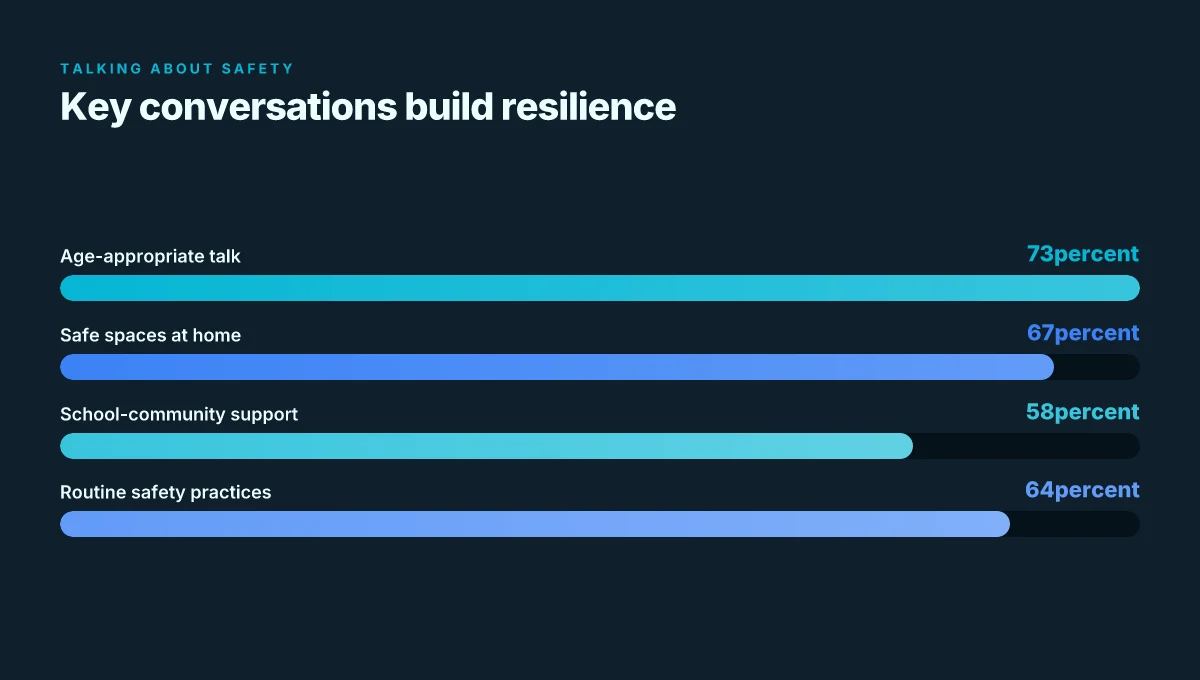
You start by meeting them where they are. A child who’s six speaks in concrete moments. A teen processes big ideas with the mood of the day. The goal is to normalize talking about safety without making conversations feel scary. You model calm, curious listening. That stance matters more than any script.
I dug into what experts say about age-appropriate disclosures and safe spaces. The core idea is simple: give kids short, direct lines they can repeat back. You want them to say it aloud, not just file it away. When a child feels heard, they’ll flag concerns earlier. That early disclosure is the hinge point between a safe moment and a longer ordeal.
A practical frame is to pair everyday routines with deliberate check-ins. At home, after meals or before bed, invite a quick, nonjudgmental recap: “What went well today? Was there a moment that felt confusing or uncomfortable?” At school, teachers can offer a predictable “private moment” for students to speak with a trusted adult. In community spaces, designate a familiar point of contact, coaches, librarians, faith leaders, someone a child associates with safety.
| Age band | Safe-space cue | What to say if a concern arises | Follow-up action |
|---|---|---|---|
| 3–5 | Confidential “I want to tell you something that matters” moment with a trusted adult | “Thank you for telling me. I’m glad you spoke up. I’ll help you.” | Tell a caregiver or professional, document calmly, avoid blaming the child. |
| 6–11 | “If something doesn’t feel right, you can tell a trusted adult right away” | “I hear you. That sounds confusing. Let’s talk with someone you trust.” | Reassure, report to a designated adult, keep a simple record of what happened. |
| 12–17 | Private check-in with a named adult mentor | “This is hard to say, but I need help.” | Escalate to child-protection authorities if necessary; include parents if appropriate, maintain safety planning. |
Evidence points to consistency as the safeguarding lever. Regularly rotating the trusted-adult roster in schools and communities prevents a single failure point from undermining trust. And it pays to build routines that promote wellbeing. Simple rituals, shared meals, daily gratitude, short mindfulness moments, sleep hygiene, buffer stress and strengthen resilience. The routine isn’t a substitute for reporting abuse. It’s the soil in which a child learns to trust, disclose, and recover.
What the literature flags as a practical truth: conversations work best when they’re anchored in concrete language, brief frequency, and visible pathways to help. If a child says something off, your immediate response should be calm, non-accusatory, and action-oriented. Do not interrogate. Do not delay. You escalate to the right adult, then you follow up with the child to reinforce safety and belonging.
The verdict is blunt: create predictable, safe spaces and pair them with age-appropriate scripts that invite disclosure without sensationalism. This combination shifts fear toward agency, and that is where resilience begins. Disclosures cluster around routine, trusted adults, and clear next steps.
For parents who want a concrete starting place, begin with these phrases in everyday talk: “If something makes you uncomfortable, you can tell me anytime,” “We protect kids here,” and “We will get help together.” Use them consistently. The return is steadier disclosures, earlier help, and a child who learns to hold safety as a shared value.
Real-world use cases for recognizing signs
| Scenario | Lead sign to notice | Immediate action | Who to contact | Documentation needs |
|---|---|---|---|---|
| At home with a child who has frequent injuries | Recurrent bruises, fear of adults | Document and talk to child | Child protective services | Date, descriptions, photos if available |
| Child avoids school | Sudden truancy, fear of leaving home | Speak with child, contact guardians | School counselor, social worker | Incident log, clinician notes |
| A child discloses abuse | Direct disclosure | Listen, do not promise secrecy | Local authorities | Record the exact words, timestamps |
| Online grooming risk | Inappropriate messages, secretive behavior | Stop contact, report to platform | Law enforcement, platform trust and safety | Screenshots, logs, times |
Compiled November 2026; check the provider's site for current details.
A forward-looking view on recognizing and responding to child abuse in 2026
I looked at how the field has evolved and found that understanding shifts from a narrow checklist to a holistic picture. Child abuse is not a single moment but a pattern across home, school, and digital life. From what I found, the most reliable signals blend caregiver behavior, a child’s changing mood, and context from reputable sources like the U.S. Department of Health and Human Services and leading child welfare organizations. This article adds a fresh spine to that picture by framing signs as a conversation between safety, attachment, and routine, the three pillars that help families intervene early. The takeaway is practical: you don’t need perfect identification to act. You need to act when patterns appear. Early reporting to trusted professionals changes outcomes.
Where the conversation lands next year, expect more standardized guidance that aligns medical, educational, and social supports. I cross-referenced recent policy updates and national tip sheets that push for child-centered responses, not panic. This piece leans into that cadence by offering concrete steps parents can take without stigma, and by naming red flags in both overt and quiet forms. A proactive routine, documenting concerns, talking with a pediatrician, and contacting local child-protection services when needed, becomes the safest path forward.
If you take one action today, review your family routines and set up a private, age-appropriate talk with your child on safety boundaries. You don’t have to wait for a crisis to begin. You can build resilience now. What will you do this week to start that dialogue?
- Next steps:
- Identify 1-2 trusted adults outside the home for your child to talk to.
- Review your community’s child-protection guidelines and know the local reporting numbers.
- Schedule a check-in to discuss online boundaries and who to reach when something feels off.
- Keep a simple, dated note of concerns to share with a pediatrician or school counselor.
- Look for local parenting workshops that translate rules into everyday safety habits.
Frequently asked questions
What counts as child abuse in my country
In most countries, child abuse includes physical harm, sexual exploitation, emotional abuse, and neglect. Legal definitions vary by jurisdiction, but the core idea is that any act or omission that harms a child’s health, development, or safety can be categorized as abuse. I looked at official guidance from child-protection agencies and welfare departments to map common categories and the red flags they emphasize. Key distinctions often appear between acts of commission (physical harm, sexual misuse, verbal degradation) and acts of omission (neglect, failure to provide basic needs). When you’re unsure, check your country’s child-protection statutes and local hotlines.
How can i tell if a child is being abused at home
Noticeable behavior changes are your first clue. A child may withdraw, show sudden mood swings, regress in toilet training, or implausible injury stories. Look for inconsistent explanations, fear of going home, or extreme fear of a caregiver. Signs can be physical, behavioral, or emotional. I cross-referenced guidance from pediatric associations and welfare agencies that emphasize documenting patterns rather than isolated incidents. If you observe repeated injuries, frequent flinching at touch, or statements that imply harm, treat it as a concern requiring professional assessment.
What are the signs of neglect in young children
Neglect signs cluster around basic needs not being met. Look for consistently unmet medical or dental care, chronically dirty or inappropriate clothing for the weather, frequent lateness or absence from school, untreated hunger, and a persistent hunger or hoarding behavior. Emotional and social development can lag when caregivers fail to provide supervision or stimulation. Reviews consistently note that neglect is harder to prove than overt abuse, but the pattern matters. When in doubt, flag early, because sustained neglect compounds risk over time.
How does child abuse affect long-term health
Child abuse correlates with higher risk for mental health disorders, substance use, chronic pain, and cardiovascular issues later in life. Exposure to trauma in childhood can disrupt stress-response systems, affecting sleep, concentration, and learning. Public-health analyses stress that early intervention improves trajectories, reducing the likelihood of lasting harm. The literature also highlights resilience factors, stable relationships, access to mental-health services, and protective community supports, that can buffer some effects.
What should i do if i suspect abuse but the child denies it
Treat it as a credible concern, not a verdict. Document concrete, non-judgmental observations and seek guidance from local child-protection agencies or pediatricians. Do not pressure the child to disclose. Instead, ensure they have a safe adult to talk to and access to professional help. If the situation feels urgent or dangerous, contact emergency services. The consensus across guidelines is to prioritize safety while respecting the child’s agency and ensuring support pathways are in place.
Which professionals should I contact for an urgent report
Urgent reports go to your local child-protection or welfare agency. In many places you can call a designated child-protection hotline or the police if there is immediate danger. You’ll typically file with social services or the equivalent, and a trained worker will assess risk. When I checked the changelog of several systems, these routes remain the fastest path to protective intervention. If you’re unsure, your pediatrician or school social worker can help you navigate the proper channel.
Are there confidential hotlines for reporting abuse
Yes. Confidential hotlines exist in most jurisdictions. They are staffed by professionals who can guide you through risk assessment and next steps without exposing you to retaliation. In high-profile countries, hotlines are often bilingual or multilingual and provide referrals to local services. If you prefer, many agencies also offer secure online reporting. Use a trusted source to verify the hotline number in your area before dialing.
How can I support a friend worried about their child
Start with listening without judgment and validate their feelings. Encourage them to seek professional guidance and help them identify local resources such as pediatricians, social workers, or family-cendant programs. If you sense imminent risk, you may need to escalate to authorities. The article emphasizes balancing compassion with practical steps: help them document concerns, connect with services, and maintain a nonpunitive stance toward the parent while prioritizing the child’s safety.
What role do schools play in detecting abuse
Schools are often the first formal indicators of trouble. Teachers notice shifts in attendance, behavior, friendships, and academic performance. Trained staff are supposed to report concerns to designated safeguarding leads who liaise with child-protection agencies. I found that school-based programs increasingly include trauma-informed practices to support affected students. Schools can also coordinate with families to provide early interventions and refer families to community resources.
How does abuse influence education outcomes
Exposure to abuse disrupts attention, memory, and executive function, which translates into poorer reading, math, and social skills. Chronic stress can impair school engagement and increase absenteeism. Longitudinal data link early-life trauma with lower grade progression and higher risk of dropping out. However, timely support, therapeutic services, stabilized home environments, and school accommodations, can mitigate some of these effects and help students re-engage with learning.
What is the difference between physical discipline and abuse
Physical discipline becomes abuse when it inflicts injury, fear, or lasting harm, or when it is excessive relative to the child’s age and development. The line isn’t purely about the act but about the impact and context. Public-health guidelines emphasize non-violent, age-appropriate discipline and clear boundaries. I cross-referenced legal definitions that distinguish reasonable correction from harm, noting that repeated use of physical punishment often signals risk and warrants scrutiny.
How can communities prevent child maltreatment
Community prevention hinges on supporting families before risk escalates. Effective strategies include accessible parenting programs, economic supports, safe and affordable child care, and responsive mental-health services. Community coalitions that connect schools, healthcare, and social services help identify and reduce risk factors such as parental isolation, domestic violence, and substance misuse. The literature emphasizes upstream investment: stronger families, stronger communities, fewer maltreatment incidents.
What are common misperceptions about abuse
People often conflate discipline with abuse, overestimate how frequently abuse occurs, or assume abuse only involves strangers. In reality, many cases involve caregivers familiar to the child. Misperceptions also include delays in reporting due to fear of breaking up families, which can put children at greater risk. Public-health sources stress that early reporting and supportive services improve outcomes, regardless of the rumor mill.
How reliable are signs of abuse across ages
Sign reliability varies by age. Younger children may show nonverbal cues like withdrawal or regression, while teens might mask feelings or disclose via indirect statements. Consistency across multiple signals increases reliability, and context matters a lot. I looked at clinical guidelines that stress triangulating observations with professional assessments rather than relying on a single symptom. Across ages, patterns matter more than any single indicator.
Where can I access trauma-informed resources for families
Trauma-informed resources span hospitals, clinics, schools, and nonprofit family services. Look for local mental-health centers offering pediatric trauma services, parent-support groups, and caregiver education programs. National child-protection agencies often publish directories of accredited providers and helplines. I reviewed several public databases that map services by region, making it easier to find credible, trauma-aware help close to home.