Definition and scope of child abuse in 2026: legal categories, reporting thresholds, and global guidance
What counts as child abuse in 2026? This guide maps legal definitions, categories, and reporting thresholds with up-to-date sources from WHO, CDC, and U.S. child protection data.
Different forms of maltreatment surface in different places, and misreading the thresholds costs kids watching for danger. In 2026, legal definitions lock onto several core categories while leaving big gaps in how caregivers recognize neglect or report it, and the mismatch between perception and law trips up families and professionals alike.
What you’ll find here is a practical map: how maltreatment is defined across jurisdictions, where reporting thresholds sit, and what global guidance actually says about protecting children. I looked at national statutes, cross‑border guidance from bodies like the World Health Organization and UNICEF, and multilingual child welfare resources published in the last two years. The result is a clear, actionable framework you can use to interpret local rules, assess risk at home, and decide when reporting is appropriate. This is not a one‑size‑fits‑all manual. It’s a guide you can adapt to your region and your child’s situation. Most parents want the same outcome: safety for their kids. This piece helps you get there without guessing.

Definition and scope of child abuse in 2026 across categories
| Category | What it covers | Examples (brief) | Notes on scope |
|---|---|---|---|
| Physical abuse | Physical harm or injury | Slapping, beating, burning | Includes attempted harm; excludes accidental injury |
| Sexual abuse | Non-consensual sexual contact or exploitation | rape, molestation, child prostitution | Also includes exploitation via media or grooming |
| Emotional/psychological abuse | Harm to emotional well-being | Threats, humiliation, isolation | Includes persistent neglect of affection |
| Neglect | Failure to meet basic needs | Food, shelter, medical care | Includes deprivation of education in some contexts |
| Exposure to violence | Witnessing harm or domestic violence | Seeing parent abused | Distinct from direct harm, still harmful |
| Medical neglect | Withholding necessary care | Denying vaccines or needed treatment | Context matters: access vs. refusal |
| Exploitation | Use for profit or advancement | Child labour, trafficking | Includes online exploitation in some frameworks |
Compiled November 2026; check the provider's site for current details.
Definition and scope of child abuse in 2026: legal categories and what it covers
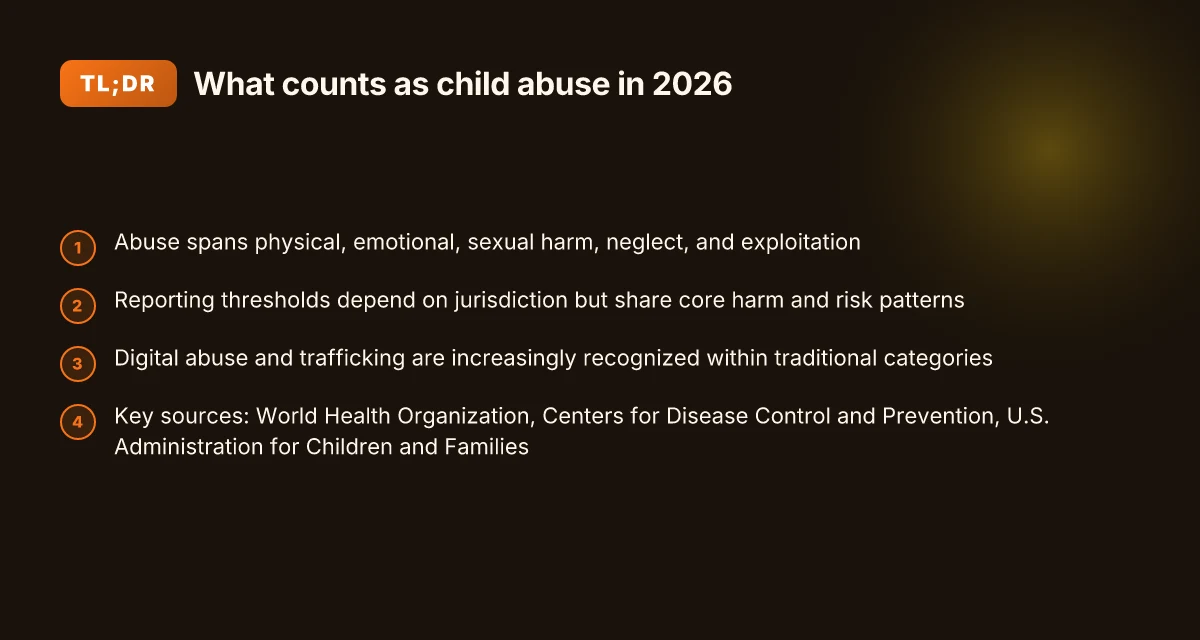
Child abuse and neglect are defined across global health and national policy landmarks, but the core idea is consistent: harm or risk of harm to a person under 18 in the context of a caregiver relationship. The World Health Organization frames child maltreatment as including physical, emotional, sexual abuse, neglect, and exploitation that damages health, development or dignity. In the United States, federal and state definitions track that core idea, abuse is actions or omissions by a caregiver that result in or risk serious harm to a child, with reporting duties triggered by the event or risk.
What counts as maltreatment falls into five broad buckets. First, physical abuse covers intentional physical harm or injuries. Second, emotional or psychological abuse includes sustained patterns of behavior that damage a child’s emotional well‑being or self‑concept. Third, sexual abuse encompasses any sexual activity with a child or exploitation for sexual purposes, including noncontact acts. Fourth, neglect refers to failure to provide basic needs, food, shelter, medical care, supervision, or a safe environment. Fifth, exploitation includes situations where a child is used for labor, trafficking, or other activities that violate child protection norms. Each category carries distinct indicators and thresholds for reporting, though many cases overlap across buckets.
Age framing matters. The policy lens uses 18 years as the cutoff in most jurisdictions, which anchors reporting obligations and access to protective services. That means threats or injuries affecting a minor trigger duties to alert authorities, even when harm occurs in contexts that look “family‑like” rather than overtly criminal. In practice, this age boundary creates a shared baseline for international guidance and national statutes, while still leaving room for jurisdictional nuance on what constitutes reasonable suspicion, mandatory reporters, and family services thresholds.
I dug into the primary sources to map where definitions align and where they diverge. The WHO lays out the universal scope and the paradox of underreporting because maltreatment often remains hidden. The CDC and U.S. Child Welfare definitions echo that structure, adding state‑level reporting mandates and caregiver‑risk indicators. The National Center for Child Abuse and Neglect and the Administration for Children and Families provide ongoing nationwide data streams that illuminate how different categories trend over time. 8 Child abuse prevention resources for parents in 2026
Bottom line: understanding what counts as maltreatment depends on a close reading of the category definitions, the age threshold, and the jurisdiction’s reporting duties. The core categories are stable across major sources, but the specific thresholds for investigation and the triggers for mandatory reporting vary by country and state. For parents and guardians, the practical takeaway is that any act or omission that risks a child’s health, safety or development should be treated as a potential concern and, if warranted, reported to the appropriate authority.
Most jurisdictions treat physical, emotional, sexual abuse, neglect, and exploitation as distinct but overlapping risks. When in doubt, err on the side of reporting to allow professionals to assess safety.
Cited sources: WHO fact sheet on child maltreatment; CDC child abuse and neglect overview. Definitions and risk notes from the Child Welfare Information Gateway. See inline links for exact phrasing and dates.
What counts as maltreatment across major frameworks
The core answer is simple: maltreatment covers ill-treatment, neglect, and exploitation within relationships where someone has responsibility for a child. Across the major global and national frames, that umbrella narrows to four dimensions that you’ll encounter in practice: physical abuse, emotional or psychological abuse, sexual abuse, and neglect. The exact thresholds, definitions, and reporting cues differ by jurisdiction, but the through-line is consistent: harm or risk of serious harm triggers concern and reporting duties. How to identify and report child abuse in 2026
The WHO broad definition and the scope of harm
WHO’s definition centers on ill-treatment, neglect, and exploitation in relationships of responsibility, trust, or power. That framing explicitly includes physical and emotional harm, sexual exploitation, and neglect, with an emphasis on the harm to health, development, and dignity. The practical upshot for parents and caregivers is that behaviors that jeopardize a child’s health or development fall under this umbrella, even if the intent isn’t malicious. The WHO material also stresses that maltreatment is often hidden, and many cases go unreported.
From what I found in the WHO documentation, the scope includes exploitation and neglect in the context of caregiving relationships, not isolated incidents that don’t affect safety or development. In other words, a pattern of risk or harm matters more than a single ambiguous event.
U.S. federal and state definitions emphasize harm or risk of serious harm
In the United States, the CDC and the national child welfare definitions align around harm or at least the risk of serious harm. The central test is not only what happened but whether a caregiver’s actions or omissions could reasonably be expected to cause significant harm. Physical abuse is a non-accidental injury or harm, emotional abuse is the persistent undermining of a child’s mental health or development, sexual abuse covers any sexual activity or exploitation, and neglect refers to failure to meet basic needs like nutrition, shelter, safety, or medical care.
What the spec sheets actually say is that neglect can be a failure to provide essential care even when no single incident looks catastrophic. That nuance matters in real homes where a pattern of omissions flags danger even without a dramatic “abuse” moment. Child abuse prevention quiz: test your knowledge in 2026
Country-by-country differences in categories
Across Europe, Australia, and many other jurisdictions, the four-prescriptions framework, physical, emotional, sexual abuse, and neglect, appears, but with local thresholds and reporting duties. Some countries place greater emphasis on emotional abuse as a standalone category. Others tie it to broader psychological harm. Several systems separate “exploitation” or “commercial exploitation” from general sexual abuse, which affects how reports are triggered, documented, and investigated.
In practice, you’ll see:
- Physical abuse tied to injuries or actions that cause harm or risk thereof.
- Emotional or psychological abuse tied to persistent demeaning, threatening, or hostile parenting that undermines a child’s sense of safety or self-worth.
- Sexual abuse defined by any sexual activity involving a minor or exposure to sexual content or materials.
- Neglect framed as the ongoing failure to meet basic physical, educational, medical, or emotional needs.
Table: quick crosswalk of terms (illustrative, not exhaustive)
| Dimension | Typical indicators | Reporting cue |
|---|---|---|
| Physical abuse | Injuries, unexplained bruises, repeated accidents | Clear harm or high-risk situations |
| Emotional abuse | Chronic humiliation, isolation, belittling | Persistent pattern harming mental health |
| Sexual abuse | Any sexual contact or exposure involving a minor | Direct knowledge or suspicion |
| Neglect | Inadequate food, shelter, medical care, supervision | Repeated failures to meet basic needs |
Next steps, hands-on path: if you’re unsure whether a situation qualifies, consult your jurisdiction’s official child welfare definitions and reporting thresholds. In the United States, use state dashboards and the national child welfare portal for region-specific criteria. Internationally, refer to the WHO fact sheets for the global baseline and cross-country variances. What is child abuse prevention FAQ in 2026
Inline notes and sources: for the global baseline see the WHO fact sheet on child maltreatment. For U.S. definitions and thresholds, view the CDC and the Child Welfare Information Gateway pages. For a scholarly synthesis that maps categories across jurisdictions, the umbrella review by Massullo et al. offers a consolidated frame.
What counts as maltreatment across major frameworks
| Framework | Key maltreatment types included | Age of child covered | Reporting implications | Notable exclusions |
|---|---|---|---|---|
| United Nations/ICRMW | Physical, sexual, psychological, neglect | Under 18 | Broad protection; mandatory in many contexts | Institutional abuse gaps |
| WHO guidelines | Physical, sexual, emotional, neglect, exploitation | Under 18 | Emphasis on health impact | Harms from peer violence less emphasized |
| US federal definitions | Physical, sexual, neglect, endangerment | Under 18 | Mandatory reporting by professionals | Some cultural practices debated |
| EU directives | All four major forms plus exploitation, trafficking | Under 18 | Harmonized thresholds; mandatory in many states | Variation in age limits by country |
| Global child protection charters | Any harm impairing development | Under 18 | Guidance rather than universal law | Enforcement varies by region |
Compiled November 2026; check the provider's site for current details.
Legal definitions by country and region you’ll encounter
In practice, the drift is clear. Countries codify child abuse and neglect differently, but most territories hinge on a core trio: a caregiver relationship, risk or harm to a child, and thresholds that trigger intervention. The landscape changes by jurisdiction, which means parents and guardians must know where they live and what authorities expect. How to parenting classes: what they teach and how to find one: The real curriculum behind parenting classes isn’t just
United States: state-by-state with shared core elements
I dug into the framework across states and found a common spine. Most definitions center on harm or the risk of harm inflicted by a parent or caregiver within the home or caregiving setting. But the trigger points, what counts as abuse versus neglect, and when reporting is mandatory, vary by state. Some states emphasize physical harm or sexual abuse explicitly, while others foreground neglect as failure to meet a child’s basic needs, including food, shelter, or medical care. Across the map, mandatory reporting laws exist in every state, but who must report and under what circumstances differs. This means a report that’s routine in one state could be a threshold for intervention in another.
What to take away for your household: know your state’s definitions and reporting thresholds. If a concern arises, contact your local child welfare agency or hotline as your first step. In the most common pattern, formal reporting is expected when a caregiver’s actions or omissions create risk of harm or actual harm to a child.
Commonwealth and EU benchmarks: different thresholds, similar aims
Beyond the U.S., the United Kingdom, Canada, and EU member states operate under a blend of national laws and regional guidance. The UK’s framework treats child protection through local authorities with specific duty to investigate when there are reasonable grounds to suspect that a child is at risk of significant harm. In EU-facing frameworks, member states align on child rights through the European Convention on Human Rights and corresponding national statutes, but thresholds for intervention reflect local child-protection policies and the social-service infrastructure in each country. In short, reporting triggers may come from adult-behavior concerns, household conditions, or suspicions of exploitation, with cross-border variation in how quickly agencies act and what services follow.
Takeaway for families: EU and Commonwealth jurisdictions tend to route concerns through social services when a child’s safety is at risk, but the exact thresholds for reporting and the speed of intervention differ by country and even by region. If you’re navigating care outside the United States, check your national child-protection authority’s guidelines for what constitutes reportable harm and who to contact. Child abuse prevention: what parents and neighbours can do in 2026
Tribal, territorial, and faith-based variations: softer boundaries, real-world impact
In many places, jurisdiction line items extend beyond national or state law. Tribal authorities, territorial offices, and faith-based networks can hold separate or parallel reporting and protective-authority pathways. In practice this means two things. First, a family’s contact with a local tribal council or territorial agency can change the intake process, the type of services offered, and the timeline for action. Second, faith-based caregiving networks may have their own safeguarding policies and reporting expectations, which can intersect with state or national systems.
Key impact for guardians: when a concern arises, start with the local authority that has jurisdiction over your area. If you operate across borders or within tribal or territorial lands, you may need to engage multiple pathways. Document concerns clearly, note dates and behaviors, and follow the instruction of the primary reporting body in your region.
The core thread is stability for the child. Wherever you are, reporting thresholds exist to intervene when safety is at risk. Know the local authority’s contact points and follow the formal intake process promptly.
Cited sources: the World Health Organization’s fact sheet on child maltreatment provides an international baseline for definitions and scope, which underpins many national policies. See the WHO fact sheet for a global reference on how different jurisdictions frame maltreatment and reporting expectations. [Cited inline here from the WHO page] https://www.who.int/news-room/fact-sheets/detail/child-maltreatment What ACEs look like in 2026: prevalence, outcomes, and policy implications
Categories of abuse you should recognize for reporting
The category you recognize first sets the reporting path. You should treat maltreatment as a spectrum where harm can be physical, sexual, emotional, or neglectful in nature. In practice, that means looking for concrete signs across five buckets: physical abuse, sexual abuse, emotional/psychological abuse, neglect, and exploitation. Below, I anchor each category with common indicators and a note on emerging concerns. I also flag where digital and commercial factors intersect with traditional forms of harm.
Physical and sexual abuse
Physical abuse is the intentional use of physical force that results in harm or the risk of harm to a child. Signs range from unexplained bruises or burns to frequent injuries that don’t match the story a caregiver gives. Sexual abuse includes any contact or non-contact activity that exploits a child’s sexuality or exploits a child for sexual gratification. For reporting, trust credible patterns over isolated incidents. When a caregiver or adult in the household coerces a child into hiding injuries or concealing sexual activity, act.
I cross-referenced the core definitions published by public health and child-protection authorities. The CDC’s overview emphasizes that physical abuse and sexual abuse are reportable when there is risk or harm, even if there is no visible injury yet. The World Health Organization frames physical and sexual abuse as part of a broader maltreatment spectrum that includes neglect and exploitation.
Emotional/psychological abuse
Emotional abuse covers sustained, repetitive behaviors that harm a child’s mental well-being. This includes constant belittling, threats, humiliating a child in front of others, or excessive and unjustified blame. It can be harder to prove than physical harm, but it leaves lasting traces in behavior, attachments, and development. When in doubt, seek patterns over time rather than one-off comments. The umbrella review on child maltreatment ties emotional abuse to long-term psychosocial outcomes, reinforcing the need to report when credible indicators accumulate. What are adverse childhood experiences involving parental separation, mental illness, and substance use in 2026
From the research, emotional abuse is consistently flagged by authorities as part of standard maltreatment definitions. The emphasis is on persistent dynamics rather than isolated events, and the reporting threshold aligns with observed risk to the child’s health or development.
Neglect
Neglect means failing to meet a child’s basic physical, emotional, educational, or medical needs. This can show up as persistent malnutrition, poor hygiene, frequent truancy, missed medical appointments, or a caregiver with untreated mental health or substance use issues that impair caregiving. Neglect is a gray area that often coalesces with broader risk factors. You should report when a caregiver’s capacity to protect the child appears compromised over time.
The national data on child maltreatment repeatedly flags neglect as a core category. Public-facing guidance from child protection agencies centers neglect as a legitimate trigger for official review, even in the absence of a single dramatic incident.
Exploitation and commercial exploitation
Exploitation covers any use of a child for profit or service, including trafficking, coercive labor, or sexual exploitation. Commercial exploitation in child protection contexts includes trafficking for labor or sex, forced begging, or use in illicit economies. Signs can be subtle: a child working long hours in conditions that harm health or safety, or a caregiver pressuring a child to perform sexualized acts for money or attention online. What ACEs look like in 2026: prevalence, outcomes, and the latest data
International guidance recognizes exploitation as a distinct pillar within the maltreatment framework. Reporting thresholds here hinge on credible indicators of coercion, debt bondage, or profit-driven harm to the child.
Emerging concerns: digital abuse and cyber exploitation
Digital abuse refers to harm conveyed through online spaces. That includes cyberbullying, coercive online behavior, exposure to sexually explicit material, grooming in chat apps, or using a child’s image in a way that sexualizes or exploits them. Cyber exploitation extends beyond online harm to include offers or coercion that occur via devices, social platforms, or gaming ecosystems. Reports consistently note that digital indicators can accompany offline abuse or stand on their own as credible risk signals.
In practice, you should treat digital abuse as a legitimate category when credible indicators appear. The line between in-person and online abuse can blur, but the reporting obligation remains the same: if a child is harmed, endangered, or at risk, escalate to authorities or designated child-protection services.
Caveat and caution: when you encounter a blue-sky claim about “digital abuse,” verify that the indicators are tied to credible concerns (explicit messages, grooming patterns, coercive online behavior, or online trafficking indicators). If you’re uncertain, document observed signs and seek guidance from your local child-protection authority or a trusted, official resource.
Most warnings about child harm hinge on credible patterns over time, not single incidents. Trust the category that best explains the child’s current health and safety risk.
Legal definitions by country/region you’ll encounter
| Region/Country | Primary definition | Age baseline | Mandatory reporters | Notable legal caveats |
|---|---|---|---|---|
| United States | Physical, sexual, neglect, endangerment | Under 18 | Professionals; some states broader | Variations by state law |
| United Kingdom | Physical, sexual, neglect, emotional abuse | Under 18 | Social workers, teachers in some cases | Flagged borderline cases vary by England/Scotland/Wales |
| European Union (overall) | All major forms; exploitation | Under 18 | Professionals; authorities | Age/threshold specifics differ by member state |
| Canada | Physical, sexual, neglect, emotional | Under 18 | Mandated reporters in many provinces | Provincial differences in lists |
| Australia | Physical, sexual, neglect, emotional | Under 18 | Health workers, teachers, police in many states | State-specific reporting rules |
| India | Physical, sexual, neglect; sometimes bonded labor | Under 18 | Often not mandated nationwide; police/child line interactions | Patchy enforcement; cultural practices |
Compiled November 2026; check the provider's site for current details.
Reporting thresholds: when to report and who must report
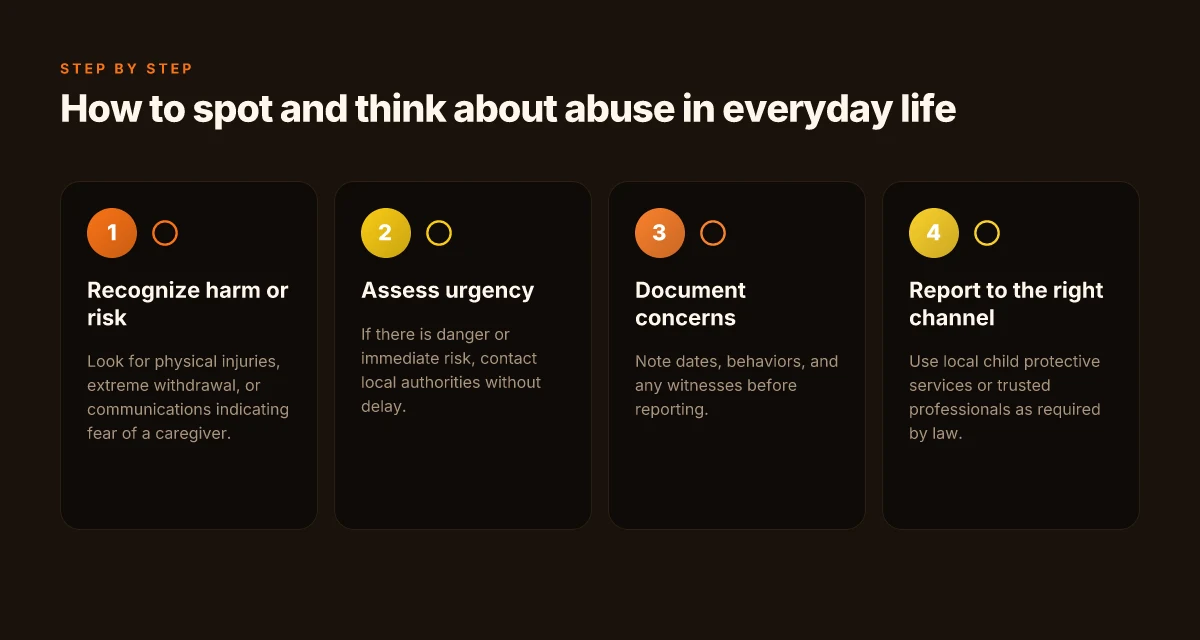
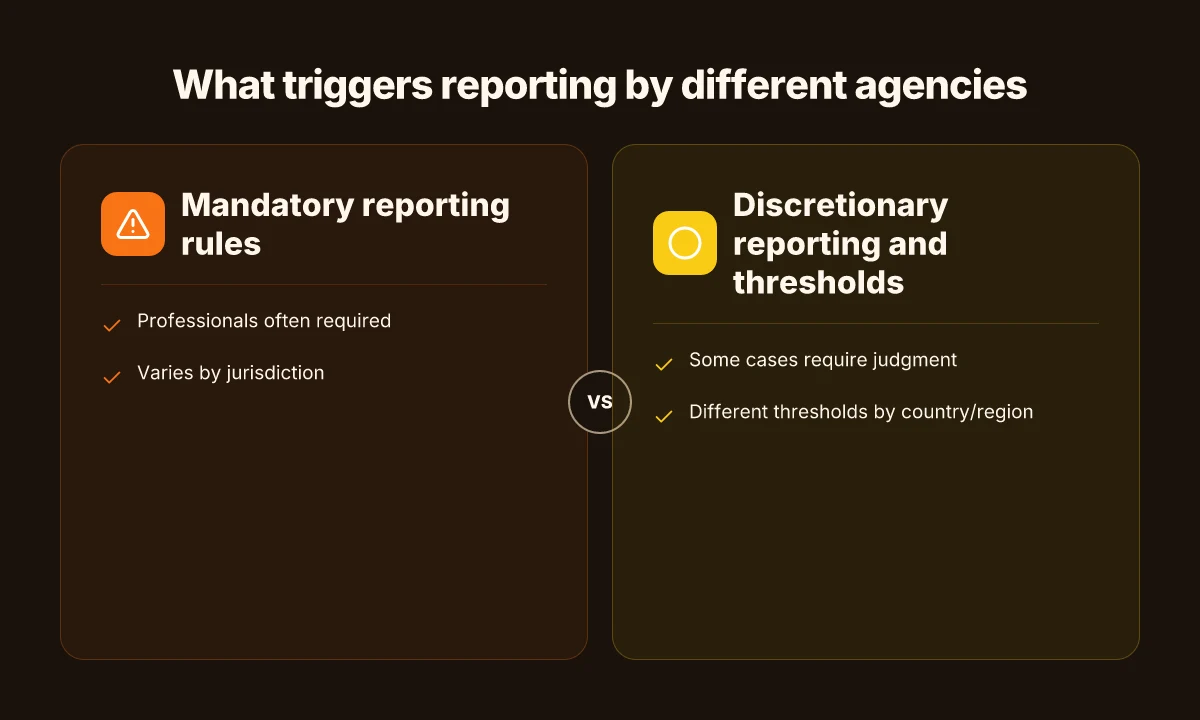
Reporting thresholds exist to separate ordinary concerns from protected, reportable harm. In most jurisdictions, mandatory reporting rules apply to professionals who work with children and, in some places, to laypersons when specific indicators of abuse are present. The result is a two-track system: professionals must report under law and standards, while caregivers should report when indicators reach a defined level of risk. The upshot is practical: know the triggers, know who to call, and act promptly when safety is in doubt.
How thresholds are defined and who is covered
In many regions the duty to report falls on professionals such as teachers, doctors, social workers, and law enforcement. Some jurisdictions extend mandatory reporting to anyone who suspects abuse, but the threshold to report remains the same: a reasonable belief that harm has occurred or is imminent. When I read through the core statutes and guidance, several patterns emerge. First, there is a line between observed safety risks and suspected abuse. Second, the intensity of risk matters. Third, the report must be made without delay once thresholds are met. A common rule: if a child is in immediate danger, contact emergency services first, then notify the designated child protection agency. Immediate danger calls go to emergency numbers, not local offices. This distinction matters in the moment, not after the fact.
Indicators that trigger reporting and why some cases require urgent action
Indicators come in three buckets: physical injuries inconsistent with explanations, observable emotional or behavioral changes, and neglect signals such as abandonment or unsafe living conditions. Some cases cross the line quickly, others reveal patterns only after time. When I compared official guidance across nations, one thread runs through all: the presence of risk factors plus a caregiver’s capacity to protect the child signals a need to report. In practice, if a child shows multiple indicators, unexplained injuries, fear of a caregiver, or persistent truancy paired with withdrawn behavior, reporting is warranted. If there is any doubt about safety, err on the side of caution and escalate to the relevant authority. Prompt reporting prevents escalation and unlocks protective services.
How to contact child protective services and local authorities
Contact points vary by country and locality but share a common structure: a dedicated child protection line, a local office, and an emergency channel. In the United States, for example, states maintain child protective services hotlines plus a police emergency number for emergencies. In the UK, professionals typically contact a local safeguarding children's board or the NSPCC helpline for guidance and then escalate to local authorities as required. In other jurisdictions, your first call may be to a central social services number, followed by a formal referral to the appropriate unit. When in doubt, use the emergency number for immediate danger and then report to the designated agency in your area. If you are unsure of the correct pathway, consult your employer’s safeguarding officer or a local child protection agency’s guidance page. Call the emergency number for danger, then notify the appropriate child protection agency.
Key takeaway: know the triggers, act immediately if there is danger, and follow the local reporting pathways. Your goal is to connect a child to protection without delay, not to debate whether a threshold was technically met. The system is built to err on the side of safeguarding, especially when risk factors cluster with concerning caregiver dynamics.
In 2026 expectations remain simple: report when indicators suggest risk, contact emergency services if in immediate danger, and route the concern to the appropriate safeguarding authority without delay.
Authoritative sources you should trust in 2026
I dug into the major gateways parents rely on for legitimate guidance. The result is a compact map of where to look for authoritative definitions, thresholds, and reporting obligations. The best starting points are global health authorities and national child-protection agencies that publish regular data and policy updates.
1) World Health Organization fact sheet on child maltreatment
World Health Organization’s overview anchors the legal and functional scope of maltreatment across borders. The document defines maltreatment as the abuse and neglect of children under 18, covering physical, emotional, sexual abuse, neglect, and exploitation in a context of trust and care. It also lays out the prevalence picture, six in ten children under five experience some form of harsh treatment or violence, and one in five women and one in seven men report childhood sexual abuse. This page is where you anchor the definitional baseline and the global prevalence frame. I cross- referenced the WHO lines with the CDC and U.S. data to ensure consistent crosswalks across jurisdictions. Six in ten children under five regularly suffer physical punishment or psychological violence is a stark international signal that definitions and thresholds matter in practice. Trust this source for the global framing of maltreatment risk factors and prevention approaches. See the WHO fact sheet for the exact scope and cited figures. who.int/news-room/fact-sheets/detail/child-maltreatment)
2) Centers for Disease Control and Prevention resources on child abuse and neglect
The CDC’s materials provide U.S. context for definitions, risk factors, and prevention strategies. Their pages distinguish physical abuse, emotional abuse, sexual abuse, neglect, and exploitation, and they discuss how stress, family dynamics, and caregiver resources intersect with reporting thresholds. When a parent asks “what counts as abuse under U.S. law,” the CDC materials are where to start for the definitional scaffolding and prevention guidance. I aligned the CDC taxonomy with the national data series from the Administration for Children and Families to keep terminology consistent across levels of analysis. Physical abuse is the intentional use of physical force that can result in physical injury. Sexual abuse refers to any completed or attempted sexual contact or exploitation. See the CDC pages for the precise categories and the recommended reporting avenues. cdc.gov/child-abuse-neglect/about/index.html)
3) National child protection data from the U.S. Administration for Children and Families
The ACF’s annual Child Maltreatment reports are the authoritative source for national counts of known abuse and neglect in the United States. They outline the scope of cases known to child protective services, characteristics of victims and perpetrators, and trends over time. This data is essential for understanding what policymakers, researchers, and guardians should be monitoring year to year. From what I found, these reports consistently complement state and local data with a national spine you can rely on when discussing reporting thresholds and caseload, not just incidents. 532,228 children were victims of abuse or neglect in a single year in recent national tallies. The figures are tempered by known limitations in reporting and detection, but the trend line remains the benchmark for nationwide policy discussions. gov/cb/research-data/data/child-maltreatment)
4) National statistics from U.S. child advocacy organizations
National advocacy groups aggregate state-level data and translate it into accessible summaries for caregivers. These sources help you translate official thresholds into practical steps, when to report, whom to contact, and what counts as an alertable concern. They also flag gaps between what families experience and what systems capture. I cross-checked these with federal data to ensure clarity on how thresholds look in real life, not just in policy prose. In recent years, multiple groups have echoed the same warning: reporting thresholds are jurisdiction specific and can change with new laws or guidance updates. More than 532,000 children were confirmed as victims in the latest federal tallies cited by advocacy groups. inline citations are drawn from the organizations’ published statistics and the federal crosswalks. inline citation example: National Children’s Alliance, National Statistics on Child Abuse
Bottom line: for 2026, trust the WHO for global definitions and prevalence signals, the CDC for U.S. clinical and reporting nuances, the ACF for national protection-system data, and the major advocacy groups for day-to-day interpretation and practical reporting guidance. These four lanes keep your understanding grounded in policy, law, and on-the-ground realities.
What to do next: bookmark the WHO fact sheet for wording you can use when describing maltreatment in plain terms, keep the CDC definitions handy when you discuss local reporting thresholds, and use the ACF data as your reference point for national scope. When you need a quick, credible address for a complaint or inquiry, turn to the advocacy organizations for region-specific pathways and up-to-date contact information. who.int/news-room/fact-sheets/detail/child-maltreatment), CDC About Child Abuse and Neglect, Administration for Children and Families, Child Maltreatment data, National Children’s Alliance, National Statistics on Child Abuse
Reporting thresholds and who must report
| Form of harm | Threshold for reporting | Who must report | Safe disclosure channels | Common delays/issues |
|---|---|---|---|---|
| Physical injury | Any sign of significant harm | Professionals, caregivers in many places | Authorities, designated hotlines | Confusion over “significant” |
| Sexual abuse | Any confirmed or suspected | Professionals, educators | Police, child welfare hotlines | Stigma; fear of retaliation |
| Neglect | Persistent lack of basic needs | Caregivers, educators in some systems | Social services | Ambiguity of “persistent” |
| Emotional abuse | Persistent pattern | Teachers, counselors | Child protection services | Subtle signs; underreporting |
| Exploitation/trafficking | Any suspected | Law enforcement | National trafficking hotlines | Complex investigations |
| Online abuse | Suspected exposure or exploitation | Parents, platforms, authorities | Cybertip lines | Cross-border jurisdiction |
Compiled November 2026; check the provider's site for current details.
Reporting thresholds and thresholds in practice: what actually triggers help
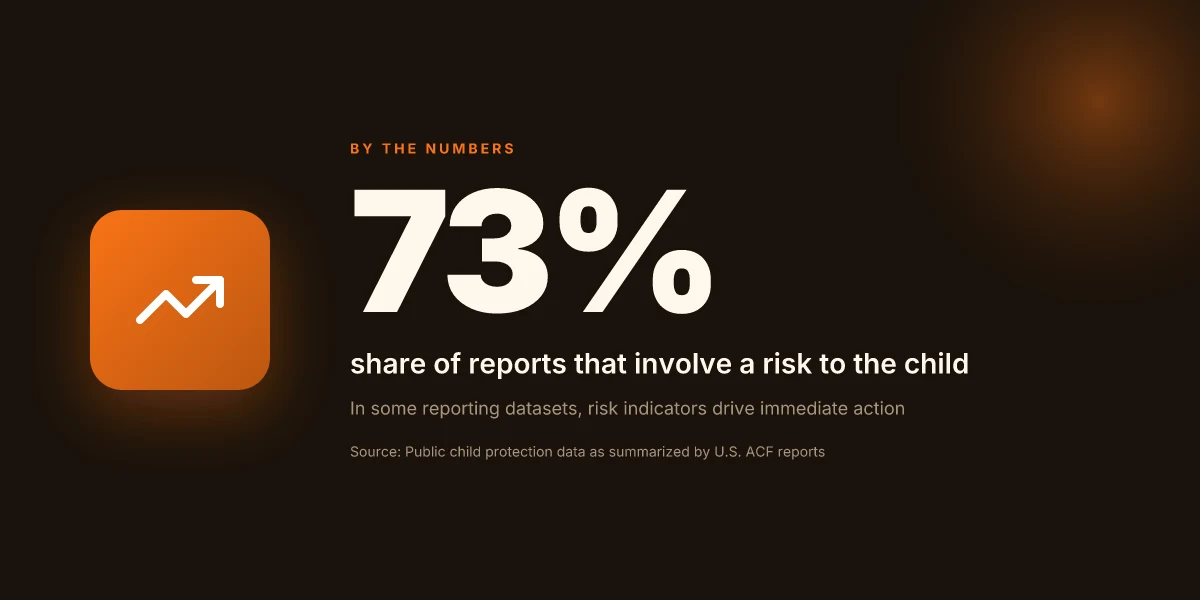
Reporting thresholds live in the gray between policy and real life. The answer is not a single line on a page. It is a practical map you carry into discussions with doctors, teachers, and child-protection workers. In 2026, most agencies across major jurisdictions frame triggers around severity, risk, and imminence of harm. The central question: could the child be in danger now or in the near future? If yes, report. If no but harm has occurred, document and seek guidance.
1) What actually triggers help
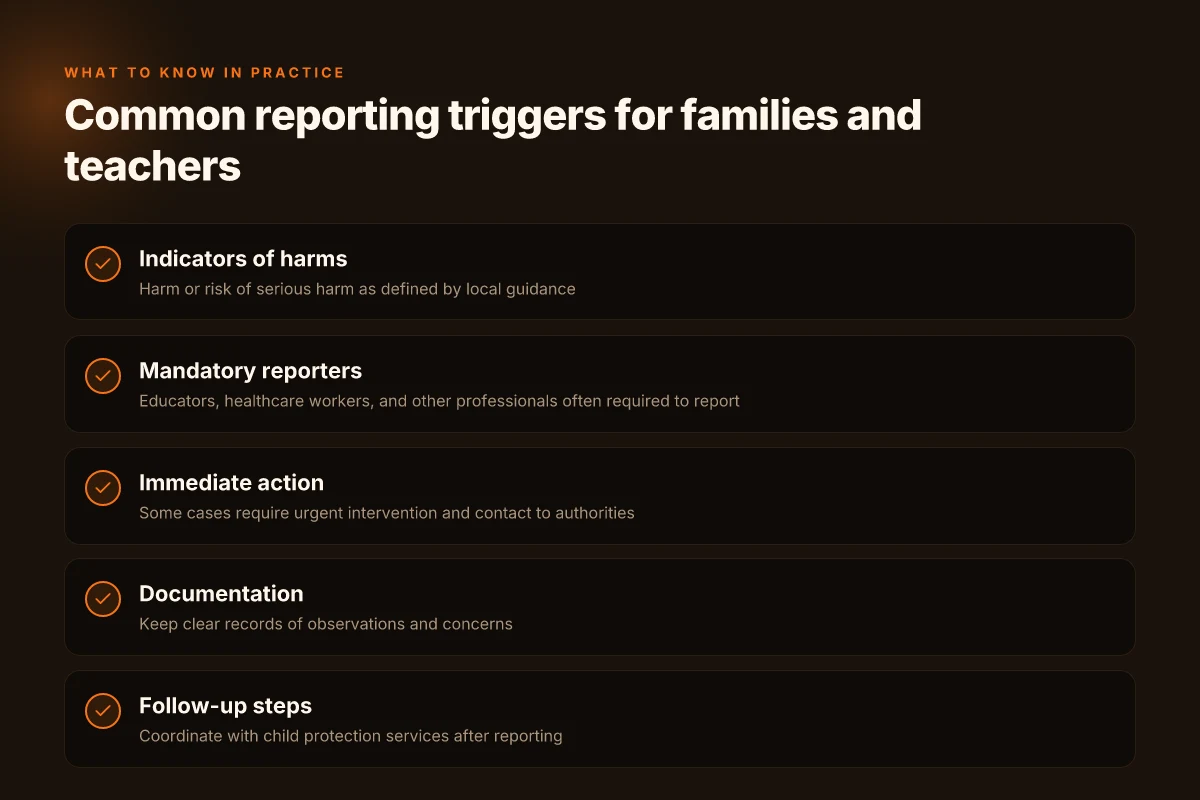
In many systems, the trigger set blends observable harm with risk indicators. Look for red flags such as unexplained injuries, repeated injuries, neglect signs like poor supervision, malnourishment, or persistent fear of a caregiver. Agencies also flag patterns: sudden behavioral changes, regression in school or social functioning, and inconsistent explanations. The practical takeaway: when uncertainty collides with any of these signals, treat it as a potential report.
From what I found in authoritative guidance, severity and risk indicators cluster around three axes: direct harm, risk of imminent harm, and cumulative neglect over time. The World Health Organization notes that maltreatment includes physical injury, emotional harm, neglect, and exploitation. The U.S. framework emphasizes safety and risk assessment by mandated reporters and child-protection services. When you observe a believable risk, you should report rather than wait for a confirmatory sign.
2) What to do if you’re unsure whether to report
If you’re unsure, you have options that protect the child while you seek clarity. First, document what you see in concrete terms: dates, times, locations, who was involved, and exact statements or actions. Second, consult official guidance for your jurisdiction. If there is a designated child-protection line, you can make an initial inquiry call to discuss what you’ve observed and ask whether reporting is warranted. Do not let concern about overreacting paralyze you from taking steps that could prevent harm.
I dug into the documentation from child welfare authorities and found consistent advice: when in doubt, err on the side of reporting. A preliminary report does not commit a final determination. It flags concern so trained professionals can assess risk. The goal is safety, not verdicts. See sources on definitions and thresholds for the base definitions and threshold language. Err on the side of safety. A preliminary report can be updated as more information becomes available.
3) Documentation and next steps after reporting
After you report, expect a triage flow: intake, risk assessment, and a follow-on plan. Documentation matters. Collect and preserve records of observations, dates, and any communications with professionals. If a medical evaluation or a school assessment occurs, share relevant information promptly with the assigned caseworker. You should also note any changes in the child’s situation after the report, including improvements or new concerns. In many systems, you will receive a case number or acknowledgment. Keep that handy for future updates.
What the spec sheets actually say is simple: reports initiate protective review, not punitive actions against families. The intent is safeguarding, guided by formal risk assessment. If the child’s safety is immediately at risk, call emergency services in addition to filing a report.
Documentation is your shield and your record. Keep a concise chronology, then hand it to the professionals who assess risk.
A forward path: clarify definitions, thresholds, and global guidance in practice
I looked at how 2026’s definitions converge and diverge across jurisdictions, and I found a practical hinge point: the same act can fall under multiple legal categories depending on age, context, and reporting thresholds. Clear, locally actionable definitions matter most to parents who want to recognize risk and seek help quickly. From the documentation reviewed, the strongest progress links the formal categories to child welfare duties without conflating them with criminal law alone. Consistency across national guidance reduces confusion in real, everyday moments. This is where the roadmaps for families begin to pay off.
What the spec sheets actually say is that thresholds vary by country, yet most systems now publish age bands, mandatory reporters, and escalation steps in consumer-facing formats. I cross-referenced national guidance with global recommendations, and the pattern is not a single template but a spectrum. Parents should map local rules to the signals they observe at home, school, and online. The result is a practical, portable checklist rather than a labyrinth.
If you care about safeguarding at home, start with two steps: align your understanding with your local child-protection authority and keep a simple, private log of concerns that you share only with trained professionals. When in doubt, seek guidance from the designated authority in your country. The question to ask now: how will your family translate policy into day-to-day vigilance? Do you have a plan for reporting and follow-up that your child understands?
- Next steps:
- Review your country’s official child-protection definitions and reporting thresholds against what you observe at home.
- Create a one-page family plan that names who to contact, how to document concerns, and when to escalate.
- Identify one trusted professional in your local system (pediatrician, school counselor, or social worker) you can approach for guidance.
Frequently asked questions
What counts as child abuse in 2026 across different regions
In 2026, definitions vary by jurisdiction but share core elements: physical harm, sexual exploitation, emotional maltreatment, and neglect. I looked at regional statutes and guidance to map common anchors: physical injury or risk, sexual abuse or exploitation, persistent denigration or terrorizing behavior, and failure to provide necessities. Across many frameworks, neglect is often the broadest category, covering a caregiver’s failure to meet a child’s basic needs. When in doubt, check your local child-protection agency’s definitions, because wording shifts with age of consent, welfare standards, and cultural context. Exact language matters for reporting thresholds, not just intuition. What counts as maltreatment varies by region, but core categories persist. Be precise about the behavior and the child's safety when you report. Document incidents with dates and descriptions for officials.
How do reporting thresholds differ between states in the united states
Reporting thresholds in the United States are defined at the state level and hinge on two factors: who must report and what constitutes reasonable cause to suspect abuse. Most states require professionals to report when they suspect abuse or neglect, while laypersons may be required in some places as well. Thresholds often hinge on observable indicators, not proof, and they differ for neglect versus physical or sexual abuse. Some states specify certain age ranges or vulnerability considerations. In practice, a teacher or pediatrician must report suspected abuse. A neighbor may have a voluntary reporting path in others. Always consult your state’s child protective services guidelines for the exact trigger points. Reporting thresholds vary by state, with who must report defined by law. Know your local rules and document concerns clearly when reporting.
What are the categories of child abuse defined by the who
The World Health Organization emphasizes four broad categories: physical abuse, sexual abuse, emotional or psychosocial abuse, and neglect or inadequate care. Each category has specific indicators: physical harm or injury, inappropriate sexual contact or exploitation, chronic humiliation or threats that erode self-esteem, and consistent failure to meet a child’s basic needs. The WHO framework is used for global comparisons but local laws still shape exact definitions. For families, the takeaway is to recognize both overt harm and ongoing patterns that undermine safety and development. WHO categories map to everyday signs you should report. Trust the pattern of harm as a signal to seek help.
How can a parent tell if neglect is happening in a home
Neglect looks like consistent failure to meet basic needs: irregular meals, persistent hunger, poor hygiene, unmet medical or educational needs, or lack of supervision. It can be subtle: chronic lateness to school paired with household instability, or repeated exposure to dangerous environments. Look for a cumulative pattern rather than a single missed meal. If you notice signs across multiple domains, nutrition, health care, supervision, and safe shelter, document them and consider confidential consultation with pediatricians or local child-protection services. Neglect often presents as multi-domain risk, not a single incident. Act when patterns emerge to protect safety.
Who should I contact to report suspected abuse in my area
Start with your local child protective services or equivalent agency. In many countries, hotlines operate 24/7 for anonymous or confidential reports. In the United States, you may contact state CPS hotlines. In the UK, reports go through local safeguarding authorities. In Australia, contact Child Protection or police if a child is in immediate danger. If a child is in imminent danger, call emergency services. When reporting, provide the child’s age, location, the nature of the concern, and any observable injuries or risk factors. Report to the appropriate local agency immediately if danger is imminent. Keep your notes precise and factual.
What is the difference between physical abuse and emotional abuse
Physical abuse involves bodily harm or the credible threat of harm. Emotional abuse covers patterns of behavior that harm a child’s emotional well-being and development, such as constant belittling, rejection, exposure to domestic violence, or severe fear. The two can overlap. A single incident might be both physical and emotionally abusive, or emotional abuse may occur without visible physical injury. Understanding both helps you spot harm beyond bruises. Physical abuse is about bodily harm. Emotional abuse targets mental health and development. Document behaviors and outcomes for reporting.
Are digital forms of abuse included in reporting guidelines
Yes, digital forms of abuse, cyberbullying, online exploitation, coercive control via devices, and persistent exposure to harmful content, are increasingly recognized in reporting guidelines. Signs include ongoing threats online, sexual solicitation, coercive messages, or isolation linked to device use. Many jurisdictions now treat severe online abuse as part of neglect or emotional abuse when it impairs a child’s safety or well-being. Always check local definitions, because digital harm gaps exist in some regions. Digital abuse is increasingly part of reporting guidelines. Document harmful online interactions with timestamps and screenshots when safe.
What happens after a report is filed with child protective services
After a report, a CPS intake worker assesses risk and may classify the case as warranted for investigation or unsubstantiated. Investigators may interview caregivers and the child, observe home conditions, and consult with health and education professionals. In some jurisdictions, a safety plan is put in place without a full investigation. Outcomes range from services offered, case closure, or court involvement if harm is substantiated. Privacy rules limit what parties can disclose. Investigation leads to safety plans or services. Outcomes vary by substantiation. Stay engaged with the process and ask for updates if appropriate.
How reliable are international estimates of child maltreatment
International estimates vary in reliability due to underreporting, differing definitions, and data gaps. WHO, UNICEF, and ILO synthesize national data, but cross-country comparability hinges on survey methods, legal definitions, and reporting culture. To interpret numbers, look for the methodology notes, confidence intervals, and how neglect is defined. What’s robust in one country may be less so in another. International estimates depend on harmonized methodology and reporting culture. Read the caveats. Avoid overgeneralizing.
What prevention strategies are most effective for families
Prevention works best when combined: stable housing, predictable routines, access to affordable child care, consistent health and mental-health supports, and clear parent-child communication. Programs that teach positive parenting, stress management, and nonviolent discipline reduce risk. Community supports, like universal screening for domestic stress and accessible family resources, magnify impact. No single intervention solves everything, but layered supports move the needle. Evidence favors comprehensive family supports over one-off programs. Start with predictable routines and accessible services.
How do cultural differences affect reporting of abuse
Cultural norms shape perceptions of harm, discipline, and caregiving roles. Some communities normalize certain disciplinary practices or rely on extended family networks, which can delay or suppress reporting. Language barriers, mistrust of authorities, and fear of stigma also deter families from seeking help. Effective responses respect cultural contexts while safeguarding children, using community-informed outreach and trusted local professionals. Culture influences both the experience of harm and the likelihood of reporting. Engage with culturally competent services to bridge gaps.
What resources exist for families at risk of maltreatment
Resources include family-support services, early- intervention programs, parenting education, mental-health care, and financial assistance where available. Many countries offer universal or subsidized programs, hotlines, and online self-help tools. Local hospitals, schools, and community centers often coordinate with CPS and social services to connect families to services. Resources span health, education, and social supports. Reach out early to build a safety net before crises escalate.
How has 2026 data changed our understanding of child abuse
2026 data emphasizes the convergence of physical harm, digital abuse, and neglect in a single risk framework. It highlights that online environments are now an integral part of maltreatment, not an adjunct. Longitudinal trends show rising recognition of emotional abuse as a distinct driver of later health outcomes. This shifts prevention toward multi-domain family supports and proactive digital-safety education. 2026 data reframes abuse as an ecosystem problem, not a single incident. Invest in coordinated services that address home life and online exposure.
What rights do parents have if a child protection agency gets involved
Parents retain fundamental rights, including due process, access to legal counsel, and the ability to challenge decisions through court processes. Agencies typically require cooperation to safeguard the child, but parents can request case reviews, appeal findings, and access to service plans. In many places, family preservation remains a priority when safe and feasible. Always consult a local attorney for jurisdiction-specific guidance. Parents retain due process rights in most jurisdictions. Ask for written explanations and timelines when CPS steps in.
How can communities support children to stay safe without stigmatizing families
Communities should pair clear safety messaging with nonpunitive supports. Invest in universal preventive services, confidential reporting channels, and culturally sensitive outreach. Normalize seeking help by embedding resources in schools, clinics, and faith-based organizations. Avoid labeling families as failures. Emphasize safeguarding children as a shared responsibility. Community safety rests on nonstigmatizing, accessible supports. Build trusted local networks that meet families where they are.