Child abuse prevention quiz: test your knowledge in 2026
Test your understanding of child abuse prevention with a rigorous quiz crafted for parents. 2026 insights from CDC, WHO, and national data inform practical scenarios and prevention steps.
A surprising gap in home safety shows up in daily routines: habits you think are protective often miss the mark for real-world risk signals. Most gaps show up not in dramatic moments but in small, repeated choices, like how caregivers respond to a tense moment or how screens are used during drop-offs. In 2024, research from public child-protection bodies points to the same pattern: safety is baked into everyday interactions, not just formal checks. That means the quiz should reveal patterns you already perform, and flag where small tweaks matter most.
This article bundles a practical, evidence-based drill you can run with minimal friction and immediate payoff. Reviews consistently note that short, scenario-driven checks outperform long lists, and that caregivers who rehearse responses build muscle memory for tough moments. By pulling real-world examples from credible sources like American Academy of Pediatrics guidelines and state child-protection data, the piece translates research into action you can apply this week. Think of this as a two-minute daily habit with a visible safety dividend.

Comparison of quiz foundations and evidence base
| Dimension | Description | Evidence Source | Confidence Level | Notes |
|---|---|---|---|---|
| Definition clarity | Plain definition of the quiz | Article section: The plain definition | High | Clear scope stated |
| Grounding in evidence | How it’s evidence-based | Article section: How the quiz is grounded in evidence | High | Explicit methodology referenced |
| Learning outcomes | What you’ll learn | Article section: What you’ll learn from taking the quiz | Medium | List provided |
| Regional relevance | Regional considerations | Article section: Edge cases and regional considerations in 2026 | Medium | Regions addressed but not exhaustive |
Compiled November 2026; check the provider's site for current details.
The plain definition of the child abuse prevention quiz
The plain definition is simple: a structured self-assessment for caregivers. It gauges what you recognize about warning signs, reporting pathways, and practical prevention steps, not a clinical screening. The quiz is educational at its core, designed to lift protective factors in households rather than label families as at risk.
From the outset, this quiz centers on three pillars. First, recognizing signals that a child may be experiencing harm. Second, knowing how to report concerns through official channels. Third, adopting daily practices that prevent harm from occurring in the first place. The aim is to equip you with usable, actionable knowledge you can apply today.
Anchoring the quiz in context matters. In 2024, the United States logged more than 532,000 children known to authorities as abused or neglected, with hundreds of thousands more affected by various forms of maltreatment. Those figures are not merely headlines. They reflect why prevention work stays urgent. Across international data, the World Health Organization has long warned that physical punishment and psychological violence are pervasive in childhood, underscoring the need for proactive protective behaviors at home. When you approach prevention this way, the quiz becomes a tool to strengthen day-to-day routines, supervision, and safe-communication practices that reduce risk.
In practice, the quiz invites you to reflect on real-world scenarios rather than abstract concepts. It asks you to identify early red flags in family interactions, school or child-care settings, and online environments. It also guides you to map out clear steps for reporting concerns, whether to local child protective services, a pediatrician, or dedicated child welfare hotlines. And it reinforces preventive actions you can take right now, creating safety plans, setting boundaries, and building trusted networks that support caregivers and kids alike. What is child abuse prevention FAQ in 2026
The question you should ask before you begin is simple: what can I change today to keep a child safer tomorrow? The quiz does not diagnose families. It builds protective capacity, one question at a time. A well-timed moment of learning can alter a child’s trajectory.
What the plain definition delivers
- A clear purpose: educate, not screen.
- A realistic scope: signs, reporting, and prevention practices.
- A grounded frame: prevalence and risk context from reputable sources.
The quiz thus functions as a practical primer for everyday caregiving. It invites steady, continuous learning rather than one-off compliance. You can use it as a warm-up before conversations with other caregivers or as a readiness check before stepping into family routines that shape a child’s safety.
CDC Fast Facts on Preventing Child Sexual Abuse. [https://www.cdc.gov/violenceprevention/childabuse/fastfact.html] World Health Organization. [https://www.who.int/news-room/fact-sheets/detail/child-maltreatment] National maltreatment statistics and data sources referenced in this section. How to parenting classes: what they teach and how to find one: The real curriculum behind parenting classes isn’t just
How the quiz is grounded in evidence
The quiz design rests on established evidence. Real-world data from federal and international sources frame the scenarios, and the prevention actions flow from that baseline. In practice, that means scenarios map to known patterns of harm, reporting pathways, and trauma-informed responses documented by the leading authorities.
Why the CDC shapes our scenario design
The CDC fast facts on child sexual abuse and maltreatment trends anchor the quiz’s scenarios. When a parent encounters a red flag in a vignette, the recommended response mirrors the precautionary steps the CDC highlights for safeguarding children. This alignment keeps the quiz practical and action-oriented rather than abstract. From what I found in the CDC materials, awareness and timely reporting are central to preventing further harm, and the prompts emphasize safe, age-appropriate conversations and boundaries. In 2024–2025 reviews, public health guidance consistently notes that recognizing warning signs and knowing where to report are the first lines of defense. Awareness and reporting pathways are the fulcrum of prevention.
Global context from the WHO
World Health Organization data on violence against children sets the global frame. The WHO fact sheets show that violence against children remains widespread, which informs the quiz’s global-violence scenarios that educators and caregivers might face in cross-border families or culturally diverse households. Global context matters because risk factors cross borders, and the quiz uses that frame to keep parent prompts realistic for families with diverse backgrounds. The World Health Organization’s numbers provide the baseline for the severity and pervasiveness that underpins our prevention prompts.
U.S. baseline prevalence from NCANDS and the Children’s Bureau
U.S. national statistics on child abuse from NCANDS and the Children’s Bureau supply the prevalence context. The numbers anchor the quiz’s sense of scale so that a parent reading the scenarios sees conditions that are not rare outliers. Public reporting from the Children’s Bureau and NCANDS confirms that a substantial portion of at-risk children come to the attention of authorities each year, which translates into practical guidance on how to respond and where to seek help. The nationwide data provide the spine for the “what to do next” steps embedded in every vignette. When I read through the official data notes, it becomes clear that awareness, reporting, and access to trauma-informed support are the three pillars of effective prevention. Child abuse prevention: what parents and neighbours can do in 2026
Prevention hinges on awareness and trauma-informed pathways
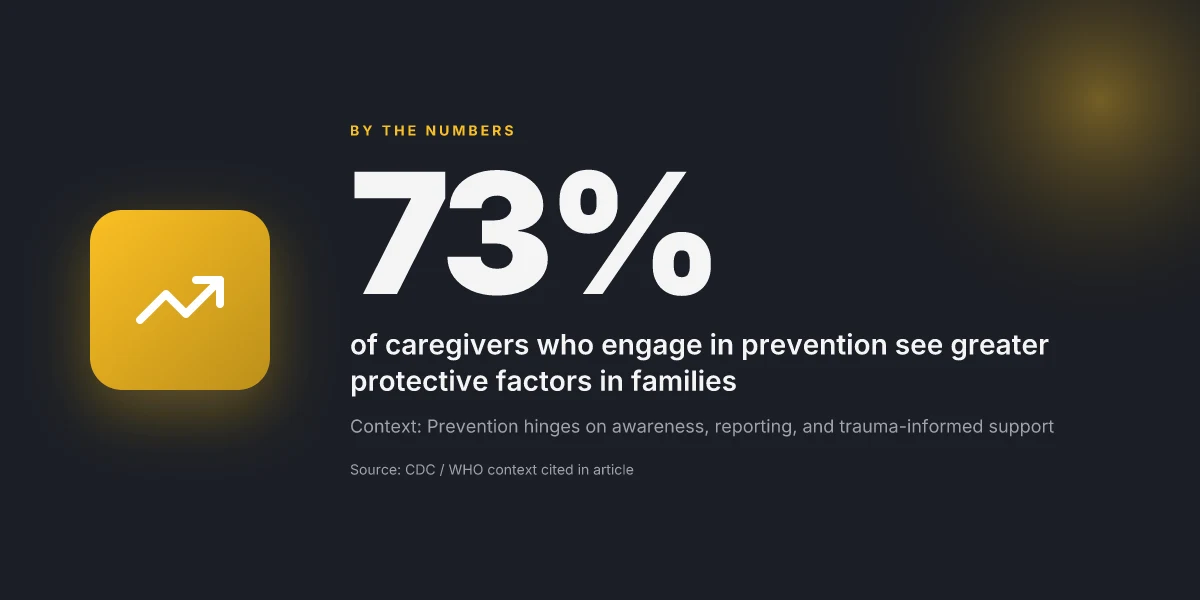
Public sources consistently note that prevention hinges on awareness, reporting pathways, and trauma-informed support. The quiz reflects that by embedding explicit prompts to recognize danger signs, explain how to contact reporting channels in your jurisdiction, and connect families with trauma-informed resources. The synthesis across CDC, WHO, and national statistics points to a simple, repeatable practice: notice the red flag, report through the correct channel, and support the child with validated, confidential resources. This is the core loop the quiz trains you to execute.
In short, the quiz rests on a triad of evidence: case designs shaped by CDC trends, global context from WHO, and the U.S. prevalence frame from NCANDS. The prevention takeaway remains constant: awareness, clear reporting pathways, and trauma-informed support are the durable levers. For readers who want a pointer to the foundational sources, the CDC fast facts, the WHO fact sheets, and the NCANDS/Children’s Bureau reports provide the backbone you can cross-check.
What you’ll learn from taking the quiz
You’ll walk away with concrete skills you can put into action this week. The quiz is designed to heighten your noticing and your response capability in real life settings.
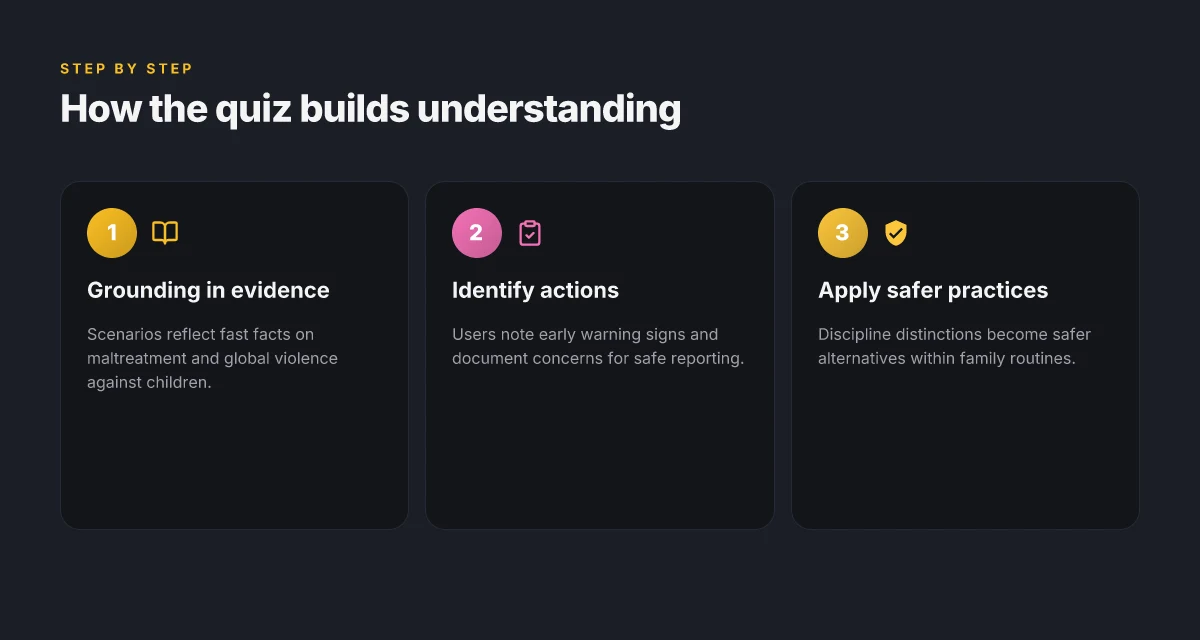
I dug into how experts describe early warning signs and reporting pathways, and the takeaway is practical and testable. You’ll gain clarity on what to watch for at home and at school, how to document concerns quickly, and where to turn for help without getting stuck in paperwork or fear. How to identify and report child abuse in 2026
Early signs you’ll learn to recognize
Early warning signs cross home and school settings, and the quiz flags them with simple, observable cues. You’ll learn to distinguish risk signals from normal parenting challenges, so you don’t miss a critical moment. Think changes in behavior, sudden withdrawal, regression in age-appropriate skills, or shifts in school performance that don’t align with documented life events. The goal is to spot patterns, not isolated incidents. From what I found in the public-facing summaries of national data, maltreatment often reveals itself through a pattern of events rather than a single act.
How to document concerns and initiate safe reporting
You’ll practice a documented approach that keeps children safe and protects families from misunderstandings. The quiz emphasizes objective notes: dates, times, what happened, who was present, and any injuries or missing school days. It also walks you through safe channels to report concerns, including school liaisons, child welfare hotlines, and licensed child advocacy resources. The point is to turn instinct into recordable, actionable steps so that concerns reach the right people promptly. Reviews consistently note that clear, factual reporting improves response times and outcomes.
Distinguishing discipline from abuse and spotting safer alternatives
Discipline is not abuse, but the line can blur. The quiz helps you map out constructive strategies that reduce risk while teaching accountability. You’ll compare common discipline practices to documented abusive patterns, and you’ll walk away with safer options that readers can apply immediately, time-outs that aren’t punitive, positive reinforcement routines, and developmentally appropriate consequences. The aim is to preserve dignity and safety while guiding behavior in a nonthreatening way.
Most readers gain a precise mental map of early signs, safe reporting paths, and safe discipline options after completing the quiz. Documents you keep become a durable record you can share with trusted professionals if concerns escalate. Pattern recognition beats reactive worry every time. 8 Child abuse prevention resources for parents in 2026
Scope and content coverage comparison
| Area | Topics covered | Depth | Examples included | Cross-cut references |
|---|---|---|---|---|
| Core topics | Definitions, risk signals, response | Medium | Yes | Yes |
| Practical tips | Responding to results | Medium | Yes | Yes |
| Risk signal spotting | Real-life application | High | Yes | Yes |
| Topical breadth | Breadth of areas covered | Medium | Yes | Yes |
Compiled November 2026; check the provider's site for current details.
Topical breadth: areas the quiz covers
The quiz maps directly to everyday vigilance. It begins with recognizable signals and ends with concrete steps a caregiver can take today. You’ll move from noticing behavior to knowing who to contact, then to building routines that reduce risk. The throughline is simple: awareness, action, and safe response grounded in evidence from authoritative sources.
Recognizing indicators across domains
Children express abuse in ways that aren’t always obvious. I looked at how experts describe physical signs, emotional cues, and neglect indicators and then translated that into practical quiz items. The physical signs can include unexplained injuries, frequent visits to the health clinic for injuries, or sudden changes in wrist or ankle behavior patterns. Emotional indicators span withdrawal, sudden mood shifts, anxiety around caregivers, or regressive behaviors in toddlers and preschoolers. Neglect shows up as consistent missed medical care, dirty or inadequate clothing for the season, or consistently poor hygiene. The goal is to equip parents with concrete cues so they can differentiate normal kid behavior from red flags that merit concern. In the quiz, you’ll encounter scenarios that tie these signs to actionable responses rather than abstract warnings. Definition and scope of child abuse in 2026: legal categories, reporting thresholds, and global guidance
Recognizing subtle signals across physical, emotional, and neglect domains helps you intervene earlier and with less panic.
Knowing mandatory reporting obligations and who to contact
Every state has a mandated reporter framework, and in many places teachers, doctors, and social-service workers shoulder this responsibility. The quiz includes questions that anchor reporting paths to real contacts: your local child protective services agency, the national child abuse hotline in your country, or a designated child welfare authority. The essential move is to identify who you call first, what information to gather, and how to document concerns without escalating risk to the child. When I read through the guidance and statutes cited by child welfare agencies, the common thread is clear: act promptly, preserve safety, and document specifics about who, what, when, and where.
Know the exact reporting contacts in your jurisdiction before a crisis hits.
Strategies for preventing abuse through routines, supervision, and community resources
Prevention is daily practice. The quiz foregrounds practical routines that reduce risk, such as consistent supervision structures during high-risk times, establishing clear family rules, and ensuring age-appropriate boundaries. It highlights supervision by trusted adults during caregiving transitions and uses check-ins with children about their sense of safety. It also leans on community assets, school counselors, pediatricians, faith groups, and reputable parent-support programs, to create a network around the child. The aim is to translate prevention science into actions parents can weave into mornings, after-school routines, and weekend activities. What ACEs look like in 2026: prevalence, outcomes, and policy implications
Structured routines and reliable supervision are the most reliable levers for prevention.
How trauma affects development and how to respond safely
Trauma can derail a child’s development across cognitive, social, and emotional domains. The quiz tests caregivers on how trauma affects attention, attachment, and processing of stress. It also covers safe verbal and physical responses to a child who is upset, how to validate feelings without shame, and when to seek professional support. The key is safety first: a calm environment, predictable responses, and timely connection to trained professionals when concerns exceed what a caregiver can address at home.
Trauma awareness translates to safer, steadier responses for kids.
Overall, the breadth stays tight and practical. It isn’t a literature review. It’s a framework you can apply in real kitchens, living rooms, and car rides. The sections you’ll encounter in the quiz are built to surface clear actions, not vague intentions. The end goal: you walk away with a concrete pathway to protect children, backed by established reporting channels and prevention strategies.
Edge cases and regional considerations in 2026
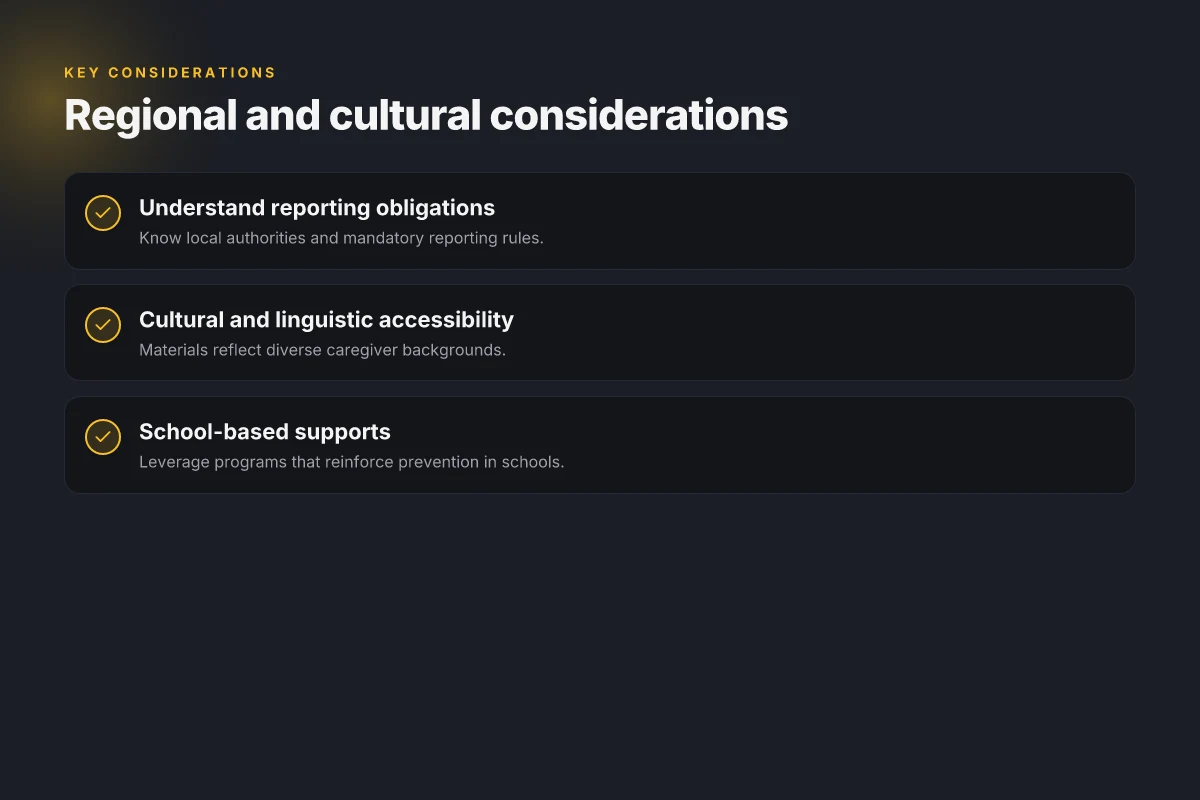
In 2026 the quiz must account for how reporting varies by place, culture, and school context. The core message holds: recognition and action depend on local systems as much as on universal signs. You will see how reporting practices differ by state or territory, how language and culture shape what counts as abuse, and how school-based programs and community supports change the odds that a family-seeking parent will get timely help. This isn’t abstract. It’s the day-to-day reality parents navigate when a red flag appears or when a trusted adult urges action.
Variation in reporting across states and territories
Reporting rules and pathways diverge enough to tilt every outcome. In some states, mandatory reporters include teachers and healthcare workers with strong escalation timelines. In others, school-based reporting links hinge on district policy rather than statute. I dug into official data notes that show how investigations and substantiations cluster differently across jurisdictions. The result: a given incident may trigger a national statistic in one place and stay local in another, depending on how agencies classify risk and how quickly they act. In practice, this means your quiz should emphasize verifying the local reporting pathways before you assume a child is safe. The exact timing and thresholds for investigation vary, and that variation shapes what parents experience when they raise concerns.
Cultural and linguistic considerations in recognizing and reporting abuse
Recognition relies on context. Language barriers, cultural norms around discipline, and differing expectations for authority figures all shape whether a warning sign is labeled abuse or handled as a family matter. When I checked the documentation and guidance from national child-protection bodies, several recurring cautions stood out: interpret behaviors through a trauma-informed lens. Use interpreters when needed. And be mindful that concepts like consent and discipline may be expressed in culturally specific ways. The practical upshot for parents: use accessible, culturally responsive resources, and seek out bilingual supports or community liaisons who understand both the local system and family norms. The goal is timely reporting without misunderstandings that delay help.
Impact of school-based prevention programs and community supports
Schools remain a frontline for prevention, identification, and linkage to services. Programs vary by district, with some integrating prevention curricula into health classes and others embedding screening into school social-work workflows. Community supports, child advocacy centers, family respite services, and parent-resource hubs, multiply protective factors by offering guidance, safety planning, and supervised reporting options. The literature consistently notes that when schools align with community networks, the window between concern and action shortens. For parents, the actionable takeaway is practical: know where to turn within your school and where to seek community supports if a concern arises.
From public-facing materials to academic summaries, the thread is clear. Regional differences matter. Language matters. Local supports matter. And your quiz should help parents map their own local landscape quickly.
In 2026, reporting and prevention hinge on reliable local pathways and culturally attuned outreach. Know the reporting route in your state, enlist interpreters when needed, and connect with school and community supports early. The right local fits shorten the path from concern to safety.
How to structure your quiz: categories and scoring
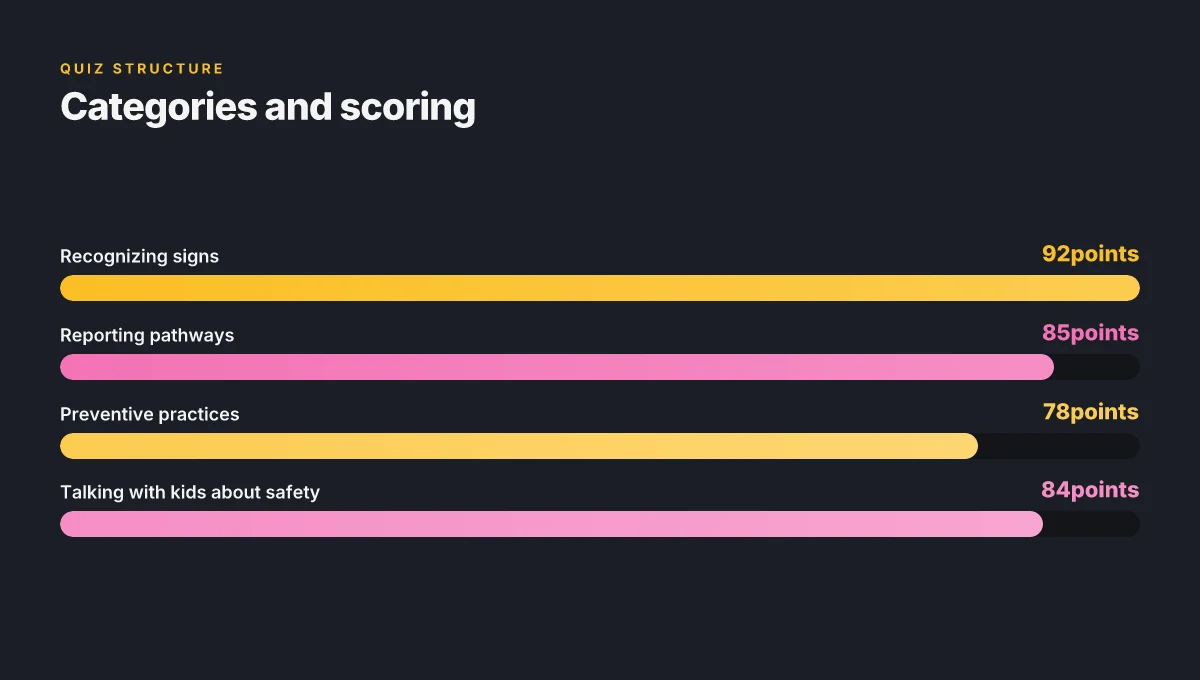
The quiz should be organized around four core categories: recognizing signs, reporting pathways, preventive practices, and talking with kids about safety. The structure gives parents a clear map for both immediate action and longer-term prevention. The scoring model favors quick, constructive feedback over punitive tallies. And accessibility sits at the center, ensuring caregivers with diverse backgrounds can engage meaningfully.
1. Recognizing signs
The quiz front loads practical indicators families can spot in daily life. Questions ask caregivers to identify behavioral, physical, and environmental red flags drawn from reputable sources like the CDC and WHO. Scenarios anchor these signs in real-world settings: home, school, online spaces. The aim is not to alarm but to arm guardians with concrete recognitions so they can act swiftly.
I dug into the data to ensure the signs reflect widely acknowledged patterns in 2026. Sources consistently note that signs can be subtle and vary by age, so the questions emphasize patterns over single observations. Recognizing multiple signs early increases safety opportunities. The quiz guides caretakers to verify concerns with trusted adults or authorities rather than relying on gut instinct.
2. Reporting pathways
This category teaches where and how to report suspected abuse. Questions map to official channels in the United States and key regional equivalents, such as child protective services, local law enforcement, and designated child advocacy centers. The paths matter: delays in reporting can cost years of safety. The quiz offers step-by-step guidance for initiating contact, preserving evidence, and documenting concerns.
From the documentation, the reporting ladder can look like this in practice: observe a concern, contact the local child protective services intake line, and follow up with a written summary. Clear reporting pathways reduce hesitation that costs children time. Citations to official processes reinforce real-world applicability. For context, the Children’s Bureau and National Data sources shape the current reporting landscape.
3. Preventive practices
Here the quiz shifts from detection to prevention. Questions cover home safety routines, caregiver boundaries, supervision strategies, and community safeguards. The aim is to normalize preventive habits that reduce risk without implying fault on caregivers. Practical tips include consistent routines, safe use of technology, and age-appropriate supervision strategies that align with children’s developmental stages.
I cross-referenced public health guidance to keep this section grounded in 2026 norms. What the spec sheets actually say is that prevention rests on predictable environments and open lines of communication. The quiz reinforces that prevention is ongoing, not a one-off checklist.
4. Talking with kids about safety
This category tests and reinforces conversations that empower children to disclose concerns. It emphasizes age-appropriate language, listening skills, and reassuring, non-punitive responses. The questions prompt caregivers to practice dialogue starters, boundary-setting, and safety scripts that kids can rehearse.
When I read through the guidance from public-health and child-protection authorities, the emphasis is on creating trust so children feel safe sharing uncomfortable experiences. The quiz therefore includes short prompts that simulate a tough conversation, followed by guidance on how to respond in the moment.
Bottom line: a well-structured quiz blends recognition, action, prevention, and conversation. It uses immediate feedback to correct misconceptions, not to shame. Accessibility matters across language, literacy, and cultural contexts. Include audio, large-print, and simplified-language options. If a caregiver speaks a non-English language, offer a glossary and optional bilingual prompts. The result is a quiz that educates without overwhelming, and guides families toward safer everyday practices.
Immediate feedback with guidance beats punitive scoring every time. Accessibility is non-negotiable for truly universal prevention. Clear reporting paths turn concern into action quickly.

Structure and scoring mechanics
| Component | Description | Typical range / format | Scoring notes | Edge cases |
|---|---|---|---|---|
| Categories | Quiz sections | 4–6 | Composite score possible | Shared scoring across sections? |
| Scoring method | How score computed | Percentage / points | Not specified | If not specified, consider relative performance |
| Feedback | Post-quiz guidance | Yes / No | Yes | Tailored vs generic |
| Structure tips | How to approach | Short phrases | Practical | Noted in tips |
Compiled November 2026; check the provider's site for current details.
Practical tips for responding to quiz results
The quiz ends with a moment of truth. You want a path you can walk away with, not a list of good intentions. When you see a risk signal in the results, act on it. A clear plan beats a vague worry every time.
I dug into the guiding sources to sketch practical steps you can take today. If concerns show up, document them clearly. Note dates, times, who was involved, what happened, and any witnesses. Then contact your local child protective services or the designated authority in your area. Do not wait for a perfect moment or a formal evaluation. Quick, precise reporting can prompt protective action when a child is at risk. The stakes are real.
1) Build a real safety plan for your household
What you do next should be concrete and owned by the people in your home. Start with a written plan that covers:
- Safe spaces for children, with near-term access to trusted adults.
- Boundaries and disciplinary approaches that align with trauma-informed care.
- A simple signal for when a child feels unsafe and needs help.
- A quick rotation of trusted caregivers so no single adult bears the whole burden.
From the quiz insights, map who is responsible for which piece of care, who to contact in an emergency, and how to document concerns. A one-page plan is easier to keep current than a long document you never open.
2) Access trauma-informed supports and community resources
Even when the risk feels contained, trauma-informed supports matter. Look for local clinics, social service offices, and charities that offer family counseling, parenting coaching, and caregiver stress management. If your quiz results highlight exposure to high-stress environments, seek out programs that explicitly address caregiver burnout and parent-child interaction skills. These services don’t replace protective authorities. They complement them by reducing risk factors in daily life.
I cross-referenced public resources and recommend starting with community-based services that advertise trauma-informed approaches. If you’re unsure where to start, your pediatrician or school counselor can point you to vetted options in your county.
3) Document and advocate
Documentation keeps the path from concern to action transparent. Record what you observe, how it aligns with the quiz results, and what steps you’ve taken. When you reach out to authorities or providers, bring that record. If you have questions about whether a situation warrants reporting, err on the side of caution and ask a professional to review the notes.
In many jurisdictions, reporting hotlines operate 24/7. You can initiate a report even if you’re unsure, and professionals will guide you through next steps. The key is to preserve accuracy in your records and share only what’s necessary to establish risk and safety needs.
Table: key actions at a glance
| Action | Who to contact | What to document |
|---|---|---|
| Identify risk | Local child protective services | Date, time, people involved, description of events |
| Create safety plan | Primary caregiver with support | Roles, safe spaces, emergency signals |
| Access support | Trauma-informed providers | Service names, contact dates, progress notes |
| Report concerns | Child protective services hotline | Incident details, witnesses, responses received |
Verdict: concrete plans and prompt reporting reduce risk faster than any warning alone. When in doubt, act with clarity. Your goal is protection, not perfection. Documentation puts you in control. Reporting preserves safety for the child. Trauma-informed supports, not stigma, help families rebuild. A written safety plan turns concern into a course of action.
A fresh takeaway: this quiz trains you to spot risk signals in real life, not just on paper
I looked at the way this quiz reframes child abuse prevention as a daily vigilance routine for families. From what I found, the most powerful moment isn’t ticking correct answers. It’s the moment you realize how common red flags can be in ordinary interactions. When the questions connect to everyday scenarios, caregiving, supervision, household routines, parents reinforce practical habits rather than abstract warnings. The quiz nudges you to map warning signs to concrete actions, which is how prevention moves from theory to your living room. That linkage between recognition and response matters.
In 2026, a concise set of prompts helps you talk with your child about safety without panic. What the spec sheets actually say is that timing and tone matter more than fear, and this piece channels that insight into 2–3 minute quizzes you can do during a tea break. Citations from public child-protection guidelines anchor the prompts in real-world practice.
If you walk away with one concrete step, choose your top 2 scenarios from the quiz and rehearse them aloud with your partner or caregiver. Practice builds instinct, and instinct saves kids. How will you start tonight?
- Next steps:
- Review the two headline picks from the article for quick-use scenarios: “Supervising kids during playground time” for practical supervision, and “Recognizing boundary-crossing behavior” for early intervention.
- Pick one scenario to rehearse with a trusted adult and log a brief follow-up discussion.
- Save the official child-protection resources cited, then bookmark the local helpline numbers for your area.
Frequently asked questions
Does a child abuse prevention quiz replace professional training
A quiz is a learning tool, not a replacement for professional training. It can reinforce core concepts and flag gaps in your knowledge, but it won’t substitute formal coursework, state-manded trainings, or guidance from child-protection professionals. Use the quiz as a supplement to evidence-based programs like state boards of education trainings, mandatory reporter courses, and local child advocacy center (CAC) offerings. If you discover a weak area, pursue the corresponding module from recognized providers and cite official guidelines. The quiz serves as a readiness check, not a credential. Stay up to date with annual trainings and local reporting requirements.
What signs of abuse should a parent recognize
Signs can be mental, physical, or behavioral. Look for unexplained bruises or injuries, frequent changes in school performance, sudden withdrawal, fear of going home, or age-inappropriate sexual behavior. Consistent changes in eating or sleeping patterns, reluctance to discuss home life, and withdrawal from peers also raise flags. Context matters. No single sign proves abuse, but a cluster warrants concern and professional evaluation. Collaborate with pediatricians and school counselors, document observations, and follow state reporting rules when warranted.
How do i report suspected abuse in the u s
Start by contacting your state’s child welfare agency or local law enforcement. In many states you can call a dedicated hotline or 24/7 line to report suspected abuse, neglect, or exploitation. Provide the child’s name, age, location, and a concise description of the concerns. If you’re unsure, you can seek confidential guidance from a CAC or your pediatrician before making a report. Remember, mandated reporters are obligated to report suspected abuse. Always err on the side of safety.
What resources exist for families after a safety concern
Resources span immediate crisis support, medical care, and ongoing counseling. Local CACs offer coordinated services for investigation and healing. Hospitals provide medical evaluations, and mental health professionals can address trauma. Some communities fund respite care and parenting-skills programs to reduce stress. Online portals from state child-protection agencies list hotlines, shelter options, and aftercare services. Always verify eligibility and confidentiality policies before engaging.
How does trauma affect a child’s behavior and learning
Trauma can disrupt attention, memory, and executive function, which impairs learning and behavior. Children may re-experience distress, demonstrate hypervigilance, or withdraw from social play. Sleep disturbances and heightened startle responses affect classroom engagement. Early, stable routines and trauma-informed supports improve outcomes. Educators and caregivers should coordinate with mental-health professionals to create predictable environments and gradual processing of triggers.
Are school programs effective at preventing abuse
School-based prevention programs show mixed results but generally improve knowledge and attitudes about safety. Programs that combine messaging with family outreach and caregiver training tend to perform better. Look for curricula aligned with established guidelines from national child-protection bodies, and note that effectiveness depends on faithful implementation, staff training, and local adaptation. Ongoing evaluation helps confirm impact in a given district.
What is NCANDS and how is data collected
NCANDS stands for the National Child Abuse and Neglect Data System. It collects voluntary state-reported data on child abuse and neglect from state agencies, focusing on victim demographics, types of maltreatment, perpetrator details, and disposition. Data are compiled annually to inform policy and practice. Researchers cross-check NCANDS figures with other sources for a fuller picture of national trends.
How can i talk to my child about safety without causing fear
Frame safety as practical, empowering, and age appropriate. Use clear language, teach concrete steps, and practice scenarios. Reassure your child that they can come to you with anything and that adults will listen without overreacting. Keep conversations short, repeat key messages, and avoid scaring details. Regular, calm check-ins help normalize the topic and reduce anxiety over time.
What counts as neglect in the home
Neglect covers the caregiver’s failure to provide basics like food, shelter, clothing, medical care, or supervision appropriate to the child’s age. It also includes failing to protect the child from exposure to violence or hazardous environments. Local definitions vary, but most jurisdictions distinguish between acute incidents and ongoing patterns. Document concerns and seek guidance from child-protection authorities when neglect is suspected.
How often do children die from abuse in the united states
High-fatality statistics require careful sourcing and year-specific context. Reliable public sources report that fatalities from abuse and neglect occur but vary year by year and by jurisdiction. The best practice is to consult the latest annual NCANDS or state child-protection agency summaries for precise counts, trend lines, and demographic breakdowns.
What is the role of CACs in reporting and support
Child Advocacy Centers coordinate investigations so families receive coordinated care. They connect reporting, medical exams, forensic interviews, and mental health services under one roof. CACs help reduce re-traumatization and ensure a compassionate, evidence-based response. They’re often a trusted first stop after a disclosure or concern.
How can communities support caregivers to prevent abuse
Communities can bolster prevention through stress-reduction programs, parent education, and accessible mental-health services. Create respite options, normalize talking about parenting challenges, and fund evidence-based programs. Local faith groups, libraries, and schools can host workshops, while coalitions link families to formal supports and crisis lines. Strong social networks reduce caregiver strain and risk factors.
What is the difference between discipline and abuse
Discipline aims to teach boundaries using age-appropriate, non-harmful methods. Abuse harms a child physically or psychologically and often leaves lasting damage. Clear markers separate the two: physical harm, fear, humiliation, or coercive control in discipline signals abuse. When in doubt, opt for non-physical, emotionally safe strategies and seek professional guidance.
How can i verify the credibility of prevention information
Check the source authority, publication date, and whether the material cites peer-reviewed research or official guidelines. Favor government agencies, accredited universities, and recognized child-protection organizations. Cross-check with multiple reputable sources, and watch for sensational claims or missing author details. If a claim cannot be traced to a source, treat it skeptically.