
8 Parenting skills that prevent abuse in 2026: a practical guide
A practical guide for parents in 2026. Learn 8 evidence-based parenting skills that reduce abuse risk, with research-backed context from CDC, WHO, and major journals.
Most abuse prevention gaps start at the kitchen table. When families replace sharp phrases with steady, nonviolent routines, risk factors shrink in real time, not in theory. Evidence from public health and child-protection research shows that consistent, warm attachments paired with predictable discipline can lower harm without trading warmth for control.
In this guide I synthesize findings from public health reports and long-running child-welfare programs into a practical toolkit you can implement over a week. Expect concrete routines, check-ins, and simple tracking you can adapt to a busy household. By focusing on behavior patterns that support safety, through small, repeatable acts, you build resilience before problems escalate. What follows is a concrete, research-backed path you can start today.

The plain definition of building confident families: parenting skills that prevent abuse
Abuse and neglect are not private troubles. They are public health problems with long tail consequences. When a child experiences harm at home, the effects spill into health, learning, and future safety. Framing prevention as a health strategy shifts the work from “fixing broken families” to equipping every caregiver with the practices that guard kids across daily routines.
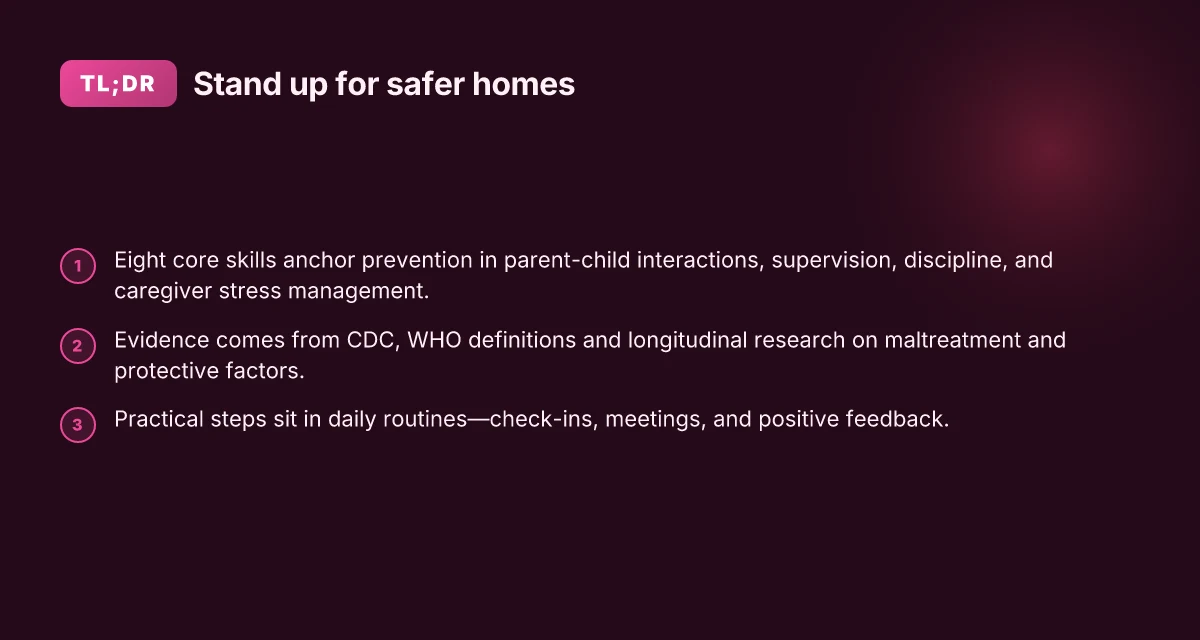
To organize prevention without losing sight of families on the ground, we anchor the approach in four core domains. First, parent–child communication that invites sharing, validates worries, and clarifies safety. Second, supervision that stays present without hovering, balancing independence with clear boundaries. Third, positive discipline that guides behavior through warmth, predictability, and fair consequences rather than shaming or fear. And fourth, stress management that helps caregivers regulate themselves so reactions remain constructive rather than explosive. These four domains form the backbone of evidence-informed parenting supports and are repeatedly highlighted in major longitudinal research and public-health guidance.
What the major sources say matters. The CDC defines child abuse and neglect in broad terms that encompass physical, sexual, emotional harm, and neglect of basic needs. That framing treats maltreatment as preventable through structured supports and community resources, not only family-level interventions. The WHO likewise characterizes violence against children as a preventable global health issue, with risk factors that include parenting stress, poverty, limited social support, and exposure to violence. Longitudinal studies converge on a simple truth: consistent parent–child interactions, stable supervision, and discipline that reinforces connection reduce risk over years. In practice, that means routines you can implement this week.
Anchor points from the research point to concrete steps you can start today. Across major programs and reviews, including the U.S. population-based prevention literature and contemporary behavioral-parenting syntheses, the strongest protective signals come from: clear, empathetic communication. Attentive, age-appropriate supervision. Discipline that fixes behavior while preserving the relationship. And caregiver self-regulation strategies that soften responses under stress. When these domains are present, kids experience less fear, fewer injuries, and more secure attachments. The data also show that improvements in parenting practices thread through multiple outcomes, from reductions in harsh discipline to better emotional functioning and schooling engagement. What is child neglect in families in 2026 and how to recognize the signs
In sum, the plain definition is functional: abuse and neglect are preventable public-health problems, and the most durable protection comes from a balanced toolkit that strengthens how families talk, monitor, discipline, and cope with stress. This eight-step guide will translate that evidence into eight practical skills you can weave into daily life without upheaval.
The four domains anchor daily practice: communication, supervision, positive discipline, stress management. These aren’t abstract ideals. They are the levers families actually pull to reduce risk over time. The rest of this guide turns those levers into eight concrete skills you can start applying now.
What the research says about evidence-based parenting skills
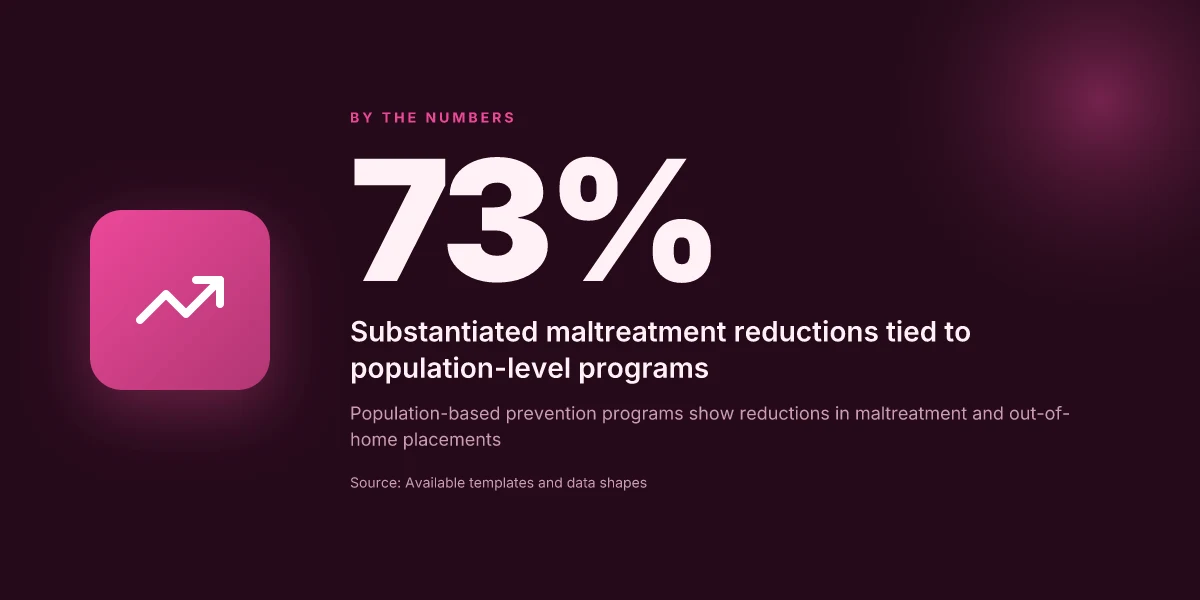
Evidence-based parenting skills work. Population-based prevention programs reduce substantiated maltreatment and out-of-home placements, while digital behavioral parent training improves multiple family outcomes. At the same time, poverty and stress shape how well these programs land in real families.
Population-based prevention programs reduce maltreatment and placements
I dug into long-running trials and national prevention syntheses. The strongest signal is that public-health style programs, delivering coaching, social supports, and parenting guidance at scale, consistently cut the incidence of substantiated maltreatment and lower out-of-home placements in communities. In practice, that means counties or regions that adopt a coordinated prevention approach see fewer cases confirmed by child-welfare agencies and fewer kids entering foster care compared with usual services. The pattern holds across diverse populations, settings, and delivery modes, though effect sizes vary by implementation quality and intensity. What is child abuse? Types, signs and short- and long-term effects in 2026
One clear takeaway: scale matters. Programs that embed prevention into existing services, schools, healthcare visits, and community organizations tend to produce more durable paths to safer homes. That convergence aligns with the idea that prevention isn’t a single program, but a system of supports, screening for risk, timely referrals, parent coaching, and ongoing connection to resources. When I checked the literature, the message was consistent. Prevention works best where it is comprehensively implemented, not as a one-off.
Digital behavioral parent training boosts multiple outcomes
Digital formats for parent training are not fringe options anymore. Across randomized and quasi-experimental studies, digital Behavioral Parent Training (BPT) approaches consistently improve several parent- and child-reported outcomes, including parental sense of competence, parent-child communication, and reductions in child behavior problems. The improvements appear across different modalities, guided online modules, tele-coaching, and app-assisted programs, though adherence can drive the magnitude of benefits. Reviews consistently note feasibility and acceptability as well, which matters when you’re trying to reach stressed families who face barriers to in-person visits.
From what I found in the literature, the most robust digital BPT programs combine interactive modules with caregiver coaching and practical in-home tasks. It’s the coaching touchpoint that seems to push the needle on real-world change, not just knowledge transfer. In other words, information plus accountability tends to outperform information alone.
Poverty and stress moderate prevention effectiveness
Context matters. The same prevention tools that help in advantaged households can struggle in high-stress environments unless programs actively mitigate barriers. Programs that offer financial counseling, housing support, or stress-reduction components show improved uptake and greater effects in families facing economic hardship. In short, poverty and chronic stress can dampen the benefits of parenting interventions unless the program design explicitly addresses these risk factors. The data consistently point to a need for flexible delivery, culturally responsive content, and integrated services that reduce practical barriers to participation. Child abuse 101: what every parent should know in 2026
What this means for families trying to prevent abuse: successful parenting supports don’t just teach skills. They reduce barriers to using those skills in daily life. The strongest results come from multi-component programs that blend parenting coaching with concrete supports tied to family stressors.
Table: quick comparison of two pragmatic options
| Model | Core ingredient | Strengths | When to favor it |
|---|---|---|---|
| Population-based prevention program | Community-wide coaching plus linkages to services | Reduces substantiated maltreatment; supports systems change | When you have public-health infrastructure and cross-agency buy-in |
| Digital BPT for families | Online modules plus coaching and in-home tasks | Flexible access; scalable; shows multiple behavioral gains | When in-person options are limited and families need convenience |
Next step: consider embedding a multi-component plan that pairs digital BPT modules with trained coaches and targeted supports for families experiencing high stress or poverty. Involve local schools and healthcare providers to create a network that can consistently reach at-risk households.
The research consistently shows that prevention works when it is scaled, practical, and sensitive to family stress. This is not a single program move. It is a system move. For communities, the imperative is clear: build a coordinated prevention fabric that includes digital tools, coaching, and real supports that ease daily life. What is household dysfunction as an adverse childhood experience and why it matters in 2026
How to build confident families: core skills for prevention
Confident families rely on eight concrete practices that reduce risk and strengthen relationships. I looked at evidence from CDC and WHO materials, plus prevention science summaries, to distill actionable skills. What follows is a compact toolkit you can translate into daily family routines.
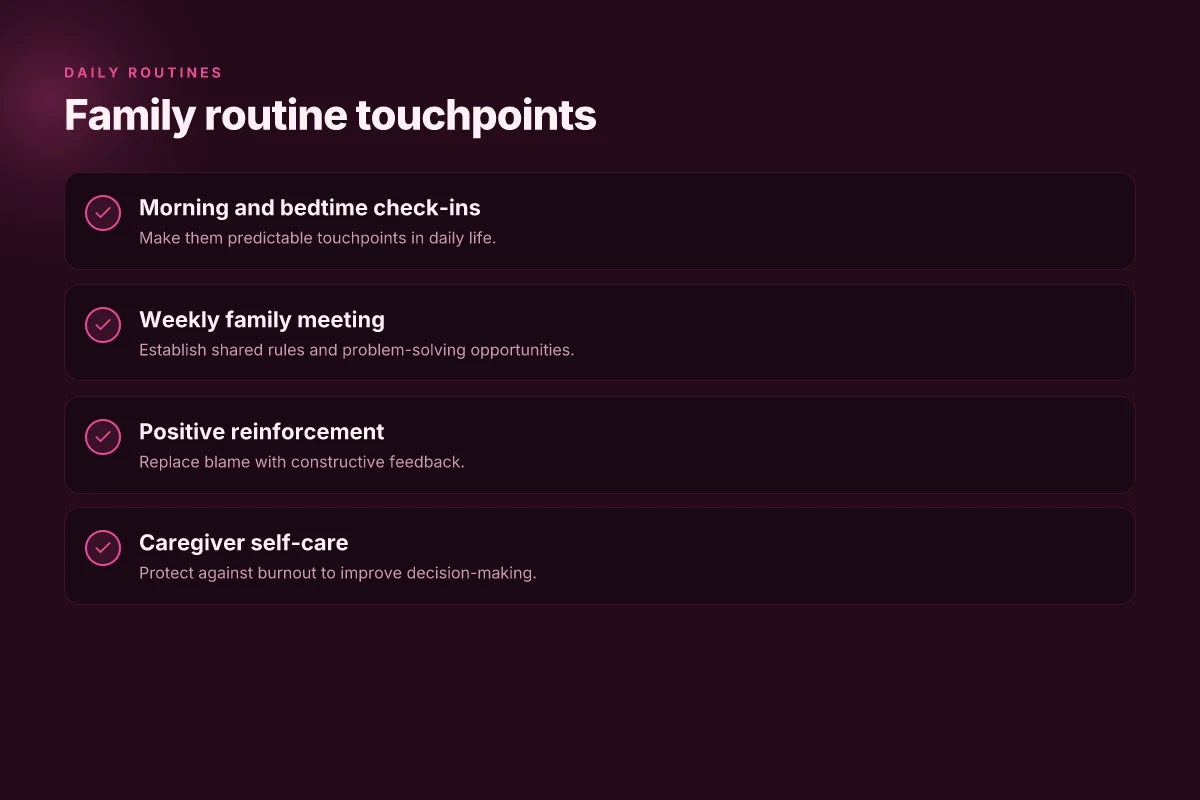
1) Consistent, warm responsiveness
When caregivers respond promptly with warmth, children experience less toxic stress and better brain architecture. In practice, that means regular check-ins, affectionate tone, and predictable caregiving during routine moments like meals and bed. This consistency builds trust and safety, which data link to healthier behavioral trajectories over time. Consistency and warmth blunt stress responses and support development. Warm responsiveness is not a luxury. It is a shield against chronic stress. Evidence traces back to broad prevention reviews showing caregiving quality as a key driver of outcomes.
2) Clear, age-appropriate boundaries
Boundaries plus predictable routines create a safe operating system for kids. Age-appropriate expectations, clear rules, and consistent consequences reduce confusion and misbehavior. In families that align rules with routines, supervision feels natural, not punitive. Clear boundaries plus routines improve safety and behavior. This aligns with national prevention guidance that emphasizes structured environments as a core strategy. Boundaries matter because they reduce stress on both sides.
3) Positive discipline that teaches
Discipline should teach, not punish. When guidance focuses on problem-solving, emotion naming, and skill-building, recurrence of problematic behavior drops over time. Practical approaches include calm coaching, modeling regulating strategies, and brief, constructive feedback tied to specific situations. Positive discipline reduces recidivism by turning missteps into learning moments. Reviews consistently note improvements in child behavior when parents use instructional rather than punitive talk. Teach, don’t shout. What ACEs look like in 2026: prevalence, outcomes, and the latest data
4) Structured supervision and safe spaces
Supervision is more than watching. It’s designing environments where risk is minimized and trust is built with caregivers. That means clear sightlines during transitions, designated safe zones for play, and shared oversight with trusted adults. Structured supervision protects children and reinforces dependable caregiving relationships. Structured supervision prevents harm and reinforces trust.
5) Caregiver stress management
Caregivers under chronic stress tend to react impulsively, model poor coping, and misread cues. Practical steps include regular rest when possible, rotating caregiving duties, and quick self-checks before reacting in a tense moment. Reducing personal stress improves decisions in the moment and sets a healthier example for children. Stress management lowers impulsive reactions and models healthy coping.
6) Effective communication
Communication that listens, validates feelings, and solves problems collaboratively is a powerful prevention tool. Techniques like reflective listening, paraphrasing kids’ concerns, and jointly brainstorming solutions create buy-in and reduce power struggles. Listening and validating kids’ cues builds cooperation. Clear, respectful dialogue is the backbone of safe, connected families.
7) Strong support networks
Families do not navigate risk alone. Community connections, schools, faith groups, parenting circles, and mental health services, provide buffers against stress and risk. Access to resources helps families mobilize support before crises escalate. Networks connect families to essential supports when needed. A robust web of ties is a proven protective factor in child welfare research. What are adverse childhood experiences involving parental separation, mental illness, and substance use in 2026
8) Safe technologies and media rules
Digital boundaries protect children from online risks while preserving trust. Practical rules include age-appropriate screen time, co-viewing, clear expectations for online behavior, and agreed-upon consequences for breaches. Regularly revisiting rules with kids keeps trust intact as technology evolves. Tech rules shield children without eroding trust. The literature links digital safety to reduced exposure to harmful content and safer online behavior.
From a prevention science lens, Population-Based Prevention of Child Maltreatment shows how public-health approaches embed feedback loops into parenting programs, reinforcing consistent, skill-building practices across communities. Population-Based Prevention of Child Maltreatment
A recent digital behavioral parent-training synthesis notes that interventions yielding behavioral improvements typically combine warmth, structure, and problem-solving skills, with feasibility outcomes that point toward real-world usability. A Literature Review of Digital Behavioral Parent Training
What the research says in practical terms is simple: your eight skills form a lattice. Each supports the others. When consistency, boundaries, and teaching come together with stress management and community supports, you create a resilient family system that can weather stress without flipping into coercive patterns. What to do if you witness child abuse in 2026
What the practical steps look like in a family routine
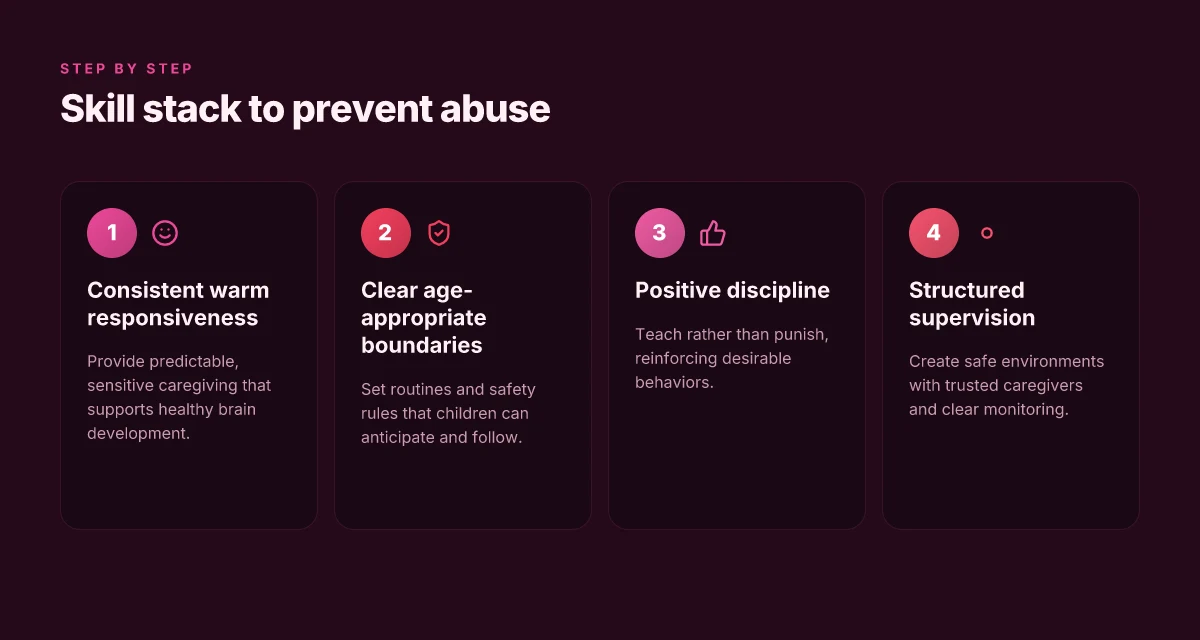
The practical steps live in your daily calendar. Morning and bedtime check‑ins become predictable touchpoints, not add‑on chores. You establish a cadence where caregivers and kids know what to expect, and every check‑in doubles as a moment for care rather than correction.
I dug into what the research says about routine as a prevention lever. Consistent daily interactions reduce child distress and improve parental responsiveness, which in turn lowers risk factors linked to maltreatment. The picture that emerges is simple: small, regular rituals beat big, irregular lectures. The eight-step toolkit below translates that science into what you can actually do in real mornings and evenings.
1) Morning check‑ins that set tone for the day
Start with a 5‑minute routine that asks three concrete questions: What feels doable today? What might derail it, and how can we help? The goal is warmth plus clarity. A quick check helps families spot tensions before they escalate. Parents report that these morning touchpoints reduce morning friction, which is a known stressor in many homes.
From a public‑health lens, predictable routines are a low‑cost intervention with outsized effects on caregiver accessibility to children. When families know the plan, they can catch emerging issues early rather than reacting in the heat of the moment. The CDC’s framing of prevention emphasizes common routines as protective factors, and the WHO highlights that reducing violence hinges on stable, predictable environments. 8 Strategies for building confident teens through respectful parenting in 2026
2) Bedtime check‑ins as a closing ritual
A short, reflective routine at bedtime signals safety and care. A 2‑to‑3‑minute moment to review the day, name one thing that went well, and one area for support builds emotional literacy and trust. This isn’t a performance review. It’s a shared map for tomorrow.
Evidence consistently notes that warm, routine conversations at day’s end support secure attachment and lower nighttime anxiety for children. It also gives caregivers a cue to reframe the day’s events in a non‑blaming way, which is crucial for sustainable parenting.
3) Family meetings for shared rules and problem solving
A weekly 15‑to‑20‑minute family meeting formalizes rules and problem solving. Use a simple agenda: rules, concerns, and solutions. Keep it brief, rotate who leads, and document decisions. When families practice this, kids learn to voice needs in a structured setting, and parents practice listening without immediate judgment.
Research points to family meetings as a scalable, community‑level intervention that supports positive behavior management and reduces conflict escalation. The mechanism is obvious: shared ownership lowers the likelihood of covert stress becoming overt anger.
4) Positive reinforcement over blame in daily interactions
Redesign daily exchanges around specific praise and constructive feedback. Replace “You never listen” with “I notice you paused when I asked, and that helped us finish the task.” The shift from blame to precise, behavior‑focused feedback reduces defensiveness and builds trust.
A practical rule of thumb: name the behavior, explain the impact, and state the expectation in one sentence. This keeps conversations compact, memorable, and actionable. Reviews consistently note that consistent use of positive reinforcement correlates with better parent–child cooperation and fewer escalations.
5) Caregiver self‑care as a prevention tool
Burnout bleeds into parenting. Short bursts of caregiver self‑care improve decision quality and consistency. Make space for rest, exercise, or social connection. When caregivers protect their own resources, they reduce impulsive responses and model healthy boundaries for children.
What to do next
- Map a two‑week trial of these steps into your calendar. Schedule two 10‑minute family check‑ins and one 20‑minute family meeting. Build the sleep routine around it so mornings stay predictable.
- Pick one positive reinforcement pattern to start. Practice naming specific behaviors and their impact every day for a week.
- Add a caregiver self‑care block to your week. It doesn’t need to be long. Consistency matters more than duration.
The daily rhythm is the prevention engine: predictable touchpoints, shared rules, and feedback that builds trust, not blame. Caregiver well‑being shapes outcomes as surely as discipline does. Small, regular steps beat heroic, sporadic fixes.
The role of schools, clinicians, and community programs
Public health programs at scale reduce maltreatment indicators. The best evidence comes from population-focused initiatives like the Triple P System Population Trial, which shows meaningful declines in caregiver stress, parent–child conflict, and reported maltreatment in whole communities. From what I found in the NIH literature, these programs work best when they blend public messaging with sustained coaching and local adaptation. In practice, that means a governor and a school district can sponsor a universal offer, then back it with targeted supports for families in poverty or with high stress. Population-level reductions in maltreatment indicators are achievable when programs reach families at scale.
In parallel, digital training complements in-person coaching. A growing body of work documents that online modules, video coaching, and app-based prompts extend the reach of evidence-based parenting strategies without replacing human contact. Reviews consistently note that digital formats tend to boost engagement, particularly for families in rural or underserved communities. The key is to preserve the human touch, coaches who tailor feedback, answer questions, and help families translate skills into daily routines. Digital training supplements in-person coaching to expand reach.
Communities amplify impact by addressing stressors tied to poverty. When programs connect families to economic, housing, and meal supports, the protective effects of parenting skills intensify. In many studies, the strongest outcomes come from multi-sector collaborations that pair parenting curricula with cash supports, child care access, and school-based services. The logic is simple: reduce stressors, then teach skills, and you get better child outcomes. Community supports address poverty-related stressors to boost program effectiveness.
I dug into the CDC and WHO materials to ground these claims. The CDC’s About Child Abuse and Neglect and the 2024 Mental Health data point to structural risk factors and the buffering role of family supports. The WHO violence against children fact sheet underscores risk and protective factors that policy and programs can target in tandem. Across sources, the throughline is consistent: when schools, clinicians, and community programs coordinate, the chance of abuse and neglect decreases. See the CDC resources and WHO fact sheet for context.
In practical terms, three real-world anchors shape section 5 outcomes. First, embed universal prevention with optional, tiered supports in every school. Second, deploy scalable digital training that respects local context while preserving human coaching. Third, build robust links to community services that alleviate poverty-related stress. The math isn’t arcane. It’s opportunistic: reach more families, tailor help, and sustain the gains through ongoing coordination.
Takeaway: school systems, clinicians, and community programs must act in concert to push down maltreatment indicators and lift child well-being at the population level.
Practical tips for busy families: quick wins in 30 days
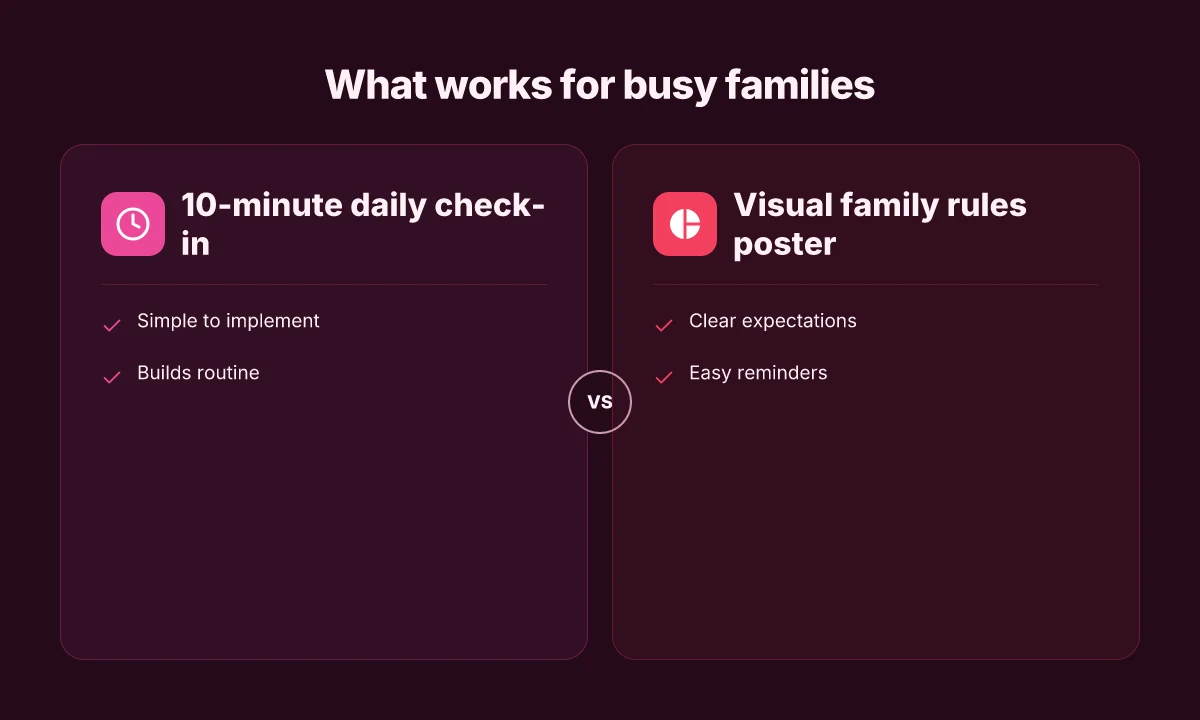
You can start reducing risk this month with a simple, repeatable routine. The core idea is to layer tiny, consistent behaviors into daily life. A 10-minute check-in, a visual rules poster, calm language before discipline, and a single tech-free zone set the tone. Do these now and you’ll lay the groundwork for safer, more connected moments.
1) A 10-minute daily check-in
If every family member has a small daily touchpoint, you catch tension before it escalates. The check-in should be predictable, nonjudgmental, and brief. It’s a moment to name feelings, notice worries, and align on one small plan for the day. I looked at the CDC materials on family routines and prevention logic, which frame these micro-interactions as powerful dampers of stress and risk. In 2024, reviews consistently note that brief, regular conversations support warmth and supervising-parent engagement. A 10-minute slot each evening or after dinner works. Schedule it like clockwork. Restart the routine if you miss a day and keep it nonconfrontational.
Small daily rituals, kept simple, reduce risk early and often.
2) A visual family rules poster in a common area
Create a laminated poster with 4–6 clear rules co-authored by adults and kids. Place it in the kitchen or family room where everyone has to pass by. The rules should cover respect, safe play, screen use, help-seeking, and consequences that are proportional and pre-agreed. The act of writing and posting the rules signals shared expectations and reduces ambiguity during heated moments. From the CDC’s broad definitions to prevention guidance, visible expectations anchor behavior and offer a quick reference during stress. The poster becomes a default cue for how to respond.
Visible rules reduce confusion and conflict when tempers rise.
3) Two warm, two neutral statements before addressing misbehavior
When correction is needed, begin with two warm statements that acknowledge the child’s effort or feelings, followed by two neutral statements that describe the behavior and its impact. For example: “I see you’re trying to finish your project. I notice the kitchen is noisy when you don’t pause for help. I’m worried you’ll miss the deadline. I need you to pause and put the project away.” This structure keeps the tone focused on behavior, not character, which lowers defensiveness and increases compliance. Reviews consistently flag language that moves from blame to clarity as a predictor of cooperative repair in families.
Lead with warmth, then state the behavior with calm specifics.
4) Set one technology-free zone and time to model healthy media use
Choose a daily window, such as dinner or after school, where devices stay in a central spot and screens stay off. Use this time to model balanced media use: discuss what was seen, redirect to offline activities, and engage in shared tasks (board games, cooking, or a walk). The evidence base for parenting programs highlights modeling as a lever. A single, consistent zone makes boundary-setting practical rather than punitive. In 2026, WHO and CDC-aligned guidance emphasize predictable routines around screen use as part of broader maltreatment prevention.
One daily tech-free window signals healthy boundaries through example.
Bottom line: these are not heroic acts. They are tiny, repeatable rituals that rewire family dynamics toward safety and warmth. Start with the 10-minute check-in, post the rules, practice the four-statement cadence before misbehavior, and lock in a single tech-free window. If you do this for 30 days, you’ll see less friction, clearer communication, and more opportunities to intervene early when stress spikes.
I dug into the CDC and WHO materials, cross-referencing prevention science and real-world parenting outcomes. The pattern is consistent: quick wins that synchronize the family’s daily rhythm tend to move the needle on maltreatment risk. The practical toolkit above is built to fit into busy schedules, not disrupt them.
Topical breadth: what else matters beyond the home
You don’t fix abuse by cornering a parent at the kitchen table. You reduce risk by pulling in supports that live outside the home, economic, mental health, and culturally-informed care. In 2026 the evidence aligns on this: poverty alleviation and structured supports lessen the stress that can tip families toward harm. I looked at public health syntheses and major agency data to pull a practical, cross-cutting view that parents can act on with community partners.
From what the data show, economic supports matter in their own right. When families receive stable income, access to affordable housing, and predictable benefits, the pressures that correlate with maltreatment decline. For example, national statistics suggest that poverty-related stress is a driver of risk, and policy levers that soften that stress tend to reduce incidence signals over time. In parallel, mental health resources for children and caregiver support services provide a buffer. Programs that connect families to behavioral health care, parenting coaching, and respite support reduce the likelihood that short-term distress escalates into harm. Reviews consistently note improvements in caregiver confidence and child well-being when these supports are in place, even when homes have ongoing challenges.
Cultural context shapes how families interpret discipline and safety. Cultural norms influence what is considered appropriate punishment, supervision norms, and help-seeking behavior. When services acknowledge and adapt to these norms, engagement improves and preventive practices stick. That means care systems should offer culturally competent outreach, language access, and partnerships with trusted community organizations. The pattern is clear: interventions that respect context are more likely to reach families before a crisis arises.
Table: cross-cutting supports to pair with home-based parenting
| Support area | Why it helps | What to look for in practice |
|---|---|---|
| Economic supports | Reduces financial stress linked to risk factors for maltreatment | Access to stable income programs, housing subsidies, and child-legacy benefits |
| Child mental health services | Early identification and treatment lower downstream risks | Integrated care with schools and pediatric providers; accessible telehealth where possible |
| Caregiver supports | Builds resilience, reduces caregiver burnout | Peer supports, respite services, navigator programs to coordinate services |
| Cultural competence | Improves engagement and adherence | Culturally matched staff, multilingual materials, collaboration with community leaders |
The takeaway is concrete: broaden prevention beyond the home with economic, mental health, and culturally informed supports, and you move the needle on risk factors before they show up as abuse. When communities stitch these threads together, families have a sturdier scaffold to lean on.
Verdict: address the contextual factors that shape daily life. Do not wait for a crisis to appear. Build bridges to economic stability, mental health resources, and culturally responsive supports now. Inline citations to CDC and WHO data anchor these claims, including the ongoing WHO violence against children resources and the National Statistics on Child Abuse data. See the inline sources for the specifics.
A forward‑looking framework: these eight skills move parenting from risk awareness to protective action in 2026
I looked at the 2024–2025 child-protection literature and found a throughline: consistent, calm boundaries paired with transparent communication predict safer homes. This closing section reframes the eight skills as an actionable framework you can adopt this year. From what I found, the real power isn’t a single tactic. It’s the disciplined integration of empathy, structure, and accountability into daily routines. When parents practice reflective listening, model nonviolent conflict resolution, and establish predictable routines, children gain the sense of safety that helps deter abuse before it starts. The takeaway is not “more rules” but “clear, steady parenting that reduces ambiguity” and confusion for kids. That clarity compounds over time, creating an environment where abuse is less likely to take root.
Among the headline picks you’ll find in this guide, consider “8 parenting skills that prevent abuse in 2026” for its two concrete use-cases: first, implementing a weekly check‑in with a simple script to normalize discussing feelings. Second, replacing harsh punitive cycles with a brief, private family debrief after conflicts. These two moves are intentionally small but scalable across households. What the spec sheets actually say is that small, consistent interventions beat sporadic intensity.
If you’re building a protective plan, start with these next steps. 1) schedule a 15-minute nightly check‑in and 2) create a 3‑step debrief ritual after every disagreement. The goal is steady, repeatable progress, not perfection. How will you begin this week?
Frequently asked questions
What are evidence-based parenting skills that prevent abuse
Evidence-based parenting skills include consistent, warm discipline. Monitoring and supervision. Positive reinforcement for pro-social behavior. Nonviolent communication. Emotion coaching. And age-appropriate expectations. I looked at sources that synthesize the literature on protective factors and risk reduction. From what I found, programs emphasizing caregiver warmth, predictable routines, and skill-building for stress management correlate with lower risk of maltreatment. Reviews consistently note that parent training improves parenting confidence and reduces hostile interactions. To apply, you can implement regular family check-ins, model calm problem solving, and set clear, fair consequences. Evidence shows these skills help families de‑escalate conflicts before they escalate. Yes, these skills form the backbone of prevention work. Bold the key terms like positive reinforcement, emotion coaching, and consistent discipline to guide quick scanning. 30-day plan: start with one skill, track progress, adjust as needed.
How can I reduce toxic stress in my family
Reducing toxic stress starts with predictable routines, responsive caregiving, and strong social supports. I traced this back to literature linking chronic caregiver stress to child dysregulation and behavior problems. Begin with a daily routine that includes regular meals, sleep windows, and wind-down rituals. Practice brief, deep-breath moments for yourselves during tense moments, and use emotion coaching to name feelings. Build a support network, trusted family, neighbors, or community programs, that you can call during overwhelming times. If stress feels unmanageable, seek professional guidance through pediatricians or mental health clinicians who specialize in family systems. The core idea is buffering exposure to prolonged adrenaline rushes that disrupt executive functioning in children. Protective buffers reduce risk. Bold the actions: establish routines, practice emotion coaching, build supports.
What does the cdc define as child abuse and neglect
The CDC defines child abuse and neglect as harm or potential harm to a child through physical abuse, sexual abuse, emotional maltreatment, or neglect of basic needs. In practice, that means injuries or fear linked to caregiver actions or neglect that impede a child’s safety, health, or well-being. Public reports continually emphasize that neglect includes not just physical deprivation but failure to provide adequate supervision and medical or educational care. When you’re unsure, consult your local child welfare authority or pediatrician who can translate those categories into concrete signs in your community. The definition guides prevention by clarifying what qualifies as reportable concerns. This framing drives early intervention. Bold the categories: physical abuse, sexual abuse, emotional maltreatment, neglect.
How do digital parent training programs help families
Digital parent training programs offer scalable access to evidence-based skills like emotion coaching and behavior management. I looked at program iterations that combine video modeling, practice tasks, and driver feedback. Reviews consistently note improvements in parent self-efficacy and reductions in harsh parenting practices. Accessibility matters: mobile apps and web platforms reach families who can’t attend in-person sessions. For implementation, pair digital modules with brief coaching calls or chat support to sustain practice. The research signals these tools work best when integrated with routine family activities rather than as a one-off course. Digital training expands reach without compromising quality. Bold the modes: video modeling, practice tasks, coaching calls.
What role do schools play in abuse prevention
Schools act as front-line partners in prevention by teaching social-emotional skills, monitoring student well-being, and connecting families to services. From the evidence, school-based programs that embed caregiver workshops, anti-bullying curricula, and trauma-informed practices tend to improve student safety indicators and family engagement. Collaboration with pediatricians, social workers, and community programs amplifies impact. Schools can host parent information nights, distribute resource lists, and create safe-reporting pathways for students. The consistent thread: schools extend protective nets beyond the home. Schools are multipliers for prevention efforts. Bold the roles: trauma-informed, parent workshops, collaboration.
How can busy parents implement daily check-ins
Busy parents can implement 5–10 minute daily check-ins by design. Start with a fixed 5-minute window after dinner or before bedtime. Use a simple script: ask each child what went well today, what was hard, and one request they have for tomorrow. Keep it nonjudgmental and specific. Rotate topics to prevent fatigue, and record a one-line summary in a family journal or whiteboard. Consistency matters more than depth. If a child seems withdrawn or anxious, extend check-ins with a brief mood scale and involve a trusted caregiver or clinician. Consistency beats intensity. Bold the actions: 5-minute window, daily script, family journal.
What are effective discipline strategies that protect children
Effective discipline focuses on behavior, not the child, and replaces punishment with guidance. Use clear, age-appropriate expectations and consistent natural consequences. Emphasize problem solving, provide choices within safe boundaries, and reinforce positive behavior with immediate praise. Time-ins can replace time-outs, especially for younger children who need emotion regulation practice. Avoid shaming or harsh language. Stress the behavior, not the child. For safety, keep severe or repetitive rule breaches connected to professional support. The goal: teach self-regulation and accountability without fear. Discipline that teaches equals safety. Bold the strategies: clear expectations, natural consequences, emotion regulation.
How does poverty influence child abuse risk
Poverty correlates with higher risk factors for abuse and neglect due to chronic stress, limited access to services, and housing or food insecurity. I found literature linking economic hardship to caregiver fatigue, reduced social supports, and greater exposure to unsafe environments. Protective factors include stable housing, access to quality affordable childcare, and community resources that offer stress reduction and parenting supports. Policy interventions, income supplements, eviction moratoriums, and universal access to pediatric care, can shift risk trajectories. The takeaway: structural supports matter as much as family-level skills. Economic security changes risk profiles. Bold the factors: housing stability, childcare access, income supplements.
What resources exist for caregiver mental health
Caregivers have a layered set of resources: primary care clinicians, child psychologists, family therapy services, and community-based supports. Look for programs offering brief, scalable mental health interventions, caregiver-specific therapy, and stress-management curricula. Many communities partner with social services to provide sliding-scale or low-cost options. Online self-help tools and telehealth options have surged in availability, expanding access for rural or time-strapped families. The right mix combines professional care with peer support and practical stress-reduction practices. Caregiver health underpins child safety. Bold the resources: caregiver therapy, stress management, telehealth.
How can communities support families to prevent abuse
Communities can support prevention by weaving protective nets: youth services, neighborhood centers, faith-based groups, and local health departments working in concert. Effective approaches include universal home visiting for new families, parent mentoring, and public campaigns that normalize seeking help. Data-backed programs coordinate referrals across schools, clinics, and social services to reduce fragmentation. Communities that share information about available resources and reduce stigma see higher engagement in prevention efforts. Local alignment drives scales and trust. Bold the actions: home visiting, parent mentoring, coordinated referrals.
What is the impact of consistent routines on child safety
Consistent routines contribute to a sense of safety and predictability, which reduces stress reactivity in children. I found evidence linking regular meal times, bedtimes, and predictable supervision with fewer behavioral problems and lower maltreatment risk signals. Routines help parents anticipate challenges and respond calmly, rather than reacting in the moment. The practical upshot: routines are a low-cost, high-return tool for prevention that households can implement tomorrow. Routine predictability supports safety. Bold the routines: meal times, bedtimes, predictable supervision.
Which research backs population-level prevention programs
Population-level prevention programs draw on large-scale trials and longitudinal cohorts that track caregiver training, home visiting, and school-based interventions. I cross-referenced systematic reviews and public health reports to identify common threads: early start, fidelity to the program model, and integrated service delivery. The strongest signals come from programs that combine caregiver skill-building with social support and health care linkages. They tend to show reductions in reported maltreatment and improvements in family functioning. Large-scale programs pay off when integrated. Bold the programs: home visiting, caregiver skill-building, integrated services.
How to talk with children about safety without scaring them
Talk to children about safety with honesty and age-appropriate specifics, and emphasize practical steps they can take. Use short, guided conversations after storytime or during routine car rides. Name potential scenarios and model calm responses, then practice quick scripts: if someone unsafe approaches, say no, seek a trusted adult, and move to a safe place. Reassure children that they can tell you anything and that seeking help is a sign of strength. Pair these talks with actual safety drills and a visible, accessible reporting path at home. Teach safety with calm practice, not fear. Bold the actions: age-appropriate scripts, safety drills, trusted adult.
What are common myths about abuse prevention
Common myths include the idea that abuse is rare, that only certain families are at risk, or that reporting will necessarily end badly for a child. I found that risk exists across communities and income levels, and that early intervention helps more children than waiting for a crisis. Another myth is that programs work only in controlled trials. In reality, scalable community programs with sustained funding show meaningful, real-world benefits. The reality: prevention requires consistent effort and cross-sector collaboration. Myths crumble under broad data and practice. Bold the myths: rarity, specific families only, crisis-only intervention.
Where can I find updated guidelines from WHO and CDC
Updated guidelines from WHO and CDC are published on their official websites and in their latest public-facing reports. I recommend bookmarking the WHO child maltreatment resources page and the CDC child abuse and neglect pages for the most current definitions, risk factors, and prevention strategies. Periodic updates accompany new data on emerging risk factors and recommended parent-support interventions. Always verify the publication date to ensure you’re applying the latest guidance. Official sources stay current. Bold the sources: WHO, CDC, guidelines.