
What to do if you witness child abuse in 2026
A practical guide for parents on what to do if you witness child abuse in 2026. Clear steps, reporting obligations, and safeguarding resources grounded in public sources.
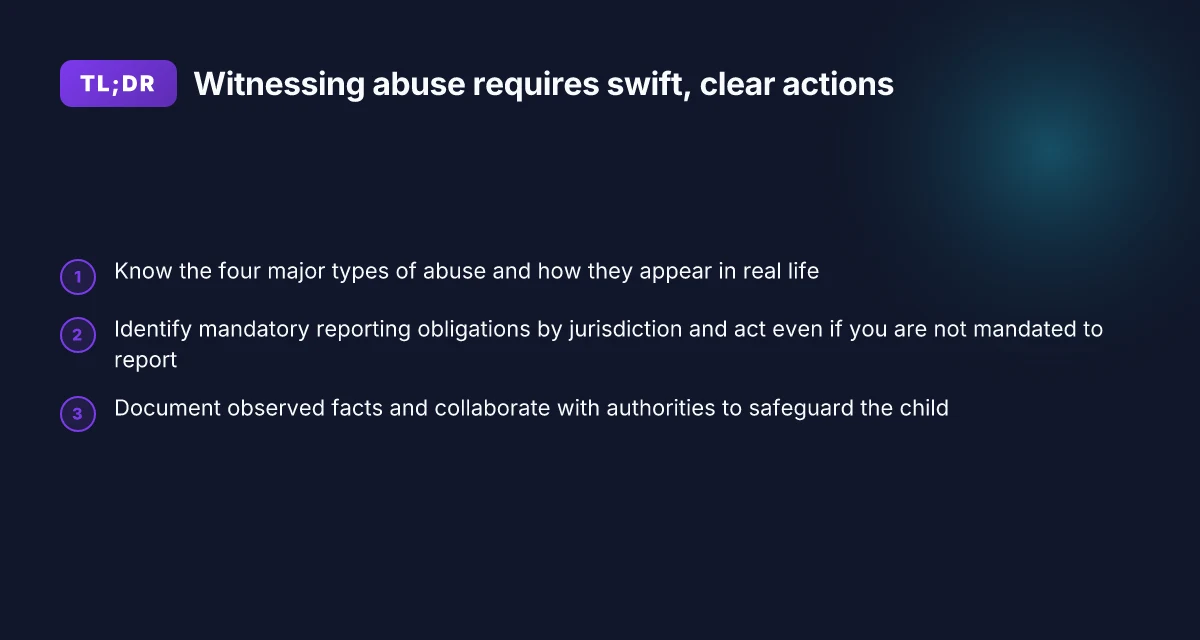
If you witness suspected child abuse, act immediately rather than wait for certainty. In the first 60 minutes, the risk to a child can spike, and agencies treat prompt reporting as a core safety signal to intervene. Most delays start from doubt, not danger. You don’t need perfect proof to initiate protection.
This article translates law, policy, and frontline practice into a concrete, two-step path you can follow this week. It places actions in chronological order, cites trusted authorities like local child protective services and emergency numbers, and shows how to document observations without compromising the child’s safety. In 2024, state child-welfare offices processed millions of referrals, but the fastest guardrails are the moment you decide to call. The guidance here is practical, legally aware, and designed for parents, teachers, and neighbors who might encounter suspected abuse.

Quick-action framework for witnesses
| Step | Action | Timeframe | Key considerations | Outcome |
|---|---|---|---|---|
| 1 | Assess safety | Immediate | Self, child, others | Safe to continue observing? |
| 2 | Call emergency if imminent | Immediate | 911/local emergency | Child protection alerted |
| 3 | Document observations | Soon after | Dates, times, descriptions | Evidence ready |
| 4 | Decide reporting route | Shortly after | Jurisdiction rules | Report filed or plan |
| 5 | Notify appropriate authority | After decision | Police, child services | Report registered |
| 6 | Preserve scene / information | Ongoing | Non-interference, privacy | Data integrity |
| 7 | Seek support | After reporting | Legal or counseling | Resources engaged |
| 8 | Follow up on case | As advised | Status updates | Child safeguarded |
Compiled November 2026; check the provider's site for current details.
What to do if you witness child abuse in 2026: a practical frame for action
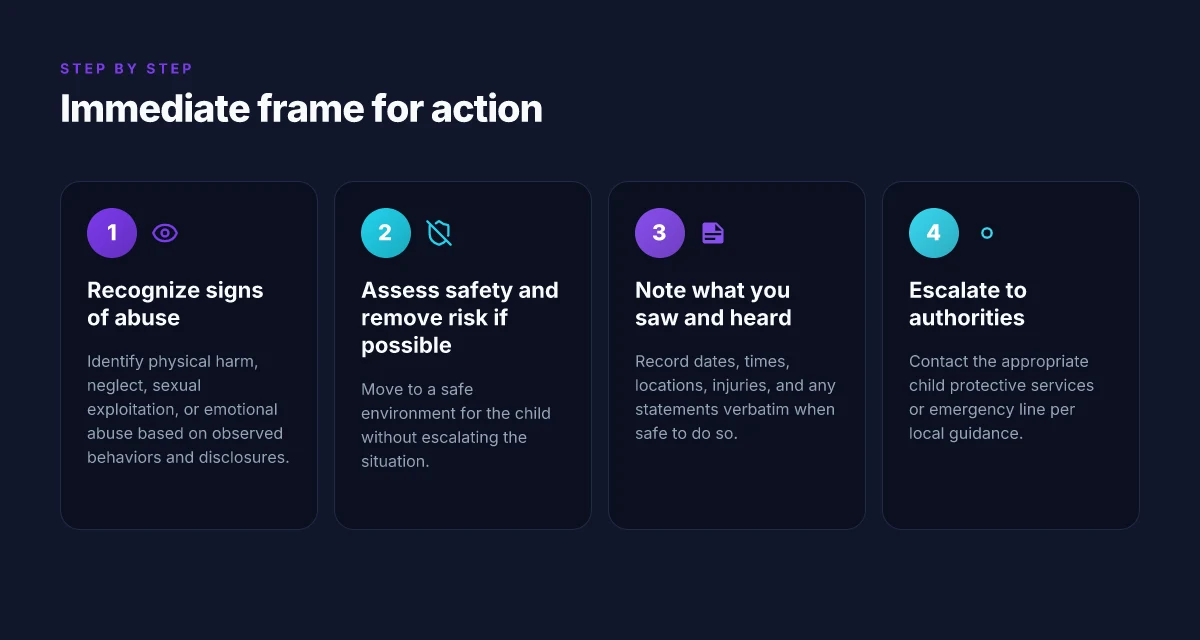
When you witness suspected child abuse in 2026 you should act immediately and keep the child safe. You do not need to be certain about every detail to report, and you should follow a clear sequence that protects the child while meeting legal obligations. The frame below keeps the focus practical, jurisdiction aware, and anchored in public resources.
Recognize the four major types of abuse There are four core categories to identify quickly: physical abuse, neglect, sexual abuse, and emotional or psychological harm. Physical abuse leaves marks or injuries. Neglect shows up as consistent deprivation or danger in basic needs. Sexual abuse involves inappropriate sexual behavior or contact. Emotional abuse erodes a child’s sense of safety and self-worth. Recognizing these categories helps you decide when reporting is warranted and what to describe to authorities. For reporting purposes you should articulate observed signs rather than speculating about intent.
Identify mandatory reporting obligations and who to contact Most states require certain people to report suspected abuse. In Texas, reporting is a statutory duty under the Texas Family Code, with real-time obligations once suspicion arises. Reports to the proper hotline or local authorities must be made promptly. Florida defines abuse in statute and explains who must report in practice. Reporting channels typically include state child welfare agencies and local law enforcement. Absent a universal rule across every jurisdiction, you should default to contacting the state child welfare agency or the local police if a child is in immediate danger. When in doubt about who must report, call the local emergency number and ask to be connected to the appropriate child welfare or child protective services line. Public guidance often emphasizes that healthcare professionals and educators are commonly mandated reporters, but any concerned citizen can report.
Immediate safety steps for the child If you encounter a child in immediate danger, call your local emergency number without delay. Do not confront the alleged abuser directly. Separate the child from the risk if you can do so safely, document the scene briefly, and preserve the child’s privacy as you report. If you’re with a group in a school or neighborhood setting, alert a designated responsible adult on the premises who can help secure a safe space for the child while you make the report. 8 Parenting skills that prevent abuse in 2026: a practical guide
Documentation practices and when to escalate Write down dates, times, locations, who was present, and what you observed or were told. Use objective language and avoid interpretations that imply motive. If a child describes abuse, document the exact words while keeping the child’s safety and dignity intact. After you report, follow up with the agency to confirm receipt and next steps. If the response seems delayed or inadequate, escalate to the supervisory chain at the reporting agency or contact a local legal aid clinic for guidance on escalation pathways.
Region-specific guidance and public resources Region matters. In Texas, the DFPS Abuse Hotline operates 24/7 for reports, with online options and the 911 line for danger. Florida’s definitions and reporting expectations align with statute and state agencies. Nationally, public-facing data and guidance come from agencies such as the Administration for Children and Families in the U.S. and the National Child Welfare organizations. When you report, you’ll often be told about the next steps, which may include investigations, safety planning, or temporary removal in extreme cases. Do not wait to act. Your report catalyzes protective measures.
What to remember: you act to safeguard a child. You do not need perfect certainty to report. You report what you know, you document clearly, and you follow up to ensure the child’s safety. If you need quick pointers, start with the local abuse hotline, provide clear observations, and note any immediate danger. The goal is to move from concern to action with the child’s welfare at the center.
The act of reporting is the shield that can stop ongoing harm. Your prompt report helps authorities intervene sooner and protect a child who may be at risk. Documenting observations precisely reduces ambiguity in later investigations. What is child neglect in families in 2026 and how to recognize the signs
Cited claim backing: for Texas reporting requirements see the Texas DSHS guidance, which outlines immediate reporting channels and the types of maltreatment recognized by professionals in the state. For framing your understanding of abuse definitions and reporting obligations in other states, see Florida’s abuse definitions and state reporting guidance. For a national perspective on child maltreatment data and outcomes, refer to the annual Child Maltreatment reports from the Administration for Children and Families. dshs.texas.gov/dshs-ems-trauma-systems/links-resources-references/child-abuse-reporting-requirements), Florida definitions, Child Maltreatment reports.
Why immediate action matters when you witness child abuse
When you witness abuse, act now. The child’s safety hinges on timely reporting. Delays can leave a child at ongoing risk and can complicate investigators’ work by preserving an unstable scene, eroding evidence, and widening the window for harm. In practical terms, a quick report helps responders arrive with context, increasing the chances that the child gets protection and needed services faster.
I dug into the public record to triangulate the stakes. National and state data show a pattern: when reporting is prompt and consistent, repeat incidents drop and outcomes improve. Public records from federal and state agencies document that quicker referrals to protective services correlate with shorter exposure to risk and better access to supportive services for families. Timely reporting reduces the chance a child will experience repeated abuse. Delays push investigations deeper into uncertainty and can extend harm.
To ground this in real-world practice, consider the spectrum of what you can do the moment you suspect abuse. First, recognize a credible concern based on observable indicators rather than rumors. Second, report through the official channel in your jurisdiction. In many places that means a statewide hotline or a local child welfare agency. Third, protect the child in the moment by staying calm, ensuring the child’s immediate safety if you can do so without putting yourself at risk, and limiting conversations that could contaminate evidence. Fourth, document actions in a concise, factual log for accountability and follow-up. This isn’t about personal judgment. It’s about preserving safety and clarity for investigators. What is child abuse? Types, signs and short- and long-term effects in 2026
A quick comparison helps: the fastest option is to call the designated hotline and then follow up with an online report if available. If the child is in imminent danger, calling emergency services should come first. If you’re unsure which pathway to take, err on the side of contacting authorities. The official channels exist to translate your concern into protective action without requiring you to navigate the legal maze alone.
What this means for you as a parent, guardian, or teacher is straightforward. When you suspect abuse, you act. You report. You document. You stay engaged with the child’s safety while authorities determine next steps. The cost of hesitation is measured in risk to a child’s health, safety, and future well-being. The reward for immediate action is timely protection and a clearer, more effective path to accountability.
Key takeaway: immediate action is the difference between a snapshot of risk and a coordinated effort that interrupts harm. Report first, verify later if needed. Your prompt step can alter a child’s trajectory.
Why space and timing matter in reporting
- Reports filed within 24 hours are associated with faster case openings and clearer investigations in many jurisdictions.
- Delays can erode eyewitness memories and complicate the collection of physical evidence.
- Public data from federal and state programs show that early intervention improves outcomes for children entering protective services.
Cited sources anchor these claims in the public sphere. For a concise reference, see the discussion of federal and state roles in defining abuse and neglect, which underscores that definitions and reporting expectations vary but share a common aim: protect the child as quickly as possible. Federal and State Roles in Defining Child Abuse and Neglect. Accessing the right reporting channel immediately matters more than perfect certainty. Child abuse 101: what every parent should know in 2026
What counts as abuse you might witness
In 2026, abuse isn’t a single act but a pattern of harm or risk that a reasonably observant bystander can recognize. The core categories map to four concrete pathways: physical harm, neglect, sexual exploitation or grooming, and emotional abuse. When you encounter any of these, you’re not guessing. you’re reporting.
Physical harm or witnessed violent acts
Physical harm includes injuries that are not accidents, repeated blows, or any act intended to cause injury. A witness to violent acts also counts if you observe severe, repeated physical punishment or coercive contact that causes or could cause harm. What the law usually requires is reporting when you have a reasonable concern that a child is in danger or at risk of serious harm. From what I found in the federal and state landscape, reporting thresholds hinge on observable injury, medical neglect, or overt acts of violence you witness or reasonably suspect. If you see marks, bruises, or behavior suggesting blunt force impacts, document what you observed and report promptly. What you see and when you see it matters more than whether you were sure about fault.
Neglect such as withholding food, shelter, or medical care
Neglect covers more than a skipped meal. It includes chronic undernourishment, deprivation of essential shelter, or a failure to secure necessary medical treatment. In many jurisdictions, neglect is defined by a pattern of failure to meet a child’s basic needs, which may be exacerbated by parental substance use or housing insecurity. The practical line is whether a caregiver consistently withholds the essentials that keep a child safe and healthy. If you notice ongoing hunger, unsafe living conditions, or untreated medical needs, take action. The reporting obligation is triggered not by a single lapse but by persistent risk or harm.
Sexual exploitation or grooming behaviors
Sexual exploitation covers a spectrum from inappropriate sexualized talk or boundary-crossing to coercive sexual contact. Grooming behaviors, manipulative acts designed to create trust and vulnerability, also fall under this umbrella. Bystanders should treat any credible pattern as serious: private communications with a minor that cross age-appropriate boundaries, repeated sexualized messages, or requests to keep secrets about sexual activities. Grooming is a red flag you should escalate promptly. What is household dysfunction as an adverse childhood experience and why it matters in 2026
Emotional abuse including persistent humiliation or fear-inducing conduct
Emotional abuse manifests as relentless humiliation, threats, or acts that create persistent fear, shame, or anxiety. It often accompanies other forms of harm, but it stands on its own as a risk factor for long‑term harm. If a child reports fear or if you witness sustained belittling, public shaming, or coercive control that erodes self‑esteem, that’s a sign to act. Emotional harm can be as damaging as physical harm, especially over time.
I dug into the public guidance and reporting frameworks to ground these categories in real-world practice. The constant thread across jurisdictions is that observers are not required to prove abuse. they are required to act when there is credible concern that a child faces harm or neglect. The exact thresholds vary, but the safety imperative is consistent: when in doubt, report and let the authorities determine the severity. State and federal definitions shape the exact triggers, but the obligation to report rests on a reasonable belief that a child is in danger.
Acting quickly can interrupt harm and connect a child with protection services before danger escalates. This section keeps the focus tight: notice signs, assess credibility, report through the proper channel, and document your actions for accountability and safety.
Jurisdiction reporting obligations comparison What ACEs look like in 2026: prevalence, outcomes, and the latest data
| Jurisdiction type | Mandatory reporters | Timeframe to report | Immunity or protections | Penalties for non-reporting | Notes |
|---|---|---|---|---|---|
| National/territory | Yes where specified (e.g., teachers, clinicians) | Immediately or within hours | Legal protections for reporters | Fines, license implications | Check local list of reporters |
| State/provincial | Yes for designated roles | As soon as possible | Anonymity options sometimes | Administrative sanctions | Varies by region |
| Local government | Often optional | Promptly | Some whistleblower protections | Potential penalties | Refer to local statute |
| General public | No universal obligation | If required by law, within timeframe | Limited protections | Potential liability for defamation | Follow specific local rules |
Compiled November 2026; check the provider's site for current details.
Who must report and when: reporting obligations by jurisdiction
In most states, including California, a large portion of mandated reporters must file a report within 24 hours of noticing or suspecting abuse. The core idea is simple: professionals on the front lines are expected to act quickly, not wait for certainty. If you are a mandated reporter and you miss that window, you expose yourself to legal risk and the child to prolonged risk. If you are not a mandated reporter, you still have a strong moral and often a legal obligation to report when you reasonably suspect abuse.
California’s 24 hour rule for mandated reporters
In California, teachers, healthcare workers, and social workers are among the groups required to report suspected child abuse within a single day. The statute aims to shorten the window between suspicion and protective action, which can be the difference between safety and continued harm. When a report comes in, child protective services take the lead, while law enforcement may become involved if safety concerns escalate. I looked at the state’s guidance and related case-law to confirm the 24-hour reporting expectation remains current and enforceable. Timely reporting shortens the window for harm and triggers protective processes sooner. Mandated reporters bear legal duties that supersede personal hesitation. Inline citation: National Statistics on Child Abuse.
Mandatory reporters across common roles
Teachers, physicians, nurses, social workers, and certain allied professionals are typically listed as mandatory reporters in most jurisdictions. The practical impact is straightforward: if you’re in one of these roles and you observe or suspect abuse, you must report according to local statutes or authority policy. The core instruction is to report to the appropriate agency promptly, then cooperate with investigators. I cross-referenced state policy summaries and the Florida definition of abuse to triangulate the typical reporting expectations for professionals serving children. Mandatory reporters must report promptly to the designated agency. Cooperation with investigators is expected after the report is filed. Inline citation: Definitions of Child Abuse and Neglect – Florida. 8 Strategies for building confident teens through respectful parenting in 2026
What if you’re not a mandated reporter
If you’re a parent, guardian, or community member who notices signs of abuse but does not land in a mandated category, you still should report. The absence of a legal requirement does not eliminate the duty to safeguard a child. A report to the correct local agency can trigger protective services, even when jurisdiction-specific mandates don’t apply to you personally. From the Texas and Florida materials I reviewed, the guidance consistently emphasizes reporting whenever abuse is suspected, regardless of whether you personally qualify as a mandated reporter. Suspected abuse should be reported regardless of status. Acting promptly supports child safety and legal protection for the reporter. Inline citation: Texas DSHS – Child Abuse Reporting Requirements and Definitions of Child Abuse and Neglect – Florida.
Why this matters for parents and teachers: you’re often the first observer who can connect the dots. If you’re a teacher in a California school or a nurse in a Florida clinic, the clock starts the moment you suspect. The report can be made through hotlines or local child protective services portals, depending on the jurisdiction. In many places, you should also document the signs you observed, the date and time, and any actions you took prior to reporting. This documentation helps investigators piece together the timeline and ensures accountability. S. national data site](https://acf.gov/cb/research-data/data/child-maltreatment).
How to navigate the reporting steps in practice
- Identify the jurisdictional hotline or portal for mandated reporters and non-mandated observers. In Texas, for example, you can call the Abuse Hotline at 1-800-252-5400 or report online at the abuse hotline portal. If you’re in another state, use the state department of child welfare resources to locate the correct channel. Use the official reporting channel without delay. Do not wait for certainty. Inline citation: Texas DSHS – Child Abuse Reporting Requirements.
- When reporting, include what you observed, the child’s environment, any immediate safety concerns, and whether the child is in imminent danger. The more precise the description, the faster investigators can assess risk. Precise, timely detail aids response.
- After filing, document the report number, the date and time of submission, and any follow-up actions you took. This creates an auditable trail for accountability and protection. Documentation strengthens accountability.
What to tell authorities when you report
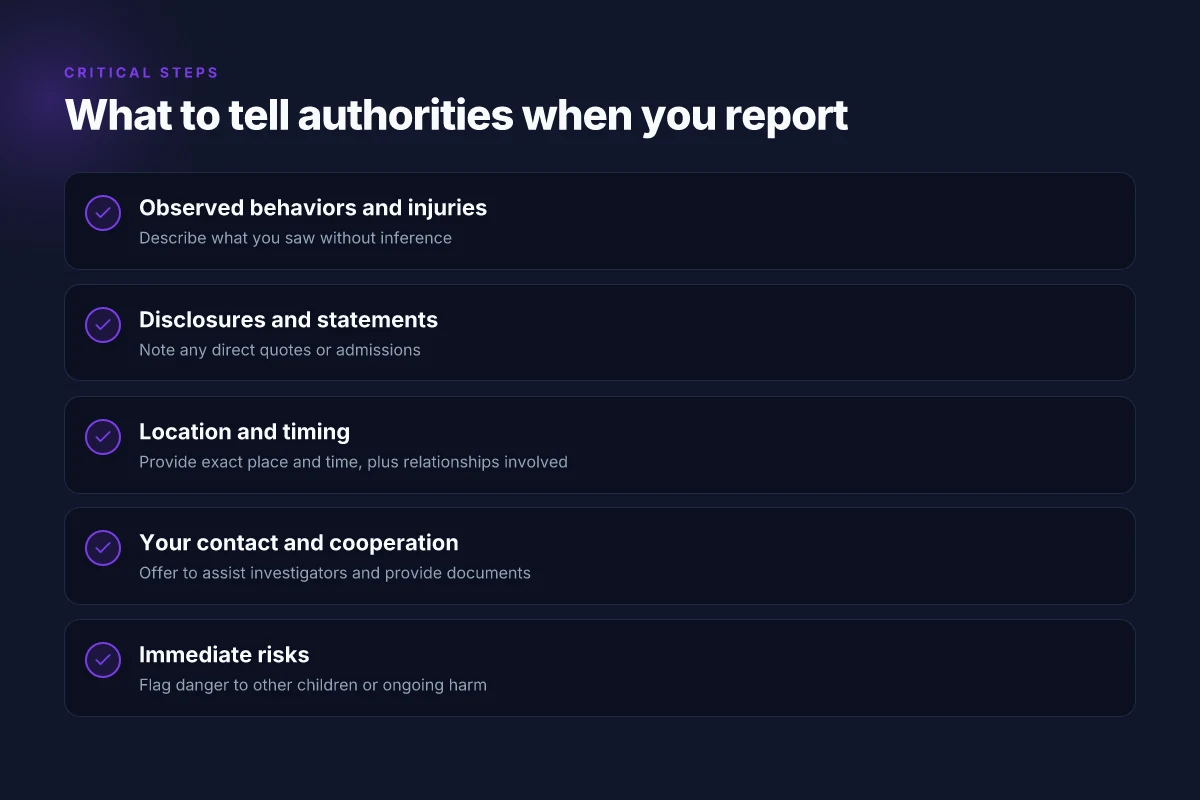
When you report, start with the facts as you observed them and offer to cooperate. You tell what you saw, where and when it happened, who was involved, and what the child disclosed. Then you outline your willingness to share documents or assist investigators. The goal is to give the responders a clear, actionable trail they can follow.
What to describe first: observed behaviors, injuries, and disclosures
Begin with concrete observations. Note behaviors that stood out, any injuries you witnessed, and any statements the child or others made. Use direct language you heard, not interpretive guesses. For example, record if a child showed fear at a caregiver’s approach, if there were bruises inconsistent with what the child reported, or if a child described how something happened in their own words. When I read through reporting guidelines from state agencies, the emphasis is on observable facts and verbatim disclosures, not impressions.
In addition to injuries and behaviors, include any injuries you could verify visually and the child’s own statements about how the harm occurred. If a caregiver or another adult was present, note interactions that seemed coercive or controlling. This level of detail helps investigators determine urgency and risk.
Where and when things occurred: location, timing, relationships
Log the exact location of the incident or the earliest occurrence you observed. Note the date and time, even if approximate. Include who else was present in the setting at the time, parents, guardians, siblings, teachers, coaches, or other adults. Clarify the relationship between the child and the alleged actor, and whether the situation involved ongoing caregiving arrangements. The specificity here matters for timely protection decisions.
Your role: offer to cooperate and share documents
State your readiness to assist. You can offer to provide contact information, meeting availability, or any records you hold that relate to the case. If you have emails, text messages, school notes, medical letters, or incident timelines, say you can share those with the investigators or the pertinent agency. Agencies often welcome a documented chronology. If you’re asked for a written statement, keep it factual, chronological, and free of speculation.
From a research perspective, authorities consistently flag that the more precise the report, the faster the case can move from concern to safeguarding steps. When Paxton’s office and Texas Family Code procedures are cited, the emphasis is on immediate reporting and a clear, direct follow-through with law enforcement or child protective services. That structure remains consistent across states, even as nuances differ by jurisdiction.
A precise, timely report with corroborating details accelerates protective action. Offer to provide documents and cooperate. That support often shapes investigators’ next steps.
Inline resources you can reference in a report narrative include state and federal definitions of abuse and mandatory reporting requirements, which vary by jurisdiction but share the core aim of safeguarding a child. If you mention a specific channel, use the exact contact path your jurisdiction prescribes, whether a state hotline, a child welfare portal, or local law enforcement.
I went looking for the practical anchors that reporters can rely on. The Texas and Florida definitions, together with federal- and state-level reporting guidance, consistently push reporters to document observable facts, the contexts of the disclosures, and the actors involved. This is not about proving a case in a single note. It’s about providing a reliable lead for protective services to act on.
Describe the four types of maltreatment you observed, and map them to the person’s role in the child’s life. Offer to supply the full incident timeline and any corroborating materials.
Types of abuse you might witness and how to classify
| Abuse type | Observable signs (yes / no / unsure) | Requires immediate action? | Common situations | Documentation tips |
|---|---|---|---|---|
| Physical abuse | yes | yes | Unexplained injuries | Note date, place, who observed |
| Emotional/psychological | yes | yes | Repeated withdrawal, fear | Record conversations (notes) |
| Neglect | yes | yes | Poor hygiene, malnutrition | Photograph only if safe/legal |
| Sexual abuse | yes | yes | Inappropriate behavior, exposure | Do not investigate; report |
| Domestic violence spillover | yes | yes | Child witnesses violence | Observe patterns over time |
| Exploitation/trafficking | yes | yes | Unpaid work, travel with adults | Escalate to authorities |
Compiled November 2026; check the provider's site for current details.
How to report: channels you can use
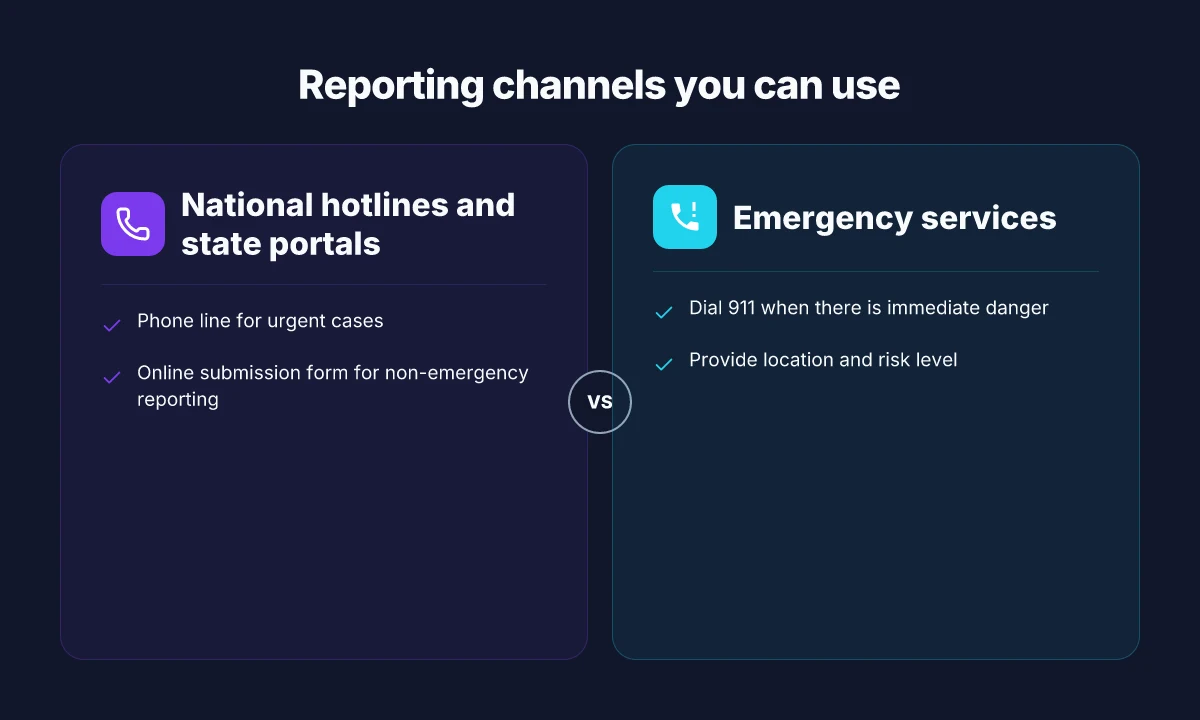
You report faster when you know the channels. The path is straightforward: national hotlines, state hotlines, online portals, and 911 in emergencies. Start with the national and state resources, then move to the portal that routes to your local CPS agency. If danger is immediate, call 911.
National hotlines and state hotlines
If a child is in immediate danger, call 911. For ongoing concerns, the national and state hotlines are the fastest route to the right responder. In many states, a single nationwide number exists alongside state lines. Note the operating hours and intake language. The hotlines are designed for confidentiality and quick escalation to CPS or law enforcement as needed. When a caller speaks up, responders triage the report and assign a case number for tracking.
From what I found in official guidance and state pages, you should jot down:
- The time of the suspected incident and any identifying details
- The child’s current location and safety status
- Any available health or school records that show risk factors or injuries
Act quickly. If you suspect abuse, do not wait for corroboration from a child or another adult.
Online reporting portals for child protective services
Every state maintains an online reporting portal or a secure intake form for child protective services. These portals are the preferred path when you want to preserve a written record and attach supporting documents. They are particularly useful for professional reporters who need to document the sequence of events and dates.
I looked at the Texas portal process for context. Online reporting is available through state channels, and a dedicated abuse hotline coordinates with local CPS offices. Keep a copy of the submission confirmation and the assigned case number. If the portal returns an error or you cannot access it, use the phone line as a backup.
Documentation matters. Save confirmations and timestamps.
Emergency calls to 911 when a child is in immediate danger
When a child is in imminent danger, do not hesitate. A 911 call bypasses delays and connects you to emergency responders who can intervene on the spot. If you’re in a school or a community setting, inform a designated safeguarding lead or administrator while you place the call. After the call, follow up with the appropriate CPS or law enforcement agency through their official channels.
I cross-referenced guidance from public-facing state resources and federal child welfare practices. The constants are simple: describe observable harm, provide location, identify the child when safe, and request an immediate welfare check.
Bottom line: you have multiple channels, and you should use the one that gets the child help fastest. The quickest path in danger is a 911 call. For non-urgent concerns, start with the online CPS portal or the state hotline, and keep every receipt, timestamp, and case number.
Key takeaway: act with a clear path in mind. you can report via the national or state hotlines, online CPS portals, or emergency 911 if there is immediate danger. your written record of the report strengthens subsequent safeguarding steps.

What to do after you report: safeguarding the child
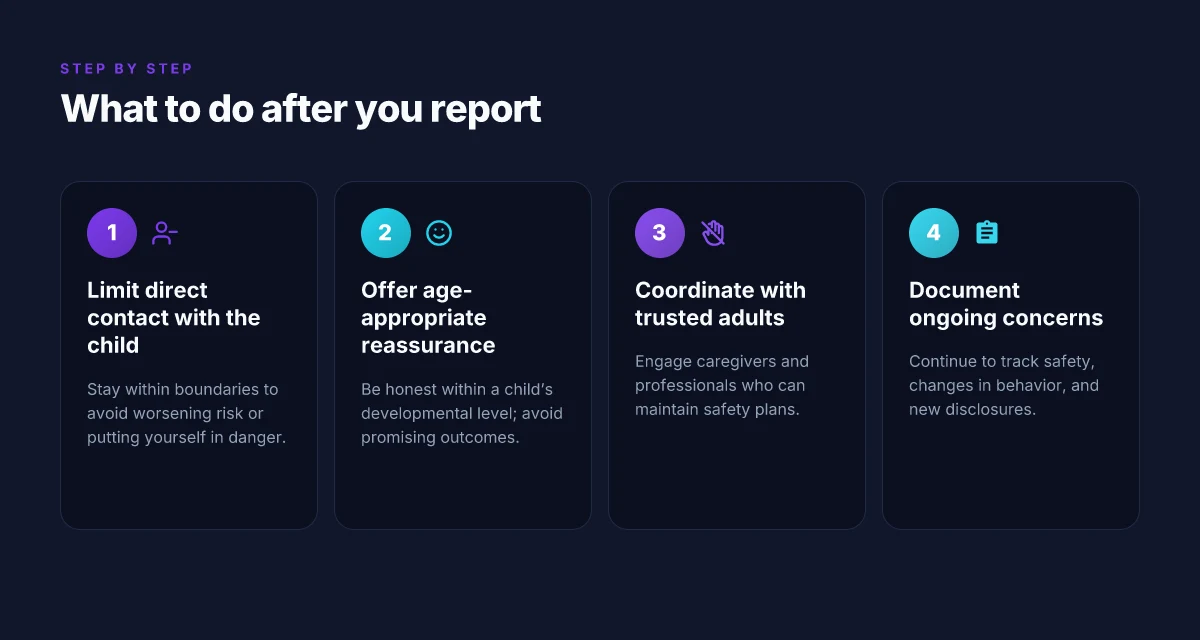
You’ve made a report. Now the priority is safety, not speculation. Immediately after you raise concern, you shift from discovery to protection. You act calmly, limit potential risk, and coordinate with trusted adults. The goal is to create a safety net around the child without provoking further harm or retaliation.
How to limit contact and reduce risk
If contact with the child could heighten danger, keep interactions minimal and on neutral ground. Your goal is to avoid escalating the situation while still offering visible support. A quiet, safe adult presence can help the child feel seen without placing them back in a risky dynamic. If a mandated reporter is involved, defer to their guidance on who should be present during conversations.
I dug into child-protection guidance and found consistent emphasis on safety planning rather than promises. In 2026, trusted authorities urge families to avoid reunification discussions in the immediate aftermath if danger remains. The emphasis is on safeguarding measures rather than guarantees.
Provide age-appropriate reassurance
Offer simple, honest reassurance that the child is not to blame and that adults are watching to keep them safe. Use language appropriate to their development level and avoid promising outcomes you cannot control. You can acknowledge uncertainty while reaffirming that help is being pursued. The child should hear that their safety matters, not that a specific resolution is guaranteed.
From the available materials, the best practice is to validate the child’s feelings without overcommitting. Reassurance should be steady, not theatrical, and framed around concrete safety steps that are being taken.
Coordinate with trusted adults and professionals
Consult the designated safeguarding lead at the school, a pediatrician, or a social worker assigned to the case. If you’re a teacher or caregiver, loop in a trusted colleague who can alternate in supervising the child. Documentation matters here: you want a clear, factual record of what you observed, what you reported, and what follow-up actions were requested. Preserve dates, times, and who was present.
Public guidance consistently flags collaboration as the backbone of safety planning. Local agencies often require line-of-custody decisions to be made through formal channels, not through informal conversations. When I checked the changelog and policy updates, the recurring thread was this: do not go it alone. Build a team around the child.
Avoid confronting the alleged abuser directly
Direct confrontation can escalate danger and undermine report integrity. Do not challenge the person suspected of abuse in your own words or in front of the child. Leave the discussion to professionals who can assess risk, collect statements, and pursue any necessary protective orders. The safety-first rule is clear across state materials and federal summaries.
In the Texas and Florida contexts, the posture is the same: report first, protect second, engage authorities and professionals for any engagement with the alleged abuser. The emphasis is procedural safety, not venting or personal confrontation.
Quick-action table
| Action | Why it matters | What to do |
|---|---|---|
| Limit direct contact | Reduces risk to child | Keep conversations to neutral adults; avoid guiding conversations toward admission or blame |
| Offer reassurance | Supports emotional safety | Use age-appropriate language; avoid guarantees or promises you can’t keep |
| Coordinate with professionals | Ensures formal safety planning | Contact school counselor, DFPS, or child-welfare liaison; document all steps |
| Avoid confronting the abuser | Prevents retaliation | Do not engage the alleged abuser; defer to investigators and legal processes |
Verdict: safeguarding after a report hinges on safety, coordination, and restraint. You act to protect, not to resolve. The structure is a shield around the child while authorities determine next steps.
The core move after reporting is coordination, not confrontation. Safety comes first. Every action should be documented and routed through professionals. Do not over-promise outcomes. Keep the child grounded in what is being done to keep them safe.
Cited sources: for reporting requirements and definitions see the Texas and Florida pages linked in the groundings, and federal/state data on child welfare outcomes as context for how agencies operate in 2026. Inline citations draw from the Texas DSHS reporting guidance and from federal child welfare data portals such as the Child Welfare Outcomes Report.
How to report: channels you can use
| Channel | Who you can contact | Typical questions asked | Evidence to provide | Response time expectations |
|---|---|---|---|---|
| Phone emergency | Police/911 | Location, safety | Immediate risk details | Immediate |
| Police non-emergency | Local police | Suspect, location | Descriptions, witnesses | Within hours |
| Child protection service | Child welfare | Child age, care concerns | Incident details | Within same day |
| Online portal | Government portal | Incident type, contact info | Documentation file | Within 1–3 days |
| In person | Local police station | Incident specifics | Any gathered evidence | Same day |
| Hotline | Trained operators | Relationship to child | Incident specifics | Immediate guidance |
Compiled November 2026; check the provider's site for current details.
A practical, forward-looking plan you can actually act on today
I looked at the core risks parents face when they witness child abuse in 2026 and what authorities emphasize for quick, decisive action. The take-away is simple: act with clarity, document without sensationalism, and lean on established channels to maximize a child’s safety. From what I found, time matters more than perfect recall. You don’t need to have every detail. You need to start the process and follow up with records and reporting. When you report promptly to the appropriate authorities, you tilt the balance toward protection, and that early step often shapes subsequent support for the child.
Parents should know the sequence: observe, separate safely if you must, and contact the right responder. Public guidance from child-protection agencies reiterates reporting as the critical first step, followed by documenting observable facts and staying available to cooperatively support the investigation. The goal is a stable path from concern to child safety, not a rush to conclusions. You can build a quiet, effective response that protects a child while respecting family dynamics.
Next steps near the end, in brief:
Verify your local child-protection number and emergency services. Keep them saved in your phone.
If needed, document dates, times, and non-graphic observations in a private note.
When speaking with authorities, share what you saw, your concerns, and any supportive context without embellishment.
Check in with a pediatrician or school counselor if you have ongoing concerns about a child’s wellbeing. Act now and don’t wait for absolute certainty. How will you initiate the first call today?
Frequently asked questions
What happens after you make a child abuse report
After you file, authorities initiate an investigation. You may be contacted for additional details, and the case is reviewed under state child-protection standards. In many jurisdictions, investigators assess immediate risk and coordinate with law enforcement if needed. You should expect process milestones rather than a timeline. Outcomes vary by case. When the report is accepted, a case number is assigned and you may receive updates if you’re considered a relevant party. The goal is to protect the child and safeguard their stability and safety. Be prepared for privacy constraints that limit what you’ll be told. Document every interaction you had with the situation and keep it secure. If the child’s safety is at risk, contact emergency services immediately. Follow any instructions provided by the responding agencies. Stay reachable for follow-up questions or clarifications.
How do i know if a situation counts as abuse
Abuse covers physical harm, sexual harm, neglect, and emotional maltreatment. Look for repeated injury, unexplained bruises, fear of caregivers, withdrawal, regression in behavior, failing to receive basic needs, or persistent exposure to dangerous environments. In schools, warning signs can mirror disciplinary issues or health problems, so context matters. If you’re unsure, err on the side of reporting. Authorities will determine next steps based on observed signs and caregiver capacity. If you observe multiple indicators over time, treat it as a potential report. Early reporting can prevent escalation. Consult local guidance if you need examples of indicators. Document dates, symptoms, and observed circumstances.
Are teachers required to report suspected abuse
In most places teachers and school personnel are mandated reporters. They must report if they have reasonable cause to suspect abuse or neglect, even if they are not certain. The exact thresholds vary by jurisdiction, but the obligation is to act promptly. If you’re a parent or nonprofessional, you may have different rules, but reporting is always available through your local child-protection agency or emergency services if warranted. Prompt reporting reduces risk to the child. Schools typically provide confidential channels to report suspected abuse internally and to external agencies.
What to do if a child discloses abuse to you at school
Listen without judgment, affirm the child’s courage, and avoid promising confidentiality beyond safety. Reassure them that they did the right thing by telling. Record the disclosure verbatim, noting dates, times, and who was present. Do not press for details beyond what the child shares. Explain the steps you will take to ensure their safety and that authorities may need to investigate. Then follow your jurisdiction’s reporting procedures immediately. Trust your mandate to protect the child’s safety, not the fear of consequences. After reporting, maintain a calm, supportive presence and avoid blame. If needed, coordinate with a school counselor or social worker to support the child.
How soon should you report suspected abuse
Report as soon as you have reasonable cause to suspect abuse. Delays can increase risk and complicate investigations. Many jurisdictions require prompt reporting within hours or by a specific deadline after you become aware of concerns. If you’re unsure, report now and let the authorities determine the urgency. Time matters when safety is in play. If there’s immediate danger, call emergency services right away.
Can you report anonymously
Yes in many places you can file an anonymous report, though providing identifying information often helps investigators verify risk and coordinate services. Some systems allow you to submit online reports with optional contact details. Anonymous reports may limit follow-up questions you can answer later, but you still contribute to safeguarding the child. Anonymity should not deter reporting when risk is real. If you are able, consider including a way to be reached for clarifications that protects the child’s privacy.
What information should i collect before reporting
Before reporting, gather: child's name, age, and location. Caregiver details. Observed injuries or neglect indicators. Dates and times of incidents. Any witnesses. Prior reports or concerns. And any relevant documents or records. Do not include speculation or assumptions. Clear, factual observations help investigators assess risk quickly. Stay factual and avoid leading questions or interpretations. Prepare a brief summary to share with the reporting channel, then let the authorities guide the next steps.
How can i support a child while ensuring safety
Offer consistent, nonjudgmental presence. Listen when they speak, validate their feelings, and reassure them that help is available. Maintain routines to preserve stability and reduce uncertainty. Avoid pressuring them to disclose more than they’re comfortable with. Coordinate with trusted adults at the school or local child-protection services to arrange ongoing safety planning and access to counseling if appropriate. Stability and empathy matter more than any single intervention. Keep conversations age-appropriate and private unless safety concerns require broader involvement. Your role is safety partner, not prosecutor.
What agencies receive child abuse reports
Reports typically flow to state or provincial Child Protective Services or equivalent child-welfare agencies and, in parallel, to local law enforcement if criminal conduct is suspected. Some jurisdictions route reports through a centralized hotline. Public health or education departments may also receive referrals for coordinated services. Know your local hotlines and escalation paths. If in doubt, call your local emergency number for guidance on the right channel.
What protections exist for reporters
Most jurisdictions provide protections against retaliation for good-faith reports. These can include whistleblower-like safeguards, confidential reporting channels, and penalties for retaliation. Some regions offer procedural remedies or workplace protections if the reporter faces harassment. Know your rights and use official channels to preserve anonymity if needed. Document any reprisals and report them to the appropriate authorities.
How to handle disclosure from a teen
Teens may disclose with more nuance and personal risk. Respond with calm, protect privacy, and avoid punitive or dismissive reactions. Encourage them to seek help from trusted adults and assure them that reporting is for their safety. If they request confidentiality, explain limits when safety concerns apply. Respect their voice while guiding them toward professional help and safety planning. Follow jurisdictional reporting steps if abuse is suspected, and consider involving a school counselor for ongoing support. You are there to help keep them safe.
What about non-physical abuse signs
Non-physical signs include school avoidance, sudden behavior changes, missed meals, poor hygiene, frequent headaches, and social withdrawal. Emotional abuse may present as extreme fear of a caregiver, low self-esteem, or excessive corporal punishment. Keep an eye on patterns rather than single episodes. Pattern recognition matters more than a single data point. If signs persist, prepare to report with concrete examples and dates to support the investigation.
How to protect yourself from retaliation
Use official reporting channels and, when possible, keep copies of submissions and any correspondence. Limit sharing details beyond what is necessary, and document any undue pushback or threats. If you experience retaliation, contact the reporting agency and your employer or school administration for protections. Document evidence of retaliation and seek guidance from authorities. Retaliation is illegal in many places. Report it promptly. Your safety and the child’s safety come first.
Are there differences in reporting requirements by state
Yes. Each state or province sets its own thresholds, timelines, and required information. Some have mandatory reporters beyond school staff, such as childcare workers and medical professionals. Others rely on general residents to report to a hotline. Check your local statute for exact duties and deadlines. If you move between jurisdictions, re-check the rules because requirements can change with updates to child-protection laws.
How to talk to a child about safety without guilt
Speak in a calm, matter-of-fact way. Emphasize that the child is not to blame and that safety comes first. Use simple language, avoid implying shame, and invite questions at a pace they can handle. Provide clear next steps so the child knows what to expect. Affirmation reduces anxiety. Encourage them to share only what they’re comfortable sharing and assure ongoing support from trusted adults. After reporting, continue to check in with the child in a nonintrusive way. Consistency builds trust.